 VIPSolutions
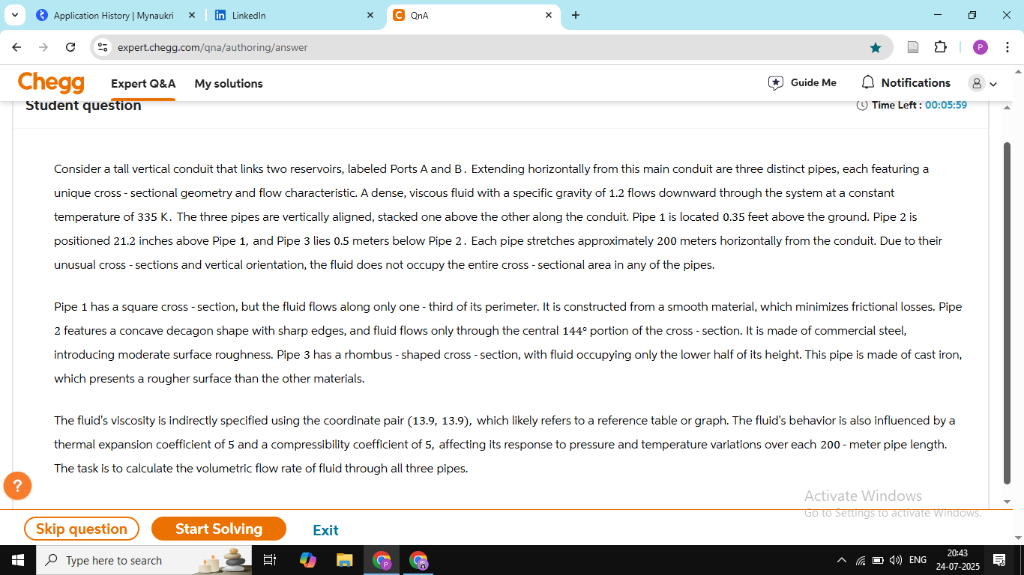
+ © doplon Hoon Myrwisi x [0 nein x Bam x + - 8 x « © %5 expertchegg.com/qna/authoring/answer * D0 Q: Chegg ewertosa mysoltions ® cudemte Notifications Student question © Time Let: 000559 x ‘Consider a tall vertical conduit that links two reservoirs, labeled Ports A and B. Extending horizontally from this main condut are three distinct pipes, each featuring a unique cross-sectional geometry and flow characteristic. A dense, viscous fluid with a specific aravity of 1.2 flows downward through the system at a constant temperature of 335 K. The three pipes are vertically aigned, stacked one above the other slong the conduit, Pipe 1s located 0.35 feet above the ground. Pipe 2s positioned 212 inches above Pipe 1, and Pipe 3 ies 0.5 meters below Pipe 2. Each pipe stretches approximately 200 meters horizontally from the conduit. Due to their unusual cross-sections and vertical orientation, the fluid does not occupy the entire cross - sectional area n any of the pipes Pipe 1 has a square cross - section, but the fluid flows along only one - third of its perimeter. It is constructed from a smooth material, which minimizes frictional losses. Pipe. 2 features a concave decagon shape with sharp edges, and fluid flows only through the cena 144° portion of the cross-section. It s made of commercial steel, introducing moderate surface roughness. Pipe 3 has a rhombus - shaped cross - section, with fluid occupying only the lower half of its height. This pipe is made of cast iron, which presents a rougher surface than the other materials. The fluids viscosity is indirectly specified using the coordinate pair (139, 13.9), which likely refers to a reference table or graph. The flid's behavior s also Influenced by a thermal expansion coefficient of 5 and a compressibility coefficient of 5, affecting its response to pressure and temperature variations over each 200 - meter pipe length. The task is to calculate the volumetric flow rate of fluid through al three pipes, Start Solving Exit b = ER.
Question:
 + © doplon Hoon Myrwisi x [0 nein x Bam x + - 8 x
« © %5 expertchegg.com/qna/authoring/answer * D0 Q:
Chegg ewertosa mysoltions ® cudemte Notifications
Student question © Time Let: 000559 x
‘Consider a tall vertical conduit that links two reservoirs, labeled Ports A and B. Extending horizontally from this main condut are three distinct pipes, each featuring a
unique cross-sectional geometry and flow characteristic. A dense, viscous fluid with a specific aravity of 1.2 flows downward through the system at a constant
temperature of 335 K. The three pipes are vertically aigned, stacked one above the other slong the conduit, Pipe 1s located 0.35 feet above the ground. Pipe 2s
positioned 212 inches above Pipe 1, and Pipe 3 ies 0.5 meters below Pipe 2. Each pipe stretches approximately 200 meters horizontally from the conduit. Due to their
unusual cross-sections and vertical orientation, the fluid does not occupy the entire cross - sectional area n any of the pipes
Pipe 1 has a square cross - section, but the fluid flows along only one - third of its perimeter. It is constructed from a smooth material, which minimizes frictional losses. Pipe.
2 features a concave decagon shape with sharp edges, and fluid flows only through the cena 144° portion of the cross-section. It s made of commercial steel,
introducing moderate surface roughness. Pipe 3 has a rhombus - shaped cross - section, with fluid occupying only the lower half of its height. This pipe is made of cast iron,
which presents a rougher surface than the other materials.
The fluids viscosity is indirectly specified using the coordinate pair (139, 13.9), which likely refers to a reference table or graph. The flid's behavior s also Influenced by a
thermal expansion coefficient of 5 and a compressibility coefficient of 5, affecting its response to pressure and temperature variations over each 200 - meter pipe length.
The task is to calculate the volumetric flow rate of fluid through al three pipes,
Start Solving Exit b
= ER.
Asked by: Kumar
Created at: 2025-07-24 20:45:15
Final Answer:
📢 Instructions:
- Ask anything relatd to above question only.
- For new Question goto :