 VIPSolutions
_—— CT I 1 J Bn - 1
Question:
 _—— CT
I 1
J
Bn - 1
This is AI generated Response.
Asked by: Veera manikanta
Created at: 2025-08-31 00:10:45
Asked by: Veera manikanta
Created at: 2025-08-31 00:10:45
Final Answer:
Rendered
Raw Text
Did you like this answer?
Let's break down the problem given in the image:
**Question:**
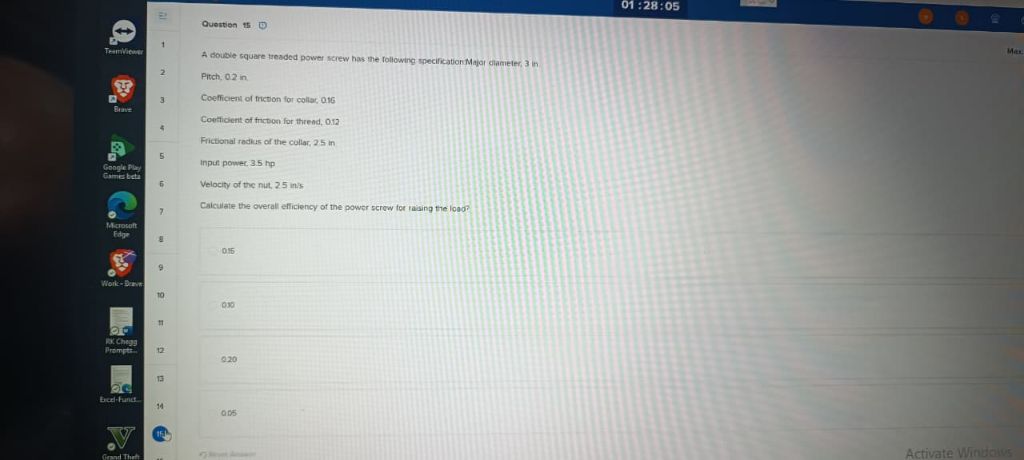
A double square threaded power screw has the following specifications:
- Major diameter: 3 in
- Pitch: 0.2 in
- Coefficient of friction for collar: 0.16
- Coefficient of friction for thread: 0.12
- Frictional radius of the collar: 2.5 in
- Input power: 3.5 hp
- Velocity of the nut: 2.5 in/s
**Asked:**
Calculate the overall efficiency of the power screw for raising the load.
---
## Step-by-Step Solution
### 1. **Calculate the Lead of the Screw**
Double-threaded means the lead \( l \) = 2 × pitch = 2 × 0.2 in = **0.4 in**
---
### 2. **Calculate the Axial Velocity**
The nut moves at 2.5 in/s.
---
### 3. **Calculate the Axial Force (\( F \))**
Power (\( P \)) = Force × Velocity
But first, convert power to consistent units:
- 1 hp = 550 ft-lb/s = 550 × 12 in-lb/s = 6600 in-lb/s
- Input power = 3.5 × 6600 = **23100 in-lb/s**
---
### 4. **Calculate Output Power (\( P_{out} \))**
\( P_{out} = F \times v \)
---
### 5. **Calculate the Torque Required to Raise Load (\( T \))**
The total torque required to overcome both thread and collar friction:
\[
T = T_{thread} + T_{collar}
\]
Where:
- For thread:
\[
T_{thread} = F \times \left[ \frac{d_m}{2} \left( \frac{l + \pi \mu_t d_m}{\pi d_m - \mu_t l} \right) \right]
\]
- For collar:
\[
T_{collar} = F \times \mu_c \times r_c
\]
Where:
- \( d_m \) = mean diameter = major diameter - (0.5 × pitch) = 3 - (0.5 × 0.2) = **2.9 in**
- \( \mu_t \) = thread friction = 0.12
- \( \mu_c \) = collar friction = 0.16
- \( r_c \) = collar radius = 2.5 in
- \( l \) = lead = 0.4 in
Let's compute:
#### a) Compute \( T_{thread} \):
\[
T_{thread} = F \times \frac{d_m}{2} \left( \frac{l + \pi \mu_t d_m}{\pi d_m - \mu_t l} \right)
\]
Numerator: \( l + \pi \mu_t d_m = 0.4 + \pi \times 0.12 \times 2.9 \approx 0.4 + 1.094 = 1.494 \)
Denominator: \( \pi d_m - \mu_t l = \pi \times 2.9 - 0.12 \times 0.4 \approx 9.11 - 0.048 = 9.062 \)
So,
\[
T_{thread} = F \times \frac{2.9}{2} \times \frac{1.494}{9.062} = F \times 1.45 \times 0.165 = F \times 0.239
\]
#### b) Compute \( T_{collar} \):
\[
T_{collar} = F \times 0.16 \times 2.5 = F \times 0.4
\]
#### c) Total Torque:
\[
T = F \times (0.239 + 0.4) = F \times 0.639
\]
---
### 6. **Input Power (\( P_{in} \))**
The torque multiplied by the angular velocity (\( \omega \)) gives the input power:
\[
P_{in} = T \times \omega
\]
The angular velocity (\( \omega \)):
\[
\omega = \frac{v}{lead} \times 2\pi
\]
\[
\omega = \frac{2.5}{0.4} \times 2\pi = 6.25 \times 2\pi = 39.27 \text{ rad/s}
\]
But in power screws, usually use rev/s:
\[
\text{rev/s} = \frac{2.5}{0.4} = 6.25 \text{ rev/s}
\]
\[
\omega = 6.25 \times 2\pi = 39.27 \text{ rad/s}
\]
So,
\[
P_{in} = T \times \omega = (F \times 0.639) \times 39.27
\]
---
### 7. **Set \( P_{in} \) Equal to Given Input Power**
\[
P_{in} = 23100 \text{ in-lb/s}
\]
\[
23100 = F \times 0.639 \times 39.27
\]
\[
F = \frac{23100}{0.639 \times 39.27} = \frac{23100}{25.09} \approx 920 \text{ lb}
\]
---
### 8. **Calculate Output Power (\( P_{out} \))**
\[
P_{out} = F \times v = 920 \times 2.5 = 2300 \text{ in-lb/s}
\]
---
### 9. **Calculate Efficiency (\( \eta \))**
\[
\eta = \frac{P_{out}}{P_{in}} = \frac{2300}{23100} \approx 0.0995 \approx 0.10
\]
---
## **Final Answer:**
**The overall efficiency of the power screw for raising the load is approximately 0.10 (10%).**
So, the closest option in the list is **0.10**.
---
### **Summary Table**
| Step | Value/Formula | Result |
|----------------------|--------------------------|------------------|
| Lead | 2 × 0.2 in | 0.4 in |
| Mean diameter (\(d_m\)) | 3 - 0.1 | 2.9 in |
| \(T_{thread}\) | \(F \times 0.239\) | |
| \(T_{collar}\) | \(F \times 0.4\) | |
| Total Torque | \(F \times 0.639\) | |
| Angular velocity | 39.27 rad/s | |
| Input Power | 23100 in-lb/s | |
| Force (\(F\)) | \( \approx 920 \) lb | |
| Output Power | 2300 in-lb/s | |
| Efficiency | \( \approx 0.10 \) | |
If you need further clarification or a simplified version, let me know!
📢 Instructions:
- Ask anything relatd to above question only.
- For new Question goto :