 VIPSolutions
"Consider the traffic light controller FSM from the book and lecture notes (shown below for your convenience). Suppose each 3-input gate has a delay of 20-50ps (i.c., ted = 20ps and tpd = 50ps). Each 2-input gate has a delay of 10-40 ps. The flip-flops have the following timing characteristics: tpeq = 23 ps, tccq = 15ps, tsetup = 30ps, thold = 17ps. What is the fastest frequency at which this circuit could run reliably? Show all of your work. CLK D EEE] FLY Ta TT iD Shy = T Te — Reset Sif |S
Question:
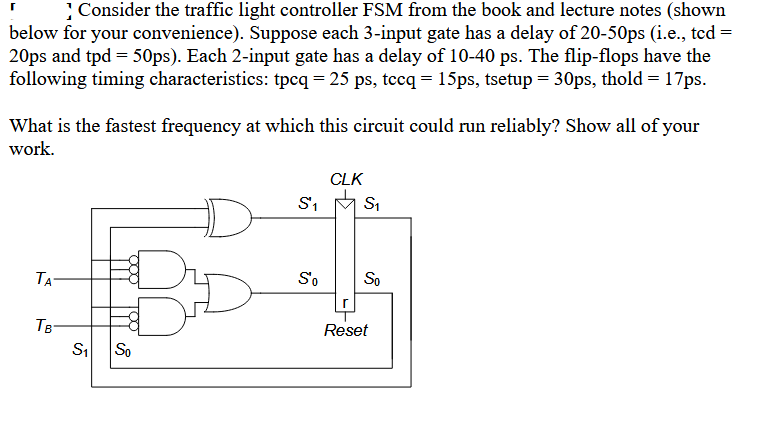 "Consider the traffic light controller FSM from the book and lecture notes (shown
below for your convenience). Suppose each 3-input gate has a delay of 20-50ps (i.c., ted =
20ps and tpd = 50ps). Each 2-input gate has a delay of 10-40 ps. The flip-flops have the
following timing characteristics: tpeq = 23 ps, tccq = 15ps, tsetup = 30ps, thold = 17ps.
What is the fastest frequency at which this circuit could run reliably? Show all of your
work.
CLK
D EEE]
FLY
Ta TT iD Shy
= T
Te — Reset
Sif |S
This is AI generated Response.
Asked by: ABCD
Created at: 2025-09-15 10:53:29
Asked by: ABCD
Created at: 2025-09-15 10:53:29
Final Answer:
Rendered
Raw Text
Did you like this answer?
# Fastest Reliable Frequency Calculation
Let's break down the problem step by step.
## **Given Data**
- **3-input gate delay:** 20-50 ps (assume worst case, **50 ps**)
- **2-input gate delay:** 10-40 ps (assume worst case, **40 ps**)
- **Flip-flop parameters:**
- \( t_{pcq} = 25 \) ps
- \( t_{ccq} = 15 \) ps
- \( t_{setup} = 30 \) ps
- \( t_{hold} = 17 \) ps
## **Step 1: Determine the Critical Path**
The critical path is from the output of one flip-flop, through the combinational logic, to the D input of the next flip-flop.
### **Combinational Logic Delay**
From the diagram, the longest path (worst-case) is likely:
- From \( S_1 \) or \( S_0 \) output of the flip-flop,
- Through a 3-input AND/OR gate (50 ps),
- Then through a 2-input gate (40 ps),
- To the D input of the flip-flop.
**Total logic delay = 3-input gate + 2-input gate = 50 ps + 40 ps = 90 ps**
## **Step 2: Setup Time Constraint**
The flip-flop's data must be stable at the D input at least \( t_{setup} \) before the clock edge.
**Timing constraint:**
\[
T_{clock} \geq t_{pcq} + t_{logic} + t_{setup}
\]
Where:
- \( t_{pcq} \): Clock to Q delay (25 ps)
- \( t_{logic} \): Logic delay (90 ps)
- \( t_{setup} \): Setup time (30 ps)
**Plug in the values:**
\[
T_{clock} \geq 25\,\text{ps} + 90\,\text{ps} + 30\,\text{ps} = 145\,\text{ps}
\]
## **Step 3: Compute Maximum Frequency**
\[
f_{max} = \frac{1}{T_{clock}}
\]
\[
f_{max} = \frac{1}{145 \times 10^{-12}}
\]
\[
f_{max} \approx 6.90\,\text{GHz}
\]
## **Step 4: Hold Time Check**
The data must be held at the input for at least \( t_{hold} \) after the clock edge. The path is:
- \( t_{ccq} \): Clock to Q contamination delay (15 ps)
- \( t_{logic, min} \): Minimum logic delay (\( t_{cd} \) for each gate, so 20 ps + 10 ps = 30 ps)
\[
t_{ccq} + t_{logic, min} = 15\,\text{ps} + 30\,\text{ps} = 45\,\text{ps}
\]
Since \( 45\,\text{ps} > t_{hold} = 17\,\text{ps} \), the hold time is satisfied.
---
## **Summary Table**
| Parameter | Value |
|----------------|----------|
| \( t_{pcq} \) | 25 ps |
| \( t_{logic} \)| 90 ps |
| \( t_{setup} \)| 30 ps |
| \( T_{clock} \)| 145 ps |
| \( f_{max} \) | 6.90 GHz |
---
## **Final Answer**
### **The fastest frequency at which this circuit could run reliably is:**
\[
\boxed{6.90\,\text{GHz}}
\]
---
**All timing constraints are met at this frequency.**
📢 Instructions:
- Ask anything relatd to above question only.
- For new Question goto :