 VIPSolutions
Consider the simple linear regression model: Yi=f+hXit+e (a) (3) Assume that X = 0 is within the scope of the model. What is the implication for the regression function if 8p = 07 (b) (4) Under the assumption of Sy = 0, derive the least squares estimate of By. (¢) (6) Find its mean and variance. Ts it unbiased? (d) (2) How do you fit such a model using the Im function? (e) (3) What is the implication for the regression function if 81 = 0? How would the regression function plot on a graph? (f) (4) Under the assumption of 3; = 0, derive the least squares estimate of J3;. (g) (6) Find the Expectation and Variance of the estimate in (f). Is it unbiased ?
Question:
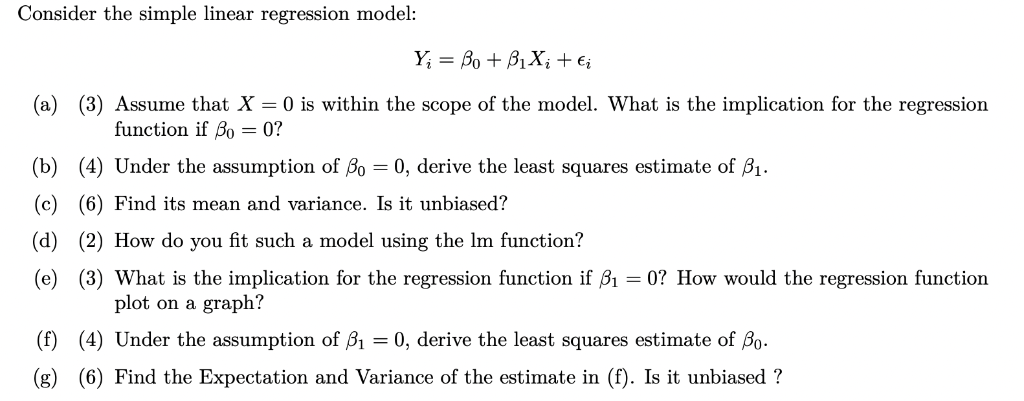 Consider the simple linear regression model:
Yi=f+hXit+e
(a) (3) Assume that X = 0 is within the scope of the model. What is the implication for the regression
function if 8p = 07
(b) (4) Under the assumption of Sy = 0, derive the least squares estimate of By.
(¢) (6) Find its mean and variance. Ts it unbiased?
(d) (2) How do you fit such a model using the Im function?
(e) (3) What is the implication for the regression function if 81 = 0? How would the regression function
plot on a graph?
(f) (4) Under the assumption of 3; = 0, derive the least squares estimate of J3;.
(g) (6) Find the Expectation and Variance of the estimate in (f). Is it unbiased ?
This is AI generated Response.
Asked by: Umesh
Created at: 2025-07-26 22:04:39
Asked by: Umesh
Created at: 2025-07-26 22:04:39
Final Answer:
Rendered
Raw Text
Did you like this answer?
Let's tackle each part of the question step by step:
---
**(a)**
*Assume that \( X = 0 \) is within the scope of the model. What is the implication for the regression function if \( \beta_0 = 0 \)?*
**Answer:**
If \( \beta_0 = 0 \), the regression equation becomes:
\[
Y_i = \beta_1 X_i + \epsilon_i
\]
When \( X = 0 \), \( Y_i = \epsilon_i \). Thus, the regression line passes through the origin (0,0) on the graph (assuming \( \epsilon_i \) has mean zero). This means there is no intercept term; all predictions are forced through the origin.
---
**(b)**
*Under the assumption of \( \beta_0 = 0 \), derive the least squares estimate of \( \beta_1 \).*
**Answer:**
When \( \beta_0 = 0 \), the model is \( Y_i = \beta_1 X_i + \epsilon_i \).
The least squares estimate minimizes:
\[
\sum_{i=1}^n (Y_i - \beta_1 X_i)^2
\]
Set the derivative with respect to \( \beta_1 \) to zero:
\[
-2 \sum_{i=1}^n X_i (Y_i - \beta_1 X_i) = 0
\implies \sum_{i=1}^n X_i Y_i = \beta_1 \sum_{i=1}^n X_i^2
\implies \hat{\beta}_1 = \frac{\sum_{i=1}^n X_i Y_i}{\sum_{i=1}^n X_i^2}
\]
---
**(c)**
*Find its mean and variance. Is it unbiased?*
**Answer:**
Recall \( Y_i = \beta_1 X_i + \epsilon_i \) and \( \epsilon_i \) has mean 0, variance \( \sigma^2 \).
\[
\hat{\beta}_1 = \frac{\sum_{i=1}^n X_i Y_i}{\sum_{i=1}^n X_i^2} = \frac{\sum_{i=1}^n X_i (\beta_1 X_i + \epsilon_i)}{\sum_{i=1}^n X_i^2}
= \beta_1 + \frac{\sum_{i=1}^n X_i \epsilon_i}{\sum_{i=1}^n X_i^2}
\]
- Expectation:
\[
E[\hat{\beta}_1] = \beta_1 + \frac{E[\sum X_i \epsilon_i]}{\sum X_i^2} = \beta_1
\]
so it **is unbiased**.
- Variance:
\[
Var(\hat{\beta}_1) = Var\left( \frac{\sum X_i \epsilon_i}{\sum X_i^2} \right) = \frac{\sum X_i^2 Var(\epsilon_i)}{(\sum X_i^2)^2} = \frac{\sigma^2}{\sum X_i^2}
\]
---
**(d)**
*How do you fit such a model using the lm function?*
**Answer:**
In R, you can fit a regression through the origin (no intercept) via:
```R
lm(Y ~ X - 1)
```
or equivalently:
```R
lm(Y ~ 0 + X)
```
---
**(e)**
*What is the implication for the regression function if \( \beta_1 = 0 \)? How would the regression function plot on a graph?*
**Answer:**
If \( \beta_1 = 0 \), the model is \( Y_i = \beta_0 + \epsilon_i \).
The regression function is a **horizontal line** at \( Y = \beta_0 \). This means \( Y \) does not depend on \( X \) at all.
---
**(f)**
*Under the assumption of \( \beta_1 = 0 \), derive the least squares estimate of \( \beta_0 \).*
**Answer:**
With \( Y_i = \beta_0 + \epsilon_i \) (no \( X \) term), minimize:
\[
\sum (Y_i - \beta_0)^2
\]
Set derivative to zero:
\[
-2\sum (Y_i - \beta_0) = 0 \implies \sum Y_i = n \beta_0 \implies \hat{\beta}_0 = \frac{1}{n} \sum Y_i = \bar{Y}
\]
---
**(g)**
*Find the Expectation and Variance of the estimate in (f). Is it unbiased?*
**Answer:**
\[
\hat{\beta}_0 = \bar{Y}
\]
- Expectation:
\[
E[\hat{\beta}_0] = E[\bar{Y}] = \beta_0 + E[\bar{\epsilon}] = \beta_0 \text{ (since } E[\bar{\epsilon}] = 0)
\]
So it is **unbiased**.
- Variance:
\[
Var(\hat{\beta}_0) = Var(\bar{Y}) = Var\left( \frac{1}{n} \sum \epsilon_i \right) = \frac{\sigma^2}{n}
\]
---
Let me know if you need any step-by-step calculation!
📢 Instructions:
- Ask anything relatd to above question only.
- For new Question goto :