 VIPSolutions
Consider steel (AISI 1010) plates of thickness § = 6 mm and length L = 1m on aside attached to a conveyor that is not moving in quiescent atmosphericair at T,, = 20°C. The initial plate temperature is T; = 300°C. Radiation effects and interactions between boundary layers on adjoining surfaces may be neglected. Conveyor GEG CRO EEO RO ZOO RROROO T; L 72 4 lls ArT. (a) For the prescribed plate dimensions and initial temperature, as well as the prescribed air temperature, what is the initial rate of heat transfer from one of the plates, in W? (b) How long, in's, does it take for a plate to cool from 300°C to 150°C?
Question:
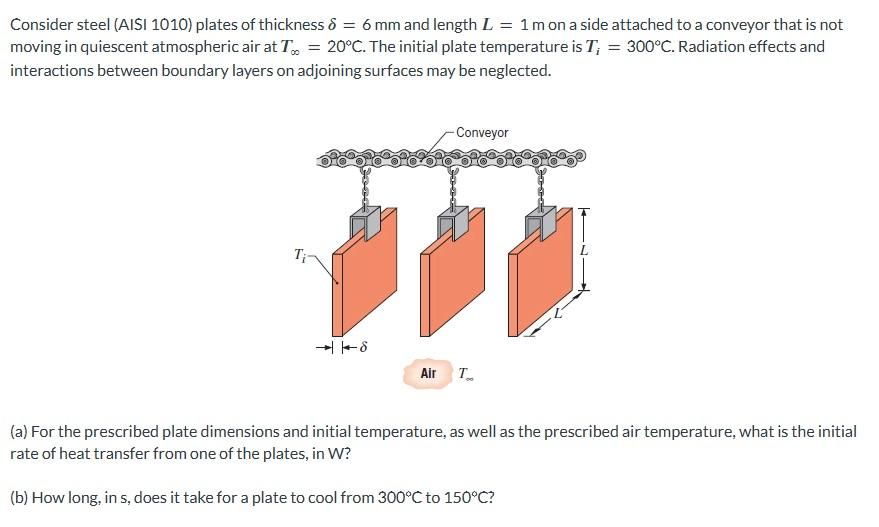 Consider steel (AISI 1010) plates of thickness § = 6 mm and length L = 1m on aside attached to a conveyor that is not
moving in quiescent atmosphericair at T,, = 20°C. The initial plate temperature is T; = 300°C. Radiation effects and
interactions between boundary layers on adjoining surfaces may be neglected.
Conveyor
GEG CRO EEO RO ZOO RROROO
T; L
72 4
lls
ArT.
(a) For the prescribed plate dimensions and initial temperature, as well as the prescribed air temperature, what is the initial
rate of heat transfer from one of the plates, in W?
(b) How long, in's, does it take for a plate to cool from 300°C to 150°C?
This is AI generated Response.
Asked by: pooja gargunde
Created at: 2025-08-15 15:46:09
Asked by: pooja gargunde
Created at: 2025-08-15 15:46:09
Final Answer:
Rendered
Raw Text
Did you like this answer?
Let's break down the problem and solve each part step by step.
---
## **Given Data**
- **Plate material:** Steel (AISI 1010)
- **Plate thickness,** \( \delta = 6 \text{ mm} = 0.006 \text{ m} \)
- **Plate side length,** \( L = 1 \text{ m} \)
- **Initial plate temperature,** \( T_i = 300^\circ C \)
- **Air temperature,** \( T_\infty = 20^\circ C \)
- **Quiescent atmospheric air (still air)**
- **Neglect radiation effects**
### **Properties of AISI 1010 Steel**
(Approximate at high temperatures)
- **Density,** \( \rho = 7832 \text{ kg/m}^3 \)
- **Specific heat,** \( c_p = 477 \text{ J/kg}\cdot\text{K} \)
- **Thermal conductivity,** \( k = 63.9 \text{ W/m}\cdot\text{K} \)
### **Properties of air (at ~160°C)**
- **Kinematic viscosity,** \( \nu \approx 3.83 \times 10^{-5} \text{ m}^2/\text{s} \)
- **Prandtl number,** \( Pr \approx 0.69 \)
- **Thermal conductivity,** \( k_{air} \approx 0.036 \text{ W/m}\cdot\text{K} \)
---
## **Part (a): Initial Rate of Heat Transfer**
### **Step 1: Find the initial heat transfer coefficient, \( h \):**
For a vertical plate in still air:
\[
Nu = C (Ra_L)^n
\]
where,
- \( Nu \) = Nusselt number
- \( Ra_L \) = Rayleigh number
\[
Ra_L = \frac{g \beta (T_s - T_\infty) L^3}{\nu \alpha}
\]
Where:
- \( g \) = gravity \( = 9.81 \text{ m/s}^2 \)
- \( \beta \) = \( 1/T_{film} \) (K\(^{-1}\)), \( T_{film} = (T_s + T_\infty)/2 \) in K
- \( \alpha \) = \( k_{air}/(\rho_{air} c_{p,air}) \)
- \( \nu \) = kinematic viscosity
#### **Estimate \( Ra_L \):**
- \( T_s = 300^\circ C = 573 \text{ K} \)
- \( T_\infty = 20^\circ C = 293 \text{ K} \)
- \( T_{film} = (573 + 293)/2 = 433 \text{ K} \)
- \( \beta = 1/433 = 0.00231 \text{ K}^{-1} \)
\[
Ra_L = \frac{9.81 \times 0.00231 \times (573-293) \times 1^3}{3.83 \times 10^{-5} \times \alpha}
\]
But let's estimate \( \alpha \) for air at \( T_{film} \):
- \( c_{p,air} \approx 1007 \text{ J/kg}\cdot\text{K} \)
- \( \rho_{air} \approx 0.7 \text{ kg/m}^3 \) at high temperature
- \( k_{air} = 0.036 \text{ W/m}\cdot\text{K} \)
\[
\alpha = \frac{k_{air}}{\rho_{air} c_{p,air}} = \frac{0.036}{0.7 \times 1007} \approx 5.13 \times 10^{-5} \text{ m}^2/\text{s}
\]
Now, plug in values:
\[
Ra_L = \frac{9.81 \times 0.00231 \times 280 \times 1}{3.83 \times 10^{-5} \times 5.13 \times 10^{-5}}
\]
\[
= \frac{9.81 \times 0.00231 \times 280}{1.964 \times 10^{-9}}
\]
\[
= \frac{6.34}{1.964 \times 10^{-9}}
\]
\[
Ra_L \approx 3.23 \times 10^9
\]
For \( 10^4 < Ra_L < 10^9 \), use:
\[
Nu = 0.59 Ra_L^{1/4}
\]
Since \( Ra_L \) is slightly above \( 10^9 \), let's use:
\[
Nu = 0.1 Ra_L^{1/3}
\]
\[
Nu = 0.1 \times (3.23 \times 10^9)^{1/3}
\]
\[
= 0.1 \times (3.23 \times 10^9)^{0.333}
\]
\[
= 0.1 \times (1.468 \times 10^3)
\]
\[
= 146.8
\]
\[
h = \frac{Nu \cdot k_{air}}{L}
= \frac{146.8 \times 0.036}{1}
= 5.28 \text{ W/m}^2\cdot\text{K}
\]
---
### **Step 2: Initial Rate of Heat Transfer**
The plate has two sides:
\[
A = 2 \times L \times L = 2 \times 1 \times 1 = 2 \text{ m}^2
\]
\[
Q = h A (T_s - T_\infty) = 5.28 \times 2 \times (300 - 20)
= 5.28 \times 2 \times 280
= 5.28 \times 560
= 2,956.8 \text{ W}
\]
**Initial rate of heat transfer: \(\boxed{2,960 \text{ W}}\) (rounded to 3 significant digits)**
---
## **Part (b): Time to Cool from 300°C to 150°C**
We can use the lumped capacitance method if Biot number \( Bi < 0.1 \):
\[
Bi = \frac{h L_c}{k}
\]
Where \( L_c = \frac{V}{A_{surf}} = \frac{\delta}{2} = 0.003 \text{ m} \)
\[
Bi = \frac{5.28 \times 0.003}{63.9} = \frac{0.01584}{63.9} \approx 0.000248
\]
This is much less than 0.1, so lumped capacitance is valid.
The lumped capacitance equation:
\[
\frac{T - T_\infty}{T_i - T_\infty} = \exp\left(-\frac{h A}{\rho V c_p} t \right)
\]
Solve for \( t \):
- \( T = 150^\circ C \)
- \( T_i = 300^\circ C \)
- \( T_\infty = 20^\circ C \)
- \( V = L \times L \times \delta = 1 \times 1 \times 0.006 = 0.006 \text{ m}^3 \)
- \( A = 2 \text{ m}^2 \)
- \( \rho = 7832 \text{ kg/m}^3 \)
- \( c_p = 477 \text{ J/kg}\cdot\text{K} \)
\[
\ln \left( \frac{T - T_\infty}{T_i - T_\infty} \right) = -\frac{hA}{\rho V c_p} t
\]
\[
\frac{150 - 20}{300 - 20} = \frac{130}{280} = 0.464
\]
\[
\ln(0.464) = -0.769
\]
\[
\frac{hA}{\rho V c_p} = \frac{5.28 \times 2}{7832 \times 0.006 \times 477}
= \frac{10.56}{22.46 \times 477}
= \frac{10.56}{10,719}
\approx 0.000985 \text{ s}^{-1}
\]
\[
-0.769 = -0.000985 t
\]
\[
t = \frac{0.769}{0.000985} \approx 781 \text{ s}
\]
---
## **Final Answers**
### **(a) Initial rate of heat transfer:**
\[
\boxed{2,960 \text{ W}}
\]
### **(b) Time to cool from 300°C to 150°C:**
\[
\boxed{781 \text{ s}}
\]
If you need more precise property values or a step-by-step substitution, let me know!
📢 Instructions:
- Ask anything relatd to above question only.
- For new Question goto :