 VIPSolutions
city government is considering two types of town-dump sanitary systems. Design A requires an inal outlay of $437,000 with annual operating and maintenance costs of $45,000 for the next 17 ‘years; design B calls for an investment of $343,000 with annual operating and maintenance costs of $92,000 per year for the next 17 years. Fee collections from the residents would again be 595,000 per year. The interest rate is 5%, and no salvage value s associated with either system. 8) Click the con to view the interest factors or discrete compounding when i=5% per year. (a) Using the benefit-cost ratio BC), which system should be selected? The PI()s- g is |]. (Round to two decimal places.)
Question:
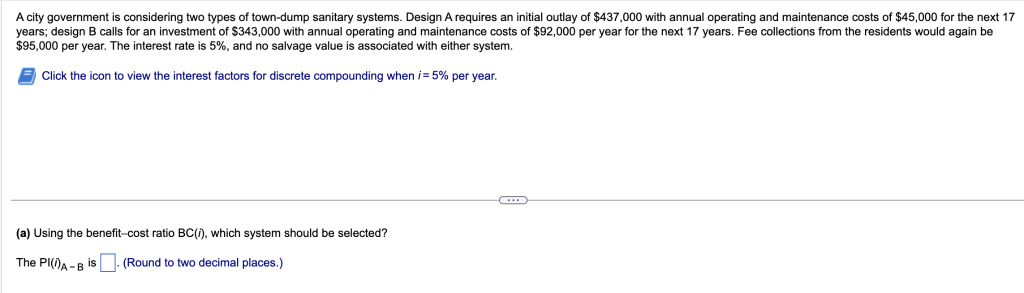 city government is considering two types of town-dump sanitary systems. Design A requires an inal outlay of $437,000 with annual operating and maintenance costs of $45,000 for the next 17
‘years; design B calls for an investment of $343,000 with annual operating and maintenance costs of $92,000 per year for the next 17 years. Fee collections from the residents would again be
595,000 per year. The interest rate is 5%, and no salvage value s associated with either system.
8) Click the con to view the interest factors or discrete compounding when i=5% per year.
(a) Using the benefit-cost ratio BC), which system should be selected?
The PI()s- g is |]. (Round to two decimal places.)
This is AI generated Response.
Asked by: PADMA
Created at: 2025-10-23 06:59:09
Asked by: PADMA
Created at: 2025-10-23 06:59:09
Final Answer:
Rendered
Raw Text
Did you like this answer?
Let's analyze the problem step-by-step:
### Given Data:
- Initial outlay for Design A: **\$437,000**
- Annual operating & maintenance costs for Design A: **\$45,000**
- Investment for Design B: **\$343,000**
- Annual operating & maintenance costs for Design B: **\$92,000**
- Revenue from collections: **\$95,000/year**
- Duration: **17 years**
- Interest rate (i): **5% per year**
---
### Step 1: Determine the benefit-cost ratio (BC) for each system
The benefit-cost ratio is given by:
\[
BC(i) = \frac{\text{Present Value of Benefits}}{\text{Present Value of Costs}}
\]
Since the benefits are the fee collections of \$95,000 annually, and costs include initial outlay and annual maintenance, the present values are calculated using the **annuity formula**:
\[
PV = \text{Annual benefit} \times \frac{1 - (1 + i)^{-n}}{i}
\]
---
### Step 2: Compute the present value of benefits
\[
PV_{benefits} = 95,000 \times \frac{1 - (1 + .05)^{-17}}{.05}
\]
Calculating:
\[
(1 + .05)^{17} \approx 2.292
\]
\[
(1 + .05)^{-17} = \frac{1}{2.292} \approx .436
\]
\[
PV_{benefits} = 95,000 \times \frac{1 - .436}{.05} = 95,000 \times \frac{.564}{.05}
\]
\[
PV_{benefits} \approx 95,000 \times 11.28 \approx 1,072,200
\]
---
### Step 3: Compute the present value of costs for each system
**Design A:**
\[
PV_{costA} = 437,000 + 45,000 \times \frac{1 - (1 + .05)^{-17}}{.05}
\]
\[
PV_{costA} = 437,000 + 45,000 \times 11.28 \approx 437,000 + 507,600 = 944,600
\]
**Design B:**
\[
PV_{costB} = 343,000 + 92,000 \times 11.28 \approx 343,000 + 1,038,000 = 1,381,000
\]
---
### Step 4: Calculate benefit-cost ratios
\[
BC_A = \frac{1,072,200}{944,600} \approx 1.14
\]
\[
BC_B = \frac{1,072,200}{1,381,000} \approx .78
\]
---
### **Answer:**
**System A** should be selected based on the benefit-cost ratio as it has a higher ratio.
**The benefit-cost ratio for System A is approximately 1.14** (rounded to two decimal places).
📢 Instructions:
- Ask anything relatd to above question only.
- For new Question goto :