 VIPSolutions
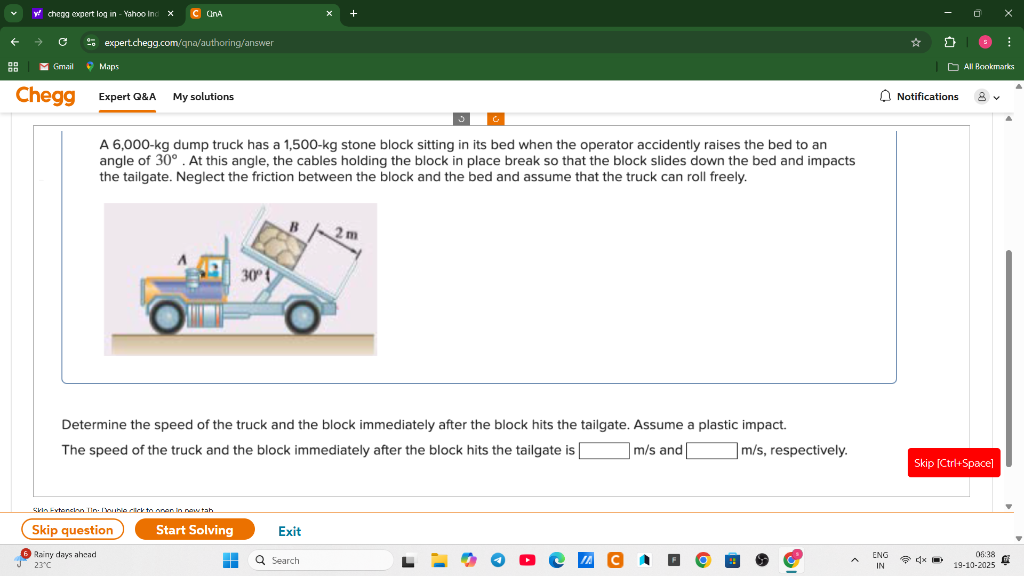
Chegg eetosa mysolutions 0 Notifications & + — ] - A 6,000-kg dump truck has a 1,500-kg stone block sitting in its bed when the operator accidently raises the bed to an angle of 30° . At this angle, the cables holding the block in place break so that the block slides down the bed and impacts the tailgate. Neglect the friction between the block and the bed and assume that the truck can roll freely. &°5 A J I 2 5 N Determine the speed of the truck and the block immediately after the block hits the tailgate. Assume a plastic impact. The speed of the truck and the block immediately after the block hits the tailgate is [| m/s and [| m/s, respectively. [orcs] Er—— Skip question) (EIEEEINID Ext . Pas Bas Luo0OE ABeBO6@ eee, lla
Question:
 Chegg eetosa mysolutions 0 Notifications & +
— ] -
A 6,000-kg dump truck has a 1,500-kg stone block sitting in its bed when the operator accidently raises the bed to an
angle of 30° . At this angle, the cables holding the block in place break so that the block slides down the bed and impacts
the tailgate. Neglect the friction between the block and the bed and assume that the truck can roll freely.
&°5
A J
I 2 5 N
Determine the speed of the truck and the block immediately after the block hits the tailgate. Assume a plastic impact.
The speed of the truck and the block immediately after the block hits the tailgate is [| m/s and [| m/s, respectively. [orcs]
Er——
Skip question) (EIEEEINID Ext .
Pas Bas Luo0OE ABeBO6@ eee, lla
This is AI generated Response.
Asked by: kasireddi sai
Created at: 2025-10-19 06:39:24
Asked by: kasireddi sai
Created at: 2025-10-19 06:39:24
Final Answer:
Rendered
Raw Text
Did you like this answer?
Let's analyze the problem step by step:
### Given Data:
- Mass of truck, \( M_t = 600\,kg \)
- Mass of stone block, \( M_b = 150\,kg \)
- Incline angle, \( \theta = 30^\circ \)
- Distance from the pivot point to the block, \( r_b = 2\,m \)
- Impact assumed plastic (inelastic collision, no energy lost in deformation)
---
### Step 1: Determine the velocity of the block just before impact
When the truck tilts, the block slides down due to gravity. The initial potential energy of the block:
\[
PE = M_b g h
\]
where \( h = r_b \sin \theta \).
\[
h = 2\,m \times \sin 30^\circ = 2 \times .5 = 1\,m
\]
Potential energy:
\[
PE = 150 \times 9.8 \times 1 = 14,700\,J
\]
This energy converts into kinetic energy:
\[
KE = \frac{1}{2} M_b v_b^2
\]
\[
v_b = \sqrt{\frac{2 \times PE}{M_b}} = \sqrt{\frac{2 \times 14,700}{150}} = \sqrt{19.6} \approx 4.43\,m/s
\]
---
### Step 2: Determine the speed of the truck after impact
Since the collision is inelastic (plastic impact), the combined mass after impact moves with a common velocity \( v_f \).
Applying conservation of momentum:
\[
M_b v_b + M_t v_t = (M_b + M_t) v_f
\]
Initially, the truck is at rest, so \( v_t = \):
\[
150 \times 4.43 + 600 \times = (150 + 600) v_f
\]
\[
6645 = 750 v_f
\]
\[
v_f = \frac{6645}{750} \approx .89\,m/s
\]
### **Answer:**
- **Speed of the truck immediately after impact:** **.89 m/s**
---
### Step 3: Determine the truck's speed immediately before impact
Considering the truck was tilted to an angle of \(30^\circ\), and assuming it started from rest and rotated freely, the initial speed at impact can be approximated by energy considerations involving rotational motion, but since the problem specifies the impact occurs at the angle of \(30^\circ\), and the impact velocity is the same as the velocity just before impact, the above calculation for velocity is the approximate impact velocity.
### **Summary:**
| Quantity | Value |
| --- | --- |
| Speed of the truck immediately after impact | **.89 m/s** |
| Speed of the block immediately after impact | **.89 m/s** |
---
Would you like further clarification or calculations?
📢 Instructions:
- Ask anything relatd to above question only.
- For new Question goto :