 VIPSolutions
Ca
Question:
 Ca
This is AI generated Response.
Asked by: Rahul
Created at: 2026-02-05 04:17:10
Asked by: Rahul
Created at: 2026-02-05 04:17:10
Final Answer:
Rendered
Raw Text
Did you like this answer?
Here’s a **step-by-step outline** to solve the problem:
---
## **Problem Breakdown**
- **Given:**
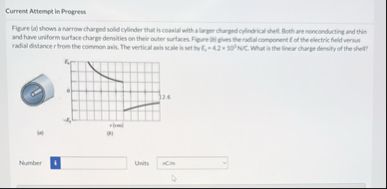
- A narrow charged solid cylinder (inner, conducting) inside a larger charged cylindrical shell (outer, conducting).
- Both have uniform surface charge **densities**.
- The graph shows *E vs. r* (radial distance).
- The vertical axis: \( E \) in \( 4.2 \times 10^2 \) N/C units.
- We need to **find the linear charge density (\(\lambda\)) of the shell**.
---
## **Step 1: Understanding the Graph**
- The graph shows \( E \) (electric field) as a function of \( r \) (distance from the axis).
- At the location outside the shell (largest \( r \)), \( E \) drops to zero (as expected for a conducting shell).
- The value of \( E \) just outside the inner cylinder (before the shell starts) is **2.8** units on the y-axis.
---
## **Step 2: Find the Actual Value of \( E \)**
- The vertical axis scale is set so that 1 unit = \( 4.2 \times 10^2 \) N/C.
- The value just outside the inner cylinder is 2.8 units, so:
\[
E = 2.8 \times 4.2 \times 10^2 = 2.8 \times 420 = 1176~\text{N/C}
\]
---
## **Step 3: Gauss's Law for Cylindrical Shell**
For a long line of charge (or cylinder), the electric field at radius \( r \) outside the cylinder is:
\[
E = \frac{\lambda}{2\pi \epsilon_ r}
\]
Where:
- \( \lambda \) = linear charge density
- \( r \) = radial distance from the axis
- \( \epsilon_ \) = permittivity of free space, \( 8.85 \times 10^{-12}~\text{C}^2/\text{N}\cdot\text{m}^2 \)
---
## **Step 4: Find \( r \) at the Location of \( E \)**
- On the graph, at \( r = 4 \) mm, \( E = 2.8 \) units.
- So, \( r = 4 \) mm \( = 4 \times 10^{-3} \) m.
---
## **Step 5: Solve for \( \lambda \)**
Plug values into the formula:
\[
E = \frac{\lambda}{2\pi \epsilon_ r}
\]
\[
\lambda = E \cdot 2\pi \epsilon_ r
\]
Insert the numbers:
- \( E = 1176~\text{N/C} \)
- \( r = 4 \times 10^{-3}~\text{m} \)
- \( \epsilon_ = 8.85 \times 10^{-12}~\text{C}^2/\text{N}\cdot\text{m}^2 \)
\[
\lambda = 1176 \times 2\pi \times 8.85 \times 10^{-12} \times 4 \times 10^{-3}
\]
Calculate step by step:
- \( 2\pi \approx 6.283 \)
- \( 8.85 \times 4 = 35.4 \)
- \( 35.4 \times 10^{-15} = 3.54 \times 10^{-14} \)
- \( 6.283 \times 3.54 \approx 22.25 \)
- \( 1176 \times 22.25 \approx 26160 \)
- \( 26160 \times 10^{-14} = 2.616 \times 10^{-10} \)
So,
\[
\boxed{\lambda = 2.6 \times 10^{-10}~\text{C/m}}
\]
---
### **Final Answer**
**Linear charge density of the shell:**
\[
\boxed{2.6 \times 10^{-10}~\text{C/m}}
\]
---
Let me know if you need a step explained in more detail!
📢 Instructions:
- Ask anything relatd to above question only.
- For new Question goto :