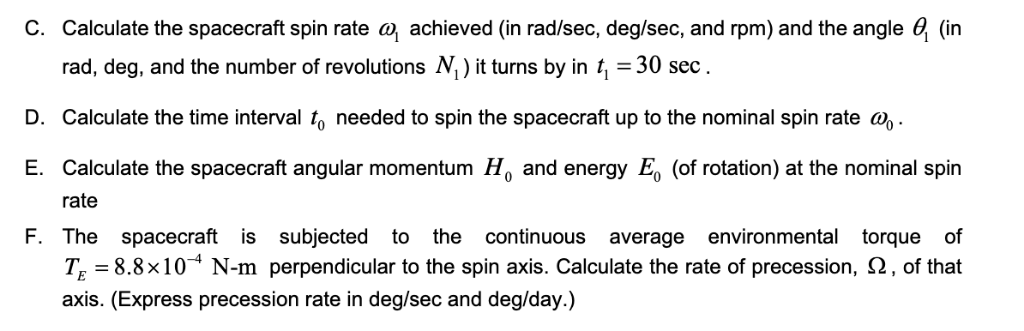
C. Calculate the spacecraft spin rate @, achieved (in rad/sec, deg/sec, and rpm) and the angle 6, (in
rad, deg, and the number of revolutions N, ) it turns by in #, =30 sec.
D. Calculate the time interval #, needed to spin the spacecraft up to the nominal spin rate @, .
E. Calculate the spacecraft angular momentum H,, and energy E, (of rotation) at the nominal spin
rate
F. The spacecraft is subjected to the continuous average environmental torque of
T, = 8.8x10™* N-m perpendicular to the spin axis. Calculate the rate of precession, Q, of that
axis. (Express precession rate in deg/sec and deg/day.)
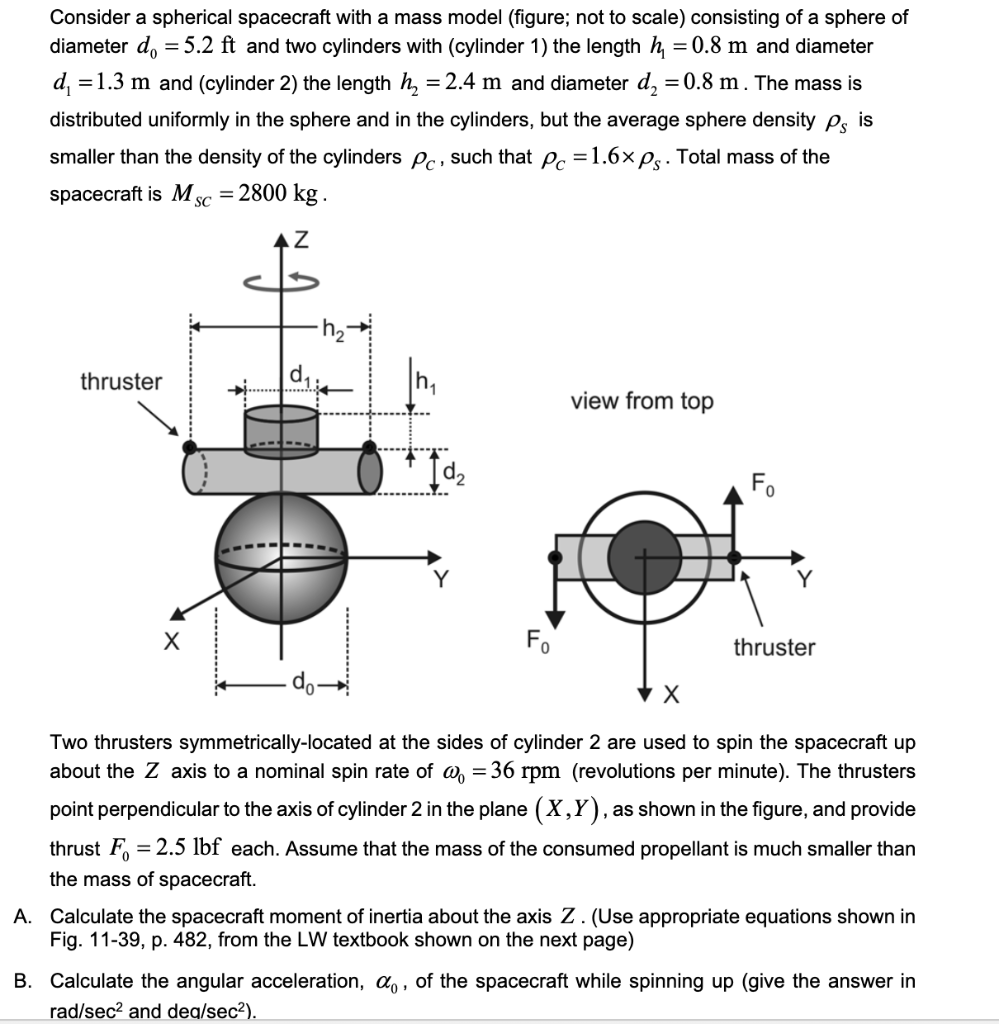
Consider a spherical spacecraft with a mass model (figure; not to scale) consisting of a sphere of
diameter d, =5.2 ft and two cylinders with (cylinder 1) the length 4 = 0.8 m and diameter
d, =1.3 m and (cylinder 2) the length 4, =2.4 m and diameter d, =0.8 m. The mass is
distributed uniformly in the sphere and in the cylinders, but the average sphere density pj is
smaller than the density of the cylinders p,., such that p. =1.6x pg. Total mass of the
spacecraftis M. =2800 kg.
z
; h, =
thruster | Ld i Jn
NN i Ps oD view from top
d.
>=
-r Y \ Y
X i i Fo thruster
dys x
Two thrusters symmetrically-located at the sides of cylinder 2 are used to spin the spacecraft up
about the Z axis to a nominal spin rate of a, =36 rpm (revolutions per minute). The thrusters
point perpendicular to the axis of cylinder 2 in the plane (X.Y) , as shown in the figure, and provide
thrust F, = 2.5 Ibf each. Assume that the mass of the consumed propellant is much smaller than
the mass of spacecraft.
A. Calculate the spacecraft moment of inertia about the axis Z . (Use appropriate equations shown in
Fig. 11-39, p. 482, from the LW textbook shown on the next page)
B. Calculate the angular acceleration, «,, of the spacecraft while spinning up (give the answer in
rad/sec? and dea/sec?).
Question:
C. Calculate the spacecraft spin rate @, achieved (in rad/sec, deg/sec, and rpm) and the angle 6, (in
rad, deg, and the number of revolutions N, ) it turns by in #, =30 sec.
D. Calculate the time interval #, needed to spin the spacecraft up to the nominal spin rate @, .
E. Calculate the spacecraft angular momentum H,, and energy E, (of rotation) at the nominal spin
rate
F. The spacecraft is subjected to the continuous average environmental torque of
T, = 8.8x10™* N-m perpendicular to the spin axis. Calculate the rate of precession, Q, of that
axis. (Express precession rate in deg/sec and deg/day.)
Consider a spherical spacecraft with a mass model (figure; not to scale) consisting of a sphere of
diameter d, =5.2 ft and two cylinders with (cylinder 1) the length 4 = 0.8 m and diameter
d, =1.3 m and (cylinder 2) the length 4, =2.4 m and diameter d, =0.8 m. The mass is
distributed uniformly in the sphere and in the cylinders, but the average sphere density pj is
smaller than the density of the cylinders p,., such that p. =1.6x pg. Total mass of the
spacecraftis M. =2800 kg.
z
; h, =
thruster | Ld i Jn
NN i Ps oD view from top
d.
>=
-r Y \ Y
X i i Fo thruster
dys x
Two thrusters symmetrically-located at the sides of cylinder 2 are used to spin the spacecraft up
about the Z axis to a nominal spin rate of a, =36 rpm (revolutions per minute). The thrusters
point perpendicular to the axis of cylinder 2 in the plane (X.Y) , as shown in the figure, and provide
thrust F, = 2.5 Ibf each. Assume that the mass of the consumed propellant is much smaller than
the mass of spacecraft.
A. Calculate the spacecraft moment of inertia about the axis Z . (Use appropriate equations shown in
Fig. 11-39, p. 482, from the LW textbook shown on the next page)
B. Calculate the angular acceleration, «,, of the spacecraft while spinning up (give the answer in
rad/sec? and dea/sec?).
This is AI generated Response.
Asked by: Adapaka Jagadeesh
Created at: 2025-07-29 16:20:06
Final Answer:
RenderedRaw Text
Did you like this answer?
Certainly! Here is a breakdown of the problem and guidance on how to approach each part with the given information.
---
### **Given Data:**
- **Sphere diameter:** \( d_0 = 5.2 \) ft \( = 1.585 \) m (since \(1\,\text{ft} = 0.3048\,\text{m}\))
- **Cylinder 1:** \( h_1 = 0.8 \) m, \( d_1 = 1.3 \) m
- **Cylinder 2:** \( h_2 = 2.4 \) m, \( d_2 = 0.8 \) m
- **Total mass:** \( M_{SC} = 2800 \) kg
- **Densities:** \( \rho_C = 1.6 \rho_S \)
- **Nominal spin rate:** \( \omega_0 = 36 \) rpm
- **Thrust per thruster:** \( F_0 = 2.5 \) lbf \( = 11.12 \) N (since \(1\,\text{lbf} = 4.4482\,\text{N}\))
---
## **A. Moment of Inertia about Z axis**
- **For a solid sphere about Z:**
\[
I_{sphere} = \frac{2}{5} m_{sphere} r_{sphere}^2
\]
- **For a solid cylinder about its axis:**
\[
I_{cyl} = \frac{1}{2} m_{cyl} r_{cyl}^2
\]
You need to:
1. **Divide the total mass** among the components based on the given density relationship and volumes.
2. **Find the radius** for each component (\( r_0, r_1, r_2 \)).
3. **Sum moments of inertia** for all components.
---
## **B. Angular Acceleration, \( \alpha_0 \)**
\[
\tau = I_Z \alpha_0
\]
- **Torque** by two thrusters: \( \tau = 2 F_0 \times (d_2 / 2) \)
- **Solve for \( \alpha_0 \):**
\[
\alpha_0 = \frac{\tau}{I_Z}
\]
---
## **C. Spin Rate, \( \omega_1 \), and Angle, \( \theta_1 \)**
- **After \( t_1 = 30 \) sec**, starting from rest:
- \( \omega_1 = \alpha_0 t_1 \)
- **Angle turned:**
\[
\theta_1 = \frac{1}{2} \alpha_0 t_1^2
\]
- Convert \( \omega_1 \) to **rad/sec, deg/sec, rpm**
- Convert \( \theta_1 \) to **rad, deg, revolutions (\( N_1 \))**
---
## **D. Time to Reach Nominal Spin Rate (\( t_0 \))**
\[
\omega_0 = \alpha_0 t_0 \implies t_0 = \frac{\omega_0}{\alpha_0}
\]
- \( \omega_0 \) in rad/sec: \( 36 \times \frac{2\pi}{60} \)
---
## **E. Angular Momentum (\( H_0 \)) and Energy (\( E_0 \))**
- **Angular momentum:**
\[
H_0 = I_Z \omega_0
\]
- **Rotational energy:**
\[
E_0 = \frac{1}{2} I_Z \omega_0^2
\]
---
## **F. Precession Rate (\( \Omega \))**
- **Average environmental torque:** \( T_E = 8.8 \times 10^{-4} \) N-m
- **Precession rate:**
\[
\Omega = \frac{T_E}{H_0}
\]
- Convert to deg/sec and deg/day.
---
## **Summary Table of Useful Conversions**
- **RPM to rad/s:** \( \omega = \text{rpm} \times \frac{2\pi}{60} \)
- **Rad to degrees:** \( 1~\text{rad} = 57.2958^\circ \)
- **Degrees per day:** \( 1~\text{deg/sec} \times 86400 \text{ sec/day} \)
---
### **If you want me to work out any specific step or calculation, please specify which part (A, B, C, etc.) you want to start with!**
Question:
calculate all and give full answer
This is AI generated Response.
Asked by: Adapaka Jagadeesh
Created at: 2025-07-29 16:21:37
VIPSolutions focuses on clear, step‑by‑step explanations so you can learn quickly. Whether you need an AI‑generated walkthrough or a short hint to get unstuck, each solution is organized for fast reading and easy review later.
Search similar questions, compare approaches, and bookmark the best answers for revision. Our goal is simple: quick, reliable study help that feels natural—not noisy.
 VIPSolutions
 C. Calculate the spacecraft spin rate @, achieved (in rad/sec, deg/sec, and rpm) and the angle 6, (in
rad, deg, and the number of revolutions N, ) it turns by in #, =30 sec.
D. Calculate the time interval #, needed to spin the spacecraft up to the nominal spin rate @, .
E. Calculate the spacecraft angular momentum H,, and energy E, (of rotation) at the nominal spin
rate
F. The spacecraft is subjected to the continuous average environmental torque of
T, = 8.8x10™* N-m perpendicular to the spin axis. Calculate the rate of precession, Q, of that
axis. (Express precession rate in deg/sec and deg/day.)
Consider a spherical spacecraft with a mass model (figure; not to scale) consisting of a sphere of
diameter d, =5.2 ft and two cylinders with (cylinder 1) the length 4 = 0.8 m and diameter
d, =1.3 m and (cylinder 2) the length 4, =2.4 m and diameter d, =0.8 m. The mass is
distributed uniformly in the sphere and in the cylinders, but the average sphere density pj is
smaller than the density of the cylinders p,., such that p. =1.6x pg. Total mass of the
spacecraftis M. =2800 kg.
z
; h, =
thruster | Ld i Jn
NN i Ps oD view from top
d.
>=
-r Y \ Y
X i i Fo thruster
dys x
Two thrusters symmetrically-located at the sides of cylinder 2 are used to spin the spacecraft up
about the Z axis to a nominal spin rate of a, =36 rpm (revolutions per minute). The thrusters
point perpendicular to the axis of cylinder 2 in the plane (X.Y) , as shown in the figure, and provide
thrust F, = 2.5 Ibf each. Assume that the mass of the consumed propellant is much smaller than
the mass of spacecraft.
A. Calculate the spacecraft moment of inertia about the axis Z . (Use appropriate equations shown in
Fig. 11-39, p. 482, from the LW textbook shown on the next page)
B. Calculate the angular acceleration, «,, of the spacecraft while spinning up (give the answer in
rad/sec? and dea/sec?).