 VIPSolutions
‘Budgeting remains a cornerstone of financial planning and control in organizations. However, in an increasingly volatile and fast-paced business environment, traditional budgeting methods are being challenged for their relevance and adaptability.’ Required With reference to the objectives of budgeting, critically evaluate the strengths and limitations of traditional budgeting approaches such as Incremental Budgeting and Zero-Based Budgeting (ZBB). In your discussion, consider how rapid technological change and the growing need for agility and responsiveness influence the effectiveness of these methods in contemporary organizational settings
Question:
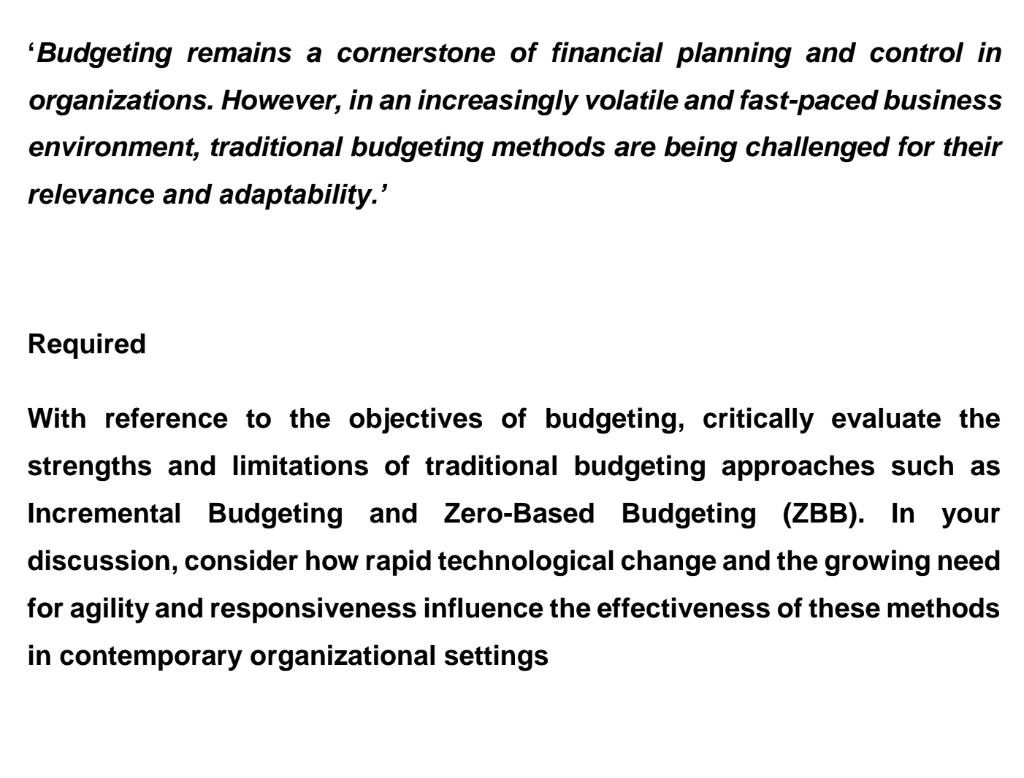 ‘Budgeting remains a cornerstone of financial planning and control in
organizations. However, in an increasingly volatile and fast-paced business
environment, traditional budgeting methods are being challenged for their
relevance and adaptability.’
Required
With reference to the objectives of budgeting, critically evaluate the
strengths and limitations of traditional budgeting approaches such as
Incremental Budgeting and Zero-Based Budgeting (ZBB). In your
discussion, consider how rapid technological change and the growing need
for agility and responsiveness influence the effectiveness of these methods
in contemporary organizational settings
This is AI generated Response.
Asked by: Veera manikanta
Created at: 2025-09-02 00:01:12
Asked by: Veera manikanta
Created at: 2025-09-02 00:01:12
Final Answer:
Rendered
Raw Text
Did you like this answer?
Certainly! Here is a critical evaluation as requested:
---
### **Objectives of Budgeting**
Budgeting aims to:
- Provide a financial framework for organizational planning and control.
- Allocate resources efficiently.
- Coordinate activities and set performance targets.
- Motivate and evaluate performance.
---
### **Traditional Budgeting Approaches**
#### **1. Incremental Budgeting**
**Strengths:**
- **Simplicity & Ease of Use:** Builds on previous budgets, making it easy and less time-consuming.
- **Stability:** Provides consistency and predictability in resource allocation.
- **Less Conflict:** Reduces internal negotiation since changes are incremental.
**Limitations:**
- **Inflexibility:** Assumes business conditions remain stable, which is rarely the case in a volatile environment.
- **Perpetuates Inefficiencies:** Past inefficiencies and outdated practices are carried forward.
- **Lack of Strategic Focus:** May not align with changing organizational priorities or external conditions.
#### **2. Zero-Based Budgeting (ZBB)**
**Strengths:**
- **Resource Optimization:** Every expense must be justified, promoting efficient allocation.
- **Alignment with Strategy:** Encourages alignment of spending with current organizational objectives.
- **Elimination of Waste:** Identifies and removes redundant or obsolete operations.
**Limitations:**
- **Resource-Intensive:** Requires significant time and effort to justify all expenses from scratch.
- **Complexity:** Can be overly detailed and burdensome, especially for large organizations.
- **Short-term Focus:** May prioritize immediate cost-saving over long-term value creation.
---
### **Relevance in a Volatile, Fast-Paced Environment**
#### **Impact of Technological Change & Need for Agility**
- **Incremental Budgeting:** Struggles to keep pace with rapid technological changes, as it is based on historical data and assumes continuity. In fast-changing environments, this can lead to misallocation of resources and missed opportunities.
- **Zero-Based Budgeting:** Better positioned to respond to change, as it requires re-evaluation of all activities. However, the resource intensity and time required for ZBB may hinder agility if not streamlined.
#### **Agility and Responsiveness**
- Modern organizations need budgeting processes that are dynamic, flexible, and can quickly adapt to shifts in market conditions, technology, and strategy.
- Traditional methods, especially incremental budgeting, often lack the responsiveness needed, leading to budgets that are outdated as soon as they are set.
- ZBB can be more responsive but may become impractical if applied too rigidly or frequently.
---
### **Conclusion**
While traditional budgeting methods like Incremental Budgeting and ZBB have strengths, their limitations are increasingly apparent in contemporary, rapidly-evolving business environments. Organizations may need to supplement or replace these methods with more agile approaches—such as rolling forecasts, flexible budgeting, or scenario planning—to remain relevant and competitive. The key is to balance control and accountability with flexibility and responsiveness, ensuring the budgeting process supports rather than hinders organizational success in the digital age.
---
**References for Further Reading:**
- Hope, J., & Fraser, R. (2003). "Beyond Budgeting."
- Chartered Institute of Management Accountants (CIMA) resources on budgeting.
Let me know if you need a more detailed answer or academic references!
📢 Instructions:
- Ask anything relatd to above question only.
- For new Question goto :