 VIPSolutions
Below is a picture of a spinning wheel that is rotating clockwise as viewed from the positive ‘X' axis (looking in the negative ‘X’ direction). If the two vertical forces (i.e. Fi and F2) were applied as shown on the diagram to create an external torque about the 'Z" axis, about which axis would the wheel precess, and in which direction (i.e. CW or CCW)?2 Explain your reasoning using vectors and the 3D axis model shown. You should redraw the 3D axis and show the appropriate vectors with labels. (3 pts) Y Y ; ’ Fy / X U X Fa Zz z
Question:
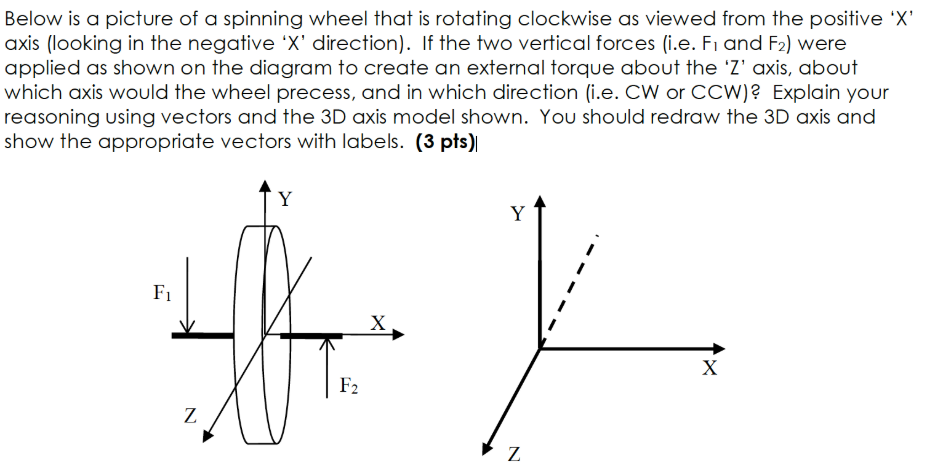 Below is a picture of a spinning wheel that is rotating clockwise as viewed from the positive ‘X'
axis (looking in the negative ‘X’ direction). If the two vertical forces (i.e. Fi and F2) were
applied as shown on the diagram to create an external torque about the 'Z" axis, about
which axis would the wheel precess, and in which direction (i.e. CW or CCW)?2 Explain your
reasoning using vectors and the 3D axis model shown. You should redraw the 3D axis and
show the appropriate vectors with labels. (3 pts)
Y
Y
;
’
Fy /
X U
X
Fa
Zz
z
This is AI generated Response.
Asked by: Govind Prajapati
Created at: 2025-11-20 22:23:09
Asked by: Govind Prajapati
Created at: 2025-11-20 22:23:09
Final Answer:
Rendered
Raw Text
Did you like this answer?
## Understanding the Problem
- **Given:** A wheel spinning clockwise as observed from the positive X-axis (i.e., looking down the X-axis towards the origin, so the wheel's spin angular momentum points along the +X direction).
- **Forces:** Two forces \( F_1 \) (downward, -Y) and \( F_2 \) (upward, +Y) applied at the edge of the wheel, creating a torque about the Z-axis.
---
## Step 1: Find the Direction of Torque (\(\vec{\tau}\))
The forces \( F_1 \) and \( F_2 \) create a couple, generating a **torque about the Z-axis**.
- \( F_1 \) (down, -Y) acts at the left edge (negative X)
- \( F_2 \) (up, +Y) acts at the right edge (positive X)
Torque (\(\vec{\tau}\)) due to a force is given by:
\[
\vec{\tau} = \vec{r} \times \vec{F}
\]
- For \( F_1 \) at \( -X \): \( \vec{r}_1 = -\hat{x} \), \( \vec{F}_1 = -\hat{y} \)
- \( \vec{r}_1 \times \vec{F}_1 = (-\hat{x}) \times (-\hat{y}) = \hat{x} \times \hat{y} = \hat{z} \)
- For \( F_2 \) at \( +X \): \( \vec{r}_2 = +\hat{x} \), \( \vec{F}_2 = +\hat{y} \)
- \( \vec{r}_2 \times \vec{F}_2 = (\hat{x}) \times (\hat{y}) = \hat{z} \)
**Sum:** Both produce \(\vec{\tau}\) in the \(+\hat{z}\) direction.
---
## Step 2: Angular Momentum (\(\vec{L}\)) of the Wheel
- The wheel spins clockwise when viewed from \( +X \) (i.e., from the right, looking left).
- **Right-hand rule:** The angular momentum vector (\(\vec{L}\)) points along the \( +X \) axis.
---
## Step 3: Precession Direction
The rate of change of angular momentum is given by the torque:
\[
\frac{d\vec{L}}{dt} = \vec{\tau}
\]
- **\(\vec{L}\) is along \(+\hat{x}\)**
- **\(\vec{\tau}\) is along \(+\hat{z}\)**
The precession is the motion of \(\vec{L}\) towards \(\vec{\tau}\):
- The tip of \(\vec{L}\) will move in the direction of \(\vec{\tau}\).
- Using the right-hand rule, the precession will be **about the Y-axis** (the only axis perpendicular to both \(\vec{L}\) and \(\vec{\tau}\)).
---
## Step 4: Direction (CW or CCW)
- Viewed from **above (+Y)**, the precession is **counter-clockwise (CCW)** about the Y-axis.
---
## Step 5: Diagram
Here is the redrawn axis with vectors:
```
^ Y
|
| (L)
| /
| /
O-------> X
/
/
v Z
- \(\vec{L}\): along +X
- \(\vec{\tau}\): along +Z
- Precession: about +Y (CCW when viewed from +Y)
```
---
## **Summary Table**
| Quantity | Direction |
|--------------|---------------|
| \(\vec{L}\) | \(+\hat{x}\) |
| \(\vec{\tau}\) | \(+\hat{z}\) |
| Precession | About \(+\hat{y}\) (CCW viewed from +Y) |
---
## **Final Answer**
- **Axis of precession:** Y-axis
- **Direction:** Counter-clockwise (CCW) when viewed from +Y
- **Reasoning:** The torque about +Z causes the angular momentum (initially along +X) to precess towards +Z, which is a rotation about the +Y axis (CCW when looking from +Y).
---
### **Labeled Diagram**
```markdown

```
- **Red arrow:** Angular momentum (\(\vec{L}\)), along +X
- **Blue arrow:** Torque (\(\vec{\tau}\)), along +Z
- **Green arrow:** Precession, about +Y (CCW viewed from +Y)
---
Let me know if you'd like a hand-drawn vector diagram!
📢 Instructions:
- Ask anything relatd to above question only.
- For new Question goto :