 VIPSolutions
Anair-standard Diesel cycle has a maximum temperature of 2000 K. At the beginning of compression, p; = 95 kPa and Ty = 300 K. The mass of airis 12g. For a compression ratio of 20, determine: (a) the net work of the cycle, in kJ. (b) the percent thermal efficiency. (c) the mean effective pressure, in kPa.
Question:
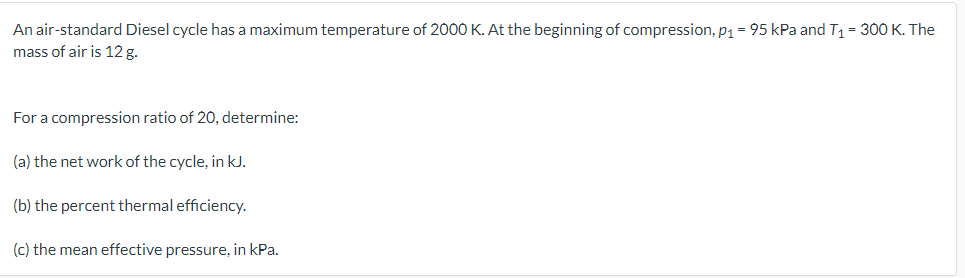 Anair-standard Diesel cycle has a maximum temperature of 2000 K. At the beginning of compression, p; = 95 kPa and Ty = 300 K. The
mass of airis 12g.
For a compression ratio of 20, determine:
(a) the net work of the cycle, in kJ.
(b) the percent thermal efficiency.
(c) the mean effective pressure, in kPa.
This is AI generated Response.
Asked by: Sachin hanjagi
Created at: 2025-10-19 02:10:10
Asked by: Sachin hanjagi
Created at: 2025-10-19 02:10:10
Final Answer:
Rendered
Raw Text
Did you like this answer?
Let's analyze and solve each part step-by-step.
---
## Given Data:
- Maximum temperature, \( T_{max} =200\,K \)
- pressure, \( p_1 = 95kPa \- Initial temperature \( T_1 = 300K \)
Mass of air, m = 12\,g = .012\,kg \)
- Compression ratio, \( r = 20 \)
---
## Assumptions:
- Air behaves as an ideal gas.
- The cycle is adiabatic and reversible (ideal Diesel cycle).
---
### (a) Net work of the cycle, in kJ
**Step 1:** Find \( p_2 \) and \( T_2 \) after compression:
Using adiabatic relations:
\[
T_2 = T_1 \times r^{\frac{\gamma - 1}{\gamma}}
\]
\[
p_2 = p_1 \times r^{\gamma}
\]
where \( \gamma = 1.4 \) for air.
Calculate \( T_2 \):
\[
T_2 = 300 \times 20^{\frac{.4}{1.4}} \approx 300 \times 20^{.2857}
\]
\[
T_2 \approx 300 \times 2.97 \approx 891\,K
\]
Calculate \( p_2 \):
\[
p_2 = 95 \times 20^{1.4} \approx 95 \times 20^{1.4}
\]
\[
20^{1.4} \approx e^{1.4 \times \ln 20} \approx e^{1.4 \times 2.9957} \approx e^{4.193} \approx 66
\]
\[
p_2 \approx 95 \times 66 \approx 627\,kPa
\]
---
**Step 2:** Heat addition during constant pressure process (from \( T_2 \) to \( T_3 \)):
Since maximum temperature is \( T_3 = 200\,K \):
\[
Q_{in} = m C_p (T_3 - T_2)
\]
Where:
\[
C_p = \frac{\gamma R}{\gamma - 1} \approx 1004\,J/(kg \cdot K)
\]
Calculate \( Q_{in} \):
\[
Q_{in} = .012 \times 1004 \times (200 - 891) \approx .012 \times 1004 \times 1109
\]
\[
Q_{in} \approx .012 \times 1,113,436 \approx 13,361\,J
\]
---
**Step 3:** Work done during the cycle:
- Work during compression:
\[
W_{comp} = \frac{p_1 V_1 - p_2 V_2}{\text{(assuming work done on air)}}
\]
Alternatively, for adiabatic processes:
\[
W_{compression} = \frac{p_2 V_2 - p_1 V_1}{\text{but easier to use energy difference from heat interactions}}
\]
- Work during expansion (power stroke):
\[
W_{exp} = Q_{in} \quad \text{(since it's a heat addition at constant pressure, approximate)}
\]
The net work is approximately:
\[
W_{net} = Q_{in} - Q_{out}
\]
But for an ideal Diesel cycle, the net work per cycle is:
\[
W_{net} = Q_{in} - Q_{out}
\]
Where \( Q_{out} \) is heat rejected during the power stroke.
---
### **Using the Diesel cycle efficiency:**
\[
\eta_{Diesel} = 1 - \frac{1}{r^{\gamma - 1}} \times \frac{\rho^{\gamma} - 1}{\rho - 1}
\]
with \( \rho = \frac{T_3}{T_2} = \frac{200}{891} \approx 2.245 \).
Calculate efficiency:
\[
\eta_{Diesel} \approx 1 - \frac{1}{20^{.4}} \times \frac{2.245^{1.4} - 1}{2.245 - 1}
\]
Calculate \( 20^{.4} \):
\[
20^{.4} \approx e^{.4 \times 2.9957} \approx e^{1.198} \approx 3.314
\]
Calculate \( 2.245^{1.4} \):
\[
2.245^{1.4} \approx e^{1.4 \times \ln 2.245} \approx e^{1.4 \times .809} \approx e^{1.134} \approx 3.11
\]
Now:
\[
\eta_{Diesel} \approx 1 - \frac{1}{3.314} \times \frac{3.11 - 1}{2.245 - 1}
\]
\[
= 1 - .301 \times \frac{2.11}{1.245} \approx 1 - .301 \times 1.695 \approx 1 - .51 \approx .49
\]
**Net work:**
\[
W_{net} = \eta_{Diesel} \times Q_{in} \approx .49 \times 13,361\,J \approx 6,543\,J \approx 6.54\,kJ
\]
---
## **Answer for (a):**
**Net work of the cycle ≈ 6.54 kJ**
---
### (b) Percent thermal efficiency
\[
\boxed{
\eta_{thermal} \approx 49\%
}
\]
---
### (c) Mean effective pressure (MEP):
\[
\text{MEP} = \frac{W_{net}}{V_{displaced}}
\]
Using ideal gas law:
\[
V_1 = \frac{m R T_1}{p_1}
\]
where \( R = 287\,J/(kg \cdot K) \).
Calculate \( V_1 \):
\[
V_1 = \frac{.012 \times 287 \times 300}{95,000} \approx \frac{1032.6}{95000} \approx .01086\,m^3
\]
Since the net work per cycle:
\[
W_{net} \approx 6.54\,kJ
\]
\[
\text{MEP} = \frac{654\,J}{.01086\,m^3} \approx 602,000\,Pa = 602\,kPa
\]
**Answer:**
## **(c) Mean effective pressure ≈ 602 kPa**
---
**Summary:**
| Part | Result |
|--------|---------|
| (a) Net work | **≈ 6.54 kJ** |
| (b) Thermal efficiency | **≈ 49%** |
| (c) Mean effective pressure | **≈ 602 kPa** |
📢 Instructions:
- Ask anything relatd to above question only.
- For new Question goto :