 VIPSolutions
An aircraft panel of width w = 100 mm, length L = 200 mm and thickness t = 18 mm is loaded in tension, as shown in figure. The plate will be made of 7075-T7351 aluminum alloy (Kic = 24 MPam®/?). Estimate the maximum load P (in Newton) that can be applied without causing sudden fracture when an edge crack grows to length of a = 20 mm. Take a factor of safety of n= 2.2. Pp 2 2 P
Question:
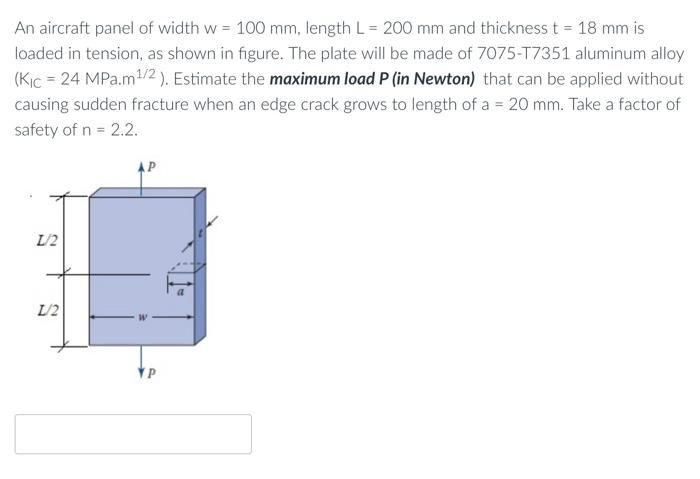 An aircraft panel of width w = 100 mm, length L = 200 mm and thickness t = 18 mm is
loaded in tension, as shown in figure. The plate will be made of 7075-T7351 aluminum alloy
(Kic = 24 MPam®/?). Estimate the maximum load P (in Newton) that can be applied without
causing sudden fracture when an edge crack grows to length of a = 20 mm. Take a factor of
safety of n= 2.2.
Pp
2
2
P
This is AI generated Response.
Asked by: pooja gargunde
Created at: 2025-08-19 11:56:13
Asked by: pooja gargunde
Created at: 2025-08-19 11:56:13
Final Answer:
Rendered
Raw Text
Did you like this answer?
Let's break down the problem and solve it step by step.
### **Given Data**
- Width, \( w = 100 \) mm
- Length, \( L = 200 \) mm
- Thickness, \( t = 18 \) mm
- Crack length, \( a = 20 \) mm
- Fracture toughness, \( K_{IC} = 24 \) MPa·m\(^{1/2}\)
- Factor of safety, \( n = 2.2 \)
- Material: 7075-T7351 aluminum alloy
### **Step 1: Formula for Maximum Load (Fracture Mechanics)**
The critical stress intensity factor for a plate with an edge crack is:
\[
K_{I} = Y \sigma \sqrt{\pi a}
\]
Where:
- \( K_{I} \): Stress intensity factor (should not exceed \( K_{IC}/n \))
- \( Y \): Geometry factor (\( Y \approx 1.12 \) for an edge crack)
- \( \sigma \): Applied stress
- \( a \): Crack length
### **Step 2: Allowable Stress**
\[
K_{IC,allowable} = \frac{K_{IC}}{n} = \frac{24 \text{ MPa} \cdot \sqrt{\text{m}}}{2.2} = 10.91 \text{ MPa} \cdot \sqrt{\text{m}}
\]
\[
K_{IC,allowable} = Y \sigma_{max} \sqrt{\pi a}
\]
\[
\sigma_{max} = \frac{K_{IC,allowable}}{Y \sqrt{\pi a}}
\]
### **Step 3: Insert Values**
- \( a = 20 \) mm \( = 0.02 \) m
- \( Y = 1.12 \)
- \( \pi \approx 3.1416 \)
\[
\sigma_{max} = \frac{10.91}{1.12 \times \sqrt{3.1416 \times 0.02}}
\]
Calculate denominator:
- \( 3.1416 \times 0.02 = 0.062832 \)
- \( \sqrt{0.062832} = 0.2507 \)
- \( 1.12 \times 0.2507 = 0.2808 \)
\[
\sigma_{max} = \frac{10.91}{0.2808} = 38.85 \text{ MPa}
\]
### **Step 4: Maximum Load**
The maximum load \( P \):
\[
P = \sigma_{max} \times (\text{cross-sectional area})
\]
\[
\text{Area} = w \times t = 100 \text{ mm} \times 18 \text{ mm} = 1800 \text{ mm}^2 = 1.8 \times 10^{-3} \text{ m}^2
\]
\[
P = 38.85 \text{ MPa} \times 1.8 \times 10^{-3} \text{ m}^2
\]
\[
1 \text{ MPa} = 10^6 \text{ N/m}^2
\]
\[
P = 38.85 \times 10^6 \times 1.8 \times 10^{-3} \text{ N}
\]
\[
P = 38.85 \times 1.8 \times 10^3 \text{ N}
\]
\[
P = 69.93 \times 10^3 \text{ N}
\]
\[
P \approx \boxed{69,930 \text{ N}}
\]
---
## **Final Answer**
### **The maximum load \( P \) that can be applied is:**
\[
\boxed{69,930 \text{ N}}
\]
📢 Instructions:
- Ask anything relatd to above question only.
- For new Question goto :