 VIPSolutions
Ahelicopter starts from rest at point A and travels along the indicated path with a constant acceleration a. If the helicopter has a speed of 79 m/s when it reaches B, determine the values of R , 6, and ¢ as measured by the radar tracking device at O at the instant. whenh=110m. B Teg [5 | he [225m He | aii c y | oy \| 2 ~~ ~ Seta i ey N ae | i: k | RA ~ 580m | Sho. LY N 0 a \ ea A Nl GJ i em om I = Og" — =~" asm
Question:
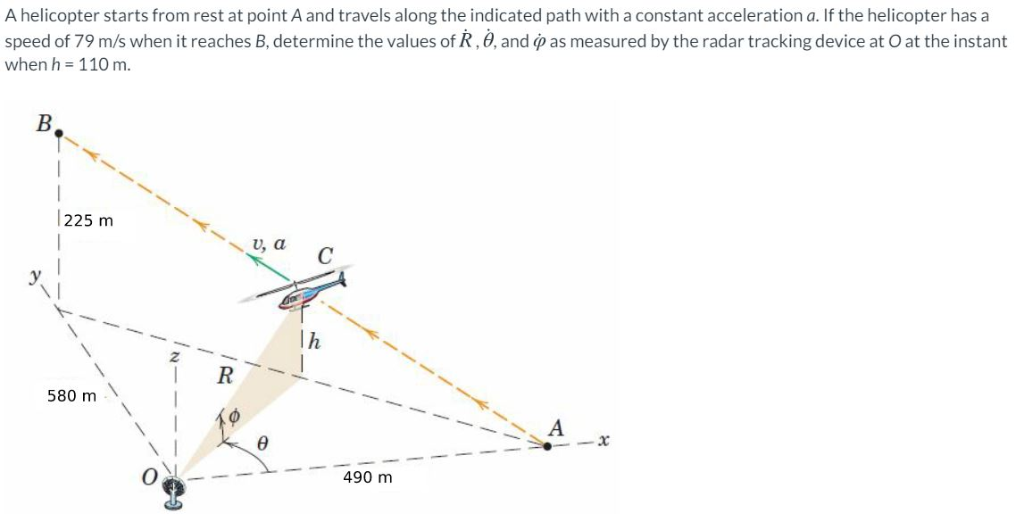 Ahelicopter starts from rest at point A and travels along the indicated path with a constant acceleration a. If the helicopter has a
speed of 79 m/s when it reaches B, determine the values of R , 6, and ¢ as measured by the radar tracking device at O at the instant.
whenh=110m.
B
Teg
[5
| he
[225m He
| aii c
y | oy
\| 2
~~ ~
Seta i ey
N ae | i:
k | RA ~
580m | Sho. LY
N 0 a
\ ea A
Nl GJ i em om I =
Og" — =~" asm
This is AI generated Response.
Asked by: amu
Created at: 2025-07-30 08:11:44
Asked by: amu
Created at: 2025-07-30 08:11:44
Final Answer:
Rendered
Raw Text
Did you like this answer?
Let's break down the problem and solve it step by step:
### **Given:**
- The helicopter starts from rest at A.
- Travels with constant acceleration \( a \).
- Path AB is straight.
- Speed at B, \( v_B = 79 \) m/s.
- Distance AB: \( s_{AB} = \sqrt{(490^2 + 225^2)} = 543.4 \) m.
- At the instant when \( h = 110 \) m (vertical height from the ground).
We are to find at that instant:
- \( \dot{R} \) (rate of change of distance from O to the helicopter)
- \( \dot{\theta} \), \( \dot{\phi} \) (rates of change of the angles as measured by the radar at O).
---
### **1. Find the Acceleration, \( a \):**
Using kinematics:
\[
v_B^2 = v_A^2 + 2as_{AB}
\]
\[
79^2 = 0^2 + 2a \cdot 543.4
\]
\[
a = \frac{79^2}{2 \times 543.4} = \frac{6241}{1086.8} = 5.74 \ \text{m/s}^2
\]
---
### **2. Find the Helicopter's Speed When \( h = 110 \) m:**
Let the distance from A to C along the path be \( s \).
Since acceleration is constant:
\[
v^2 = 2as
\]
Let \( s_C \) be the distance from A to C.
#### Find \( s_C \) corresponding to \( h = 110 \):
From the diagram:
- The path AB is in the \( x-y \) plane.
- \( \frac{h}{s} = \frac{225}{543.4} \Rightarrow \frac{110}{s_C} = \frac{225}{543.4} \)
\[
s_C = \frac{110 \cdot 543.4}{225} = 265.64 \ \text{m}
\]
#### Now, find the speed at C:
\[
v_C^2 = 2a s_C = 2 \times 5.74 \times 265.64 = 3048.3
\]
\[
v_C = \sqrt{3048.3} = 55.23 \ \text{m/s}
\]
---
### **3. Find Coordinates of C:**
- \( x_C = \frac{490}{543.4} \cdot s_C = \frac{490}{543.4} \cdot 265.64 = 239.6 \) m
- \( y_C = \frac{225}{543.4} \cdot s_C = \frac{225}{543.4} \cdot 265.64 = 110 \) m (matches \( h \))
- \( z_C = 110 \) m
---
### **4. Find \( R \) (Distance from O to C):**
From the diagram:
O is at (0, 0, 0), C is at (239.6, 110, 110)
\[
R = \sqrt{x_C^2 + y_C^2 + z_C^2} = \sqrt{239.6^2 + 110^2 + 110^2}
\]
\[
R = \sqrt{57408.16 + 12100 + 12100} = \sqrt{81608.16} = 285.7\, \text{m}
\]
---
### **5. Find \( \dot{R} \):**
The velocity vector along the path from A to B:
- Direction cosines: \( \frac{x_C}{s_C}, \frac{y_C}{s_C}, \frac{z_C}{s_C} \)
- \( \vec{v} = v_C \cdot \left(\frac{x_C}{s_C}\hat{i} + \frac{y_C}{s_C}\hat{j} + \frac{z_C}{s_C}\hat{k}\right) \)
\[
\vec{R} = (x_C, y_C, z_C), \quad \hat{R} = \frac{\vec{R}}{R}
\]
\[
\dot{R} = \vec{v} \cdot \hat{R}
\]
So,
\[
\hat{R} = \left(\frac{239.6}{285.7}, \frac{110}{285.7}, \frac{110}{285.7}\right)
\]
\[
\vec{v} = 55.23 \cdot \left(\frac{239.6}{265.64}, \frac{110}{265.64}, \frac{110}{265.64}\right)
\]
Dot product:
\[
\dot{R} = 55.23 \left[ \frac{239.6}{265.64} \cdot \frac{239.6}{285.7} + \frac{110}{265.64} \cdot \frac{110}{285.7} + \frac{110}{265.64} \cdot \frac{110}{285.7} \right]
\]
Calculate each term:
- \( \frac{239.6}{265.64} \approx 0.9023 \)
- \( \frac{239.6}{285.7} \approx 0.8386 \)
- \( \frac{110}{265.64} \approx 0.4141 \)
- \( \frac{110}{285.7} \approx 0.3849 \)
So,
- First term: \( 0.9023 \times 0.8386 = 0.7568 \)
- Second term: \( 0.4141 \times 0.3849 = 0.1595 \)
- Third term: \( 0.4141 \times 0.3849 = 0.1595 \)
- Sum: \( 0.7568 + 0.1595 + 0.1595 = 1.0758 \)
So,
\[
\dot{R} = 55.23 \times 1.0758 = 59.43 \,\text{m/s}
\]
---
### **6. Find \( \dot{\theta} \) and \( \dot{\phi} \):**
#### **a. \( \dot{\theta} \):**
- \( \tan\theta = \frac{y_C}{x_C} = \frac{110}{239.6} = 0.459 \)
- \( \theta = \tan^{-1}(0.459) = 24.7^\circ \)
\[
\dot{\theta} = \frac{d}{dt} \tan^{-1}\left(\frac{y}{x}\right) = \frac{1}{1 + (y/x)^2} \cdot \frac{x \dot{y} - y \dot{x}}{x^2}
\]
- \( \dot{x} = v_C \cdot \frac{x_C}{s_C} = 55.23 \cdot 0.9023 = 49.85 \) m/s
- \( \dot{y} = v_C \cdot \frac{y_C}{s_C} = 55.23 \cdot 0.4141 = 22.88 \) m/s
\[
\dot{\theta} = \frac{1}{1 + 0.459^2} \cdot \frac{239.6 \cdot 22.88 - 110 \cdot 49.85}{(239.6)^2}
\]
Calculate numerator:
- \( 239.6 \cdot 22.88 = 5483.65 \)
- \( 110 \cdot 49.85 = 5483.5 \)
- \( 5483.65 - 5483.5 = 0.15 \)
Denominator:
- \( 1 + 0.2107 = 1.2107 \)
- \( (239.6)^2 = 57408.16 \)
So,
\[
\dot{\theta} = \frac{1}{1.2107} \cdot \frac{0.15}{57408.16} = \frac{0.826}{57408.16} \approx 1.44 \times 10^{-5} \,\text{rad/s}
\]
---
#### **b. \( \dot{\phi} \):**
- \( \tan\phi = \frac{z_C}{\sqrt{x_C^2 + y_C^2}} = \frac{110}{\sqrt{239.6^2 + 110^2}} = \frac{110}{263.45} = 0.4177 \)
- \( \phi = \tan^{-1}(0.4177) = 22.7^\circ \)
\[
\dot{\phi} = \frac{\sqrt{x^2 + y^2} \dot{z} - z \frac{x \dot{x} + y \dot{y}}{\sqrt{x^2 + y^2}}}{x^2 + y^2 + z^2}
\]
- \( \sqrt{x_C^2 + y_C^2} = 263.45 \)
- \( x_C \dot{x} + y_C \dot{y} = 239.6 \cdot 49.85 + 110 \cdot 22.88 = 11945.06 + 2516.8 = 14461.86 \)
- \( \dot{z} = v_C \cdot \frac{z_C}{s_C} = 55.23 \cdot 0.4141 = 22.88 \) m/s
Numerator:
\[
263.45 \cdot 22.88 - 110 \cdot \frac{14461.86}{263.45} = 6028.5 - 110 \times 54.92 = 6028.5 - 6041.2 = -12.7
\]
Denominator:
\[
x^2 + y^2 + z^2 = 57408.16 + 12100 + 12100 = 81608.16
\]
So,
\[
\dot{\phi} = \frac{-12.7}{81608.16} = -1.56 \times 10^{-4} \ \text{rad/s}
\]
---
## **Summary of Answers**
- \( \dot{R} = 59.43 \) m/s
- \( \dot{\theta} = 1.44 \times 10^{-5} \) rad/s
- \( \dot{\phi} = -1.56 \times 10^{-4} \) rad/s
Let me know if you'd like to see the step-by-step breakdown for any part!
📢 Instructions:
- Ask anything relatd to above question only.
- For new Question goto :