 VIPSolutions
. A vertical rod of cross. sectional area A is secured firmly at its top and has a collar of inextensible mass attached firmly to its bottom as shown in figure Q3. If a mass of magnitude, M, is dropped onto the collar from a distance, h above it, determine the maximum values of stress and deflection that will occur owing to this impact. Neglect energy and other losses, and assume that the mass is in the form of an annular ring. Determine the maximum stress if the mass, M, is applied at effective height of zero. M oe . il | Py 5 ‘4 3 ¥ Fe i FA BY
Question:
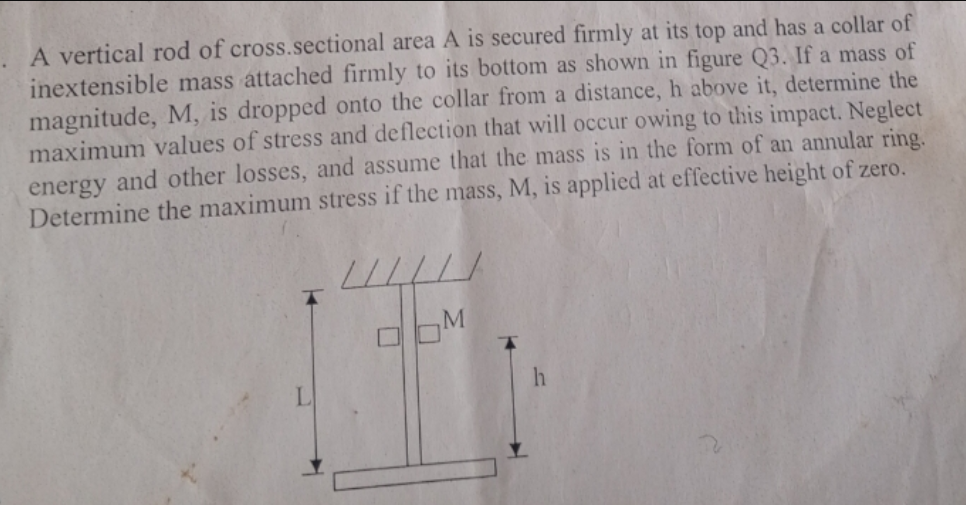 . A vertical rod of cross. sectional area A is secured firmly at its top and has a collar of
inextensible mass attached firmly to its bottom as shown in figure Q3. If a mass of
magnitude, M, is dropped onto the collar from a distance, h above it, determine the
maximum values of stress and deflection that will occur owing to this impact. Neglect
energy and other losses, and assume that the mass is in the form of an annular ring.
Determine the maximum stress if the mass, M, is applied at effective height of zero.
M
oe
. il |
Py 5 ‘4
3 ¥
Fe i
FA BY
This is AI generated Response.
Asked by: Govind Prajapati
Created at: 2025-08-28 01:01:45
Asked by: Govind Prajapati
Created at: 2025-08-28 01:01:45
Final Answer:
Rendered
Raw Text
Did you like this answer?
Let's break down the problem and solve for the **maximum stress** and **maximum deflection** in the rod.
### **Problem Analysis**
- **Rod:** Vertical, cross-sectional area \(A\), length \(L\)
- **Collar:** Attached to the bottom, inextensible mass \(M\)
- **Mass dropped:** From height \(h\) above the collar
- **Neglect:** Energy and other losses
- **Assume:** Mass is an annular ring (acts instantly on the collar)
- **Find:** Maximum stress and maximum deflection due to impact
---
## **Step 1: Energy Consideration**
When the mass \(M\) is dropped from height \(h\), it gains kinetic energy as it falls and imparts this energy to the rod upon impact.
**Total Potential Energy Lost by Mass:**
\[
E = Mgh
\]
When the mass hits the collar, it causes the rod to extend by a maximum deflection \(\delta_{max}\), so the total energy absorbed by the rod is:
\[
Mgh = \text{Work done in stretching the rod}
\]
The work done in stretching the rod (if the maximum force is \(F_{max}\)) is:
\[
\text{Work} = \frac{1}{2} F_{max} \delta_{max}
\]
---
## **Step 2: Static Deflection**
If the mass \(M\) is gently placed, the static deflection (\(\delta_{st}\)) is:
\[
\delta_{st} = \frac{MgL}{AE}
\]
where:
- \(L\) = Length of the rod
- \(A\) = Cross-sectional area
- \(E\) = Young's modulus
---
## **Step 3: Maximum Deflection from Impact**
From energy balance, for impact loading:
\[
Mgh = \frac{1}{2} F_{max} \delta_{max}
\]
But \(F_{max}\) is related to \(\delta_{max}\) by:
\[
F_{max} = \frac{AE}{L} \delta_{max}
\]
So,
\[
Mgh = \frac{1}{2} \left(\frac{AE}{L} \delta_{max}\right) \delta_{max}
\]
\[
Mgh = \frac{AE}{2L} \delta_{max}^2
\]
\[
\delta_{max} = \sqrt{\frac{2MghL}{AE}}
\]
But, including the static deflection due to the weight \(Mg\) as well, the total energy is:
\[
Mgh + Mg\delta_{max} = \frac{1}{2} \frac{AE}{L} \delta_{max}^2
\]
So,
\[
Mgh + Mg\delta_{max} = \frac{AE}{2L} \delta_{max}^2
\]
\[
\frac{AE}{2L} \delta_{max}^2 - Mg\delta_{max} - Mgh = 0
\]
This is a quadratic equation in \(\delta_{max}\):
\[
\delta_{max}^2 - \frac{2MgL}{AE} \delta_{max} - \frac{2MghL}{AE} = 0
\]
Let \(a = 1\), \(b = -\frac{2MgL}{AE}\), \(c = -\frac{2MghL}{AE}\):
\[
\delta_{max} = \frac{-b + \sqrt{b^2 - 4ac}}{2a}
\]
Plug in the values:
\[
\delta_{max} = \frac{\frac{2MgL}{AE} + \sqrt{\left(\frac{2MgL}{AE}\right)^2 + \frac{8MghL}{AE}}}{2}
\]
\[
\delta_{max} = \frac{MgL}{AE} + \frac{1}{2}\sqrt{\left(\frac{2MgL}{AE}\right)^2 + \frac{8MghL}{AE}}
\]
Or, more simply:
\[
\delta_{max} = \frac{MgL}{AE} \left[1 + \sqrt{1 + \frac{2hAE}{MgL}}\,\right]
\]
---
## **Step 4: Maximum Stress in the Rod**
The maximum force in the rod at maximum deflection:
\[
F_{max} = \frac{AE}{L} \delta_{max}
\]
So,
\[
\sigma_{max} = \frac{F_{max}}{A} = \frac{E}{L} \delta_{max}
\]
---
## **Step 5: Special Case (\(h = 0\))**
If \(h = 0\), mass is applied gently (no drop, only the static case):
\[
\delta_{max} = \frac{MgL}{AE}
\]
\[
\sigma_{max} = \frac{Mg}{A}
\]
---
## **Summary of Answers**
### **(a) Maximum deflection:**
\[
\boxed{
\delta_{max} = \frac{MgL}{AE} \left[ 1 + \sqrt{1 + \frac{2hAE}{MgL}}\,\right]
}
\]
### **(b) Maximum stress:**
\[
\boxed{
\sigma_{max} = \frac{E}{L} \delta_{max}
}
\]
### **(c) For \(h = 0\) (static case):**
\[
\boxed{
\sigma_{max} = \frac{Mg}{A}
}
\]
---
### **Let me know if you need a numerical example or further clarification!**
📢 Instructions:
- Ask anything relatd to above question only.
- For new Question goto :