 VIPSolutions
A three-point test cross revealed a total of 11 double crossovers among a total of 726 test- cross progeny. Using the genetic map provided, calculate the coefficient of Interference (1). CJ] 15 cM 25cM
Question:
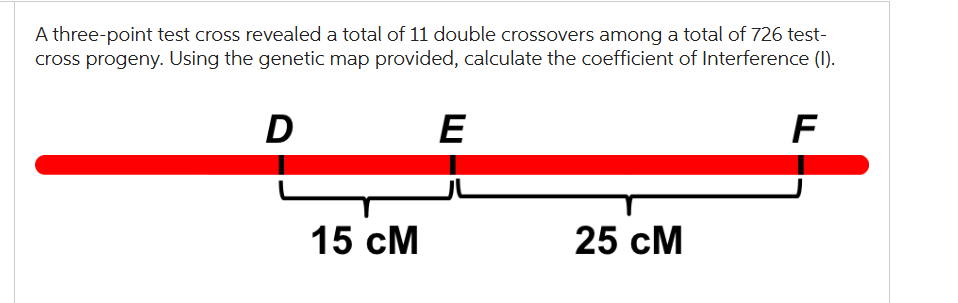 A three-point test cross revealed a total of 11 double crossovers among a total of 726 test-
cross progeny. Using the genetic map provided, calculate the coefficient of Interference (1).
CJ]
15 cM 25cM
This is AI generated Response.
Asked by: Nikita Gaikwad
Created at: 2025-06-21 22:14:49
Asked by: Nikita Gaikwad
Created at: 2025-06-21 22:14:49
Final Answer:
Rendered
Raw Text
Did you like this answer?
Let's solve the problem step by step:
### **Step 1: Calculate the Expected Number of Double Crossovers**
First, we need to calculate the expected frequency of double crossovers between the two intervals (D–E and E–F):
- Recombination frequency between D and E = 15 cM = 0.15
- Recombination frequency between E and F = 25 cM = 0.25
**Expected frequency of double crossovers:**
\[
\text{Expected frequency} = (\text{frequency D–E}) \times (\text{frequency E–F}) = 0.15 \times 0.25 = 0.0375
\]
**Expected number of double crossovers:**
\[
\text{Expected number} = \text{Expected frequency} \times \text{Total progeny} = 0.0375 \times 726 = 27.225
\]
---
### **Step 2: Coefficient of Coincidence (c)**
\[
\text{Coefficient of Coincidence (c)} = \frac{\text{Observed Double Crossovers}}{\text{Expected Double Crossovers}}
\]
\[
c = \frac{11}{27.225} \approx 0.404
\]
---
### **Step 3: Coefficient of Interference (I)**
\[
I = 1 - \text{Coefficient of Coincidence}
\]
\[
I = 1 - 0.404 = 0.596
\]
---
### **Final Answer:**
**The coefficient of interference (I) is approximately \(\boxed{0.60}\) (rounded to two decimal places).**
If you need further explanation, let me know!
📢 Instructions:
- Ask anything relatd to above question only.
- For new Question goto :