VIPSolutions logo ✨ VIPSolutions

A stock recently has been estimated to have a beta of 1.25: a. What will a beta book compute as the “adjusted beta” of this stock? (Do not round intermediate calculations. Round your answer 102 decimal places) ‘Adusted bela F b. Suppose that you estimate the following regression describing the evolution of beta over time: Be = 0.2 + 0.85e 1 What would be your predicted beta for next year? (Do not round intermediate calculations. Round your answer to 3 decimal places.) Predicted beta [

Question:
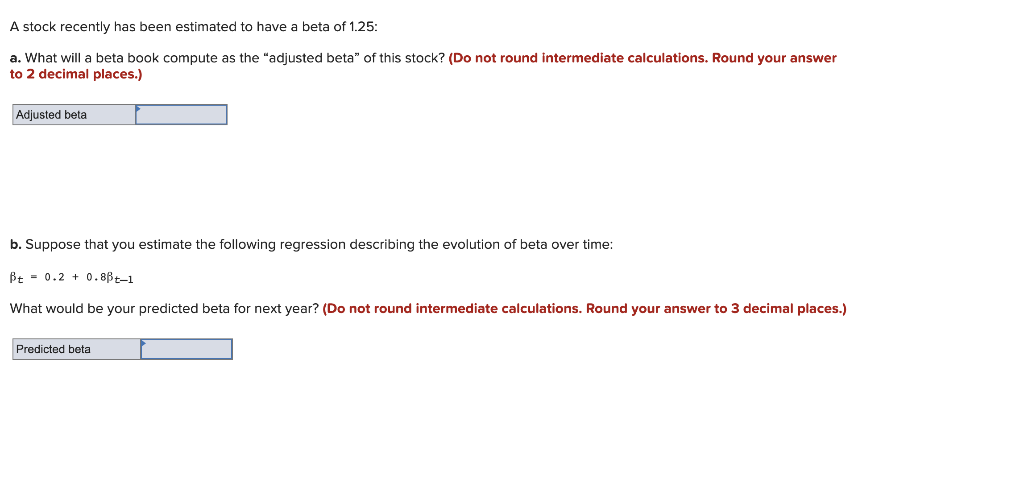
Uploaded ImageA stock recently has been estimated to have a beta of 1.25: a. What will a beta book compute as the “adjusted beta” of this stock? (Do not round intermediate calculations. Round your answer 102 decimal places) ‘Adusted bela F b. Suppose that you estimate the following regression describing the evolution of beta over time: Be = 0.2 + 0.85e 1 What would be your predicted beta for next year? (Do not round intermediate calculations. Round your answer to 3 decimal places.) Predicted beta [

This is AI generated Response.
Asked by: Sampangi Swetha
Created at: 2025-06-28 12:33:24

Final Answer:

Rendered Raw Text
Did you like this answer?
Let's break down each part: ### Part a: Adjusted Beta The "adjusted beta" is commonly calculated using the formula: \[ \text{Adjusted Beta} = 0.67 \times (\text{Raw Beta}) + 0.33 \times 1.0 \] Given: Raw Beta = 1.25 \[ \text{Adjusted Beta} = 0.67 \times 1.25 + 0.33 \times 1.0 \] \[ = 0.8375 + 0.33 \] \[ = 1.1675 \] **Rounded to 2 decimal places:** \[ \boxed{1.17} \] --- ### Part b: Predicted Beta Next Year The regression equation is: \[ \beta_t = 0.2 + 0.8\beta_{t-1} \] Given: \(\beta_{t-1} = 1.25\) \[ \beta_t = 0.2 + 0.8 \times 1.25 \] \[ = 0.2 + 1.0 \] \[ = 1.2 \] **Rounded to 3 decimal places:** \[ \boxed{1.200} \] --- ### Summary of Answers: - **Adjusted beta:** `1.17` - **Predicted beta:** `1.200`

Question:

2)Updated Calculations Question Prompt: 1: Introduction: Provide the complete necessary conceptual background concepts explanation and the introduction required to understand and answer the given question. Add an Explanation block at the end of the introduction by adding various relevant supporting statements and explaining the introduction concisely. Note: Do not use personal pronouns like I, we, you, etc. The response must look as if it is written by a human. Explanation: Articulate the importance of the introduction, providing more relevant comprehensive supporting statements that link these concepts directly to the question. This explanation should clarify how the introduction aids in comprehending the subsequent steps. 2: Presentation of Relevant Formulas Required To Solve The Question: List and also describe all formulas required to solve the question. Ensure each formula is presented clearly and is directly applicable to the problem. Explanation: Detail the derivation or rationale behind each formula, explaining its relevance and necessity in the context of the problem-solving process. Use more relavent comprehensive supporting statements to reinforce the significance of these mathematical tools. 3: A Detailed Step-by-Step Solution: Write a step-by-step in-depth comprehensive straight forward complete solution in a structured way without missing anything as per the requirements and also include explanation [ Write relevant supporting statements in the explanation block ] for every step in the solution. Conclusion: Conclude with a concise summary of the solution, succinctly presenting the final answer short summary derived from the calculations. Follow These Guidelines While Answering The Question: 1. Maintain a professional and impersonal tone throughout, avoiding personal pronouns such as 'I', 'we', 'you', etc. 2. Ensure more accuracy and adherence to the necessary concepts and correct textbook based correct formulas and other relevant, required to solve the question. 3. Include an Explanation block at the end of each step to provide context and clarify the methodology used by providing the necessary supporting statements. 4. Focus solely on delivering a well-explained direct and complete answer to the question, without additional guidance [ I don’t need any guidance of how to solve the question – I just need well-explained complete solution ] or extraneous content. 5. Make sure that strictly follow the specified format, ensuring that each section, especially the introduction and each step of the solution, is accompanied by a detailed relevant supporting statement in the explanation. 6. I need the exact detailed comprehensive direct step-by-step answer as I don’t need any guidance to write the answer and strictly add the explanation for each with the required supporting statement & Please give me the complete answer as per the question requirements without skipping anything in the answer. 7. Always provide correct, complete detailed & well-explained solution. 8. Ensure that there are no typo/formula/calculation/programming/grammatical errors are present in your solution. 9. Give the correct graphs/diagrams/tables/charts whenever required in the solution. 10. Ensure that there are NO Errors in Units/Notations are there in your solution. 11. Avoid missing any vital part in the solution [ Don’t miss any part in the solution ]. give all steps calculations without missing any points and give finar answer

This is AI generated Response.
Asked by: Sampangi Swetha
Created at: 2025-06-28 12:33:57

Final Answer:

Rendered Raw Text
Did you like this answer?
**Introduction** The concept of beta in finance measures a stock’s sensitivity to market movements, indicating its systematic risk relative to the overall market. A beta value of 1 implies that the stock tends to move in tandem with the market, whereas a beta greater than 1 indicates higher volatility, and a beta less than 1 suggests lower volatility compared to the market. Adjusted beta accounts for the tendency of beta estimates to regress toward the mean over time, often using a weighted average of the observed beta and 1.0, which is considered the market’s beta. Regression analysis, on the other hand, helps forecast future beta values based on historical data, capturing the dynamic evolution of the stock’s risk profile. **Explanation** Understanding beta and its adjustment is crucial for portfolio management and risk assessment. The adjusted beta provides a more realistic estimate that considers the tendency of beta to revert toward the market average, reducing potential overestimations or underestimations of risk. Regression analysis enables the prediction of future beta by modeling the relationship between past and future values, capturing trends and shifts in the stock’s systematic risk over time. These concepts are fundamental in making informed investment decisions and managing portfolio risk effectively. --- ### **Relevant Formulas and Their Explanation** 1. **Adjusted Beta Formula:** \[ \text{Adjusted Beta} = 0.67 \times \text{Raw Beta} + 0.33 \times 1.0 \] *This formula adjusts the raw beta estimate by giving more weight (67%) to the observed beta and a smaller weight (33%) to the market average (which is 1). This reflects the tendency of beta estimates to regress toward the mean over time.* 2. **Regression Forecasting Formula:** \[ \beta_{t+1} = \alpha + \beta \times \beta_t \] *This is a simple linear regression model where \(\alpha\) (intercept) and \(\beta\) (slope coefficient) are estimated parameters. The next period’s beta (\(\beta_{t+1}\)) is predicted based on the current beta (\(\beta_t\)).* *In this context, the regression equation is given as:* \[ \beta_e = 0.2 + 0.85 \times \beta_{t-1} \] *This models the evolution of beta over time, allowing the prediction of future beta based on the previous year’s beta.* --- ### **Step-by-Step Solution** **Part a: Calculating the Adjusted Beta** **Step 1:** Identify the raw beta value given. \[ \text{Raw Beta} = 1.25 \] **Step 2:** Apply the adjusted beta formula: \[ \text{Adjusted Beta} = 0.67 \times 1.25 + 0.33 \times 1.0 \] **Step 3:** Perform the calculations: \[ 0.67 \times 1.25 = 0.8375 \] \[ 0.33 \times 1.0 = 0.33 \] **Step 4:** Sum the results: \[ 0.8375 + 0.33 = 1.1675 \] **Step 5:** Round to two decimal places (as per standard practice): \[ \boxed{1.17} \] *This adjusted beta incorporates the tendency of beta to regress toward the mean market beta of 1, providing a more conservative estimate of the stock’s systematic risk.* --- **Part b: Predicting the Next Year’s Beta Using Regression** **Step 1:** Write down the regression equation: \[ \beta_e = 0.2 + 0.85 \times \beta_{t-1} \] **Step 2:** Substitute the previous year's beta: \[ \beta_{t-1} = 1.25 \] **Step 3:** Calculate the predicted beta: \[ \beta_e = 0.2 + 0.85 \times 1.25 \] \[ 0.85 \times 1.25 = 1.0625 \] \[ \beta_e = 0.2 + 1.0625 = 1.2625 \] **Step 4:** Round to three decimal places: \[ \boxed{1.263} \] *This prediction suggests that based on the historical trend modeled by regression, the beta of the stock for the upcoming year is approximately 1.263, indicating a slight increase in systematic risk.* --- ### **Final Answers:** - **Adjusted Beta:** **1.17** - **Predicted Beta for Next Year:** **1.263** These calculations provide a refined understanding of the stock’s risk profile, incorporating both the regression trend and the adjustment for mean reversion in beta estimates.

📢 Instructions:

  • Ask anything relatd to above question only.
  • For new Question goto :

Study Help, Fast Answers

VIPSolutions focuses on clear, step‑by‑step explanations so you can learn quickly. Whether you need an AI‑generated walkthrough or a short hint to get unstuck, each solution is organized for fast reading and easy review later.

Search similar questions, compare approaches, and bookmark the best answers for revision. Our goal is simple: quick, reliable study help that feels natural—not noisy.