 VIPSolutions
. A power amplifier with an output impedance of 50 Q is to be matched to a 200 Q transmission line. Design and illustrate the schematic for one-, two-, and three-section quarter-wave impedance transformers to achieve this matching. Also analyze and discuss the performance and implications of each design. (25 Marks)
Question:
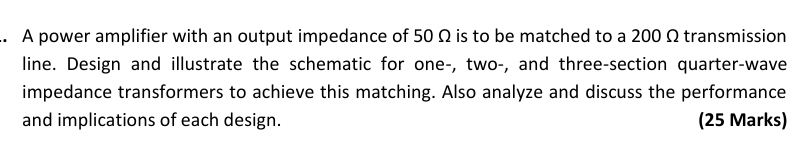 . A power amplifier with an output impedance of 50 Q is to be matched to a 200 Q transmission
line. Design and illustrate the schematic for one-, two-, and three-section quarter-wave
impedance transformers to achieve this matching. Also analyze and discuss the performance
and implications of each design. (25 Marks)
This is AI generated Response.
Asked by: rohit singh
Created at: 2025-11-07 18:25:49
Asked by: rohit singh
Created at: 2025-11-07 18:25:49
Final Answer:
Rendered
Raw Text
Did you like this answer?
# Quarter-Wave Impedance Transformer Design
## Problem Restatement
- **Objective:** Match a 50 Ω power amplifier output to a 200 Ω transmission line.
- **Task:** Design and illustrate **one-, two-, and three-section quarter-wave impedance transformers**; analyze and discuss each.
---
## 1. **One-Section Quarter-Wave Transformer**
### **Design & Calculation**
A single quarter-wave transformer of impedance \( Z_1 \):
\[
Z_1 = \sqrt{Z_S Z_L} = \sqrt{50 \times 200} = 100 \ \Omega
\]
### **Schematic**
```
[50 Ω] ──[λ/4 @ 100 Ω]── [200 Ω]
```
### **Performance & Implications**
- **Pros:** Simple, easy to implement.
- **Cons:** Narrow bandwidth (best for single frequency); mismatch increases rapidly off-design frequency.
---
## 2. **Two-Section Quarter-Wave Transformer**
### **Design & Calculation**
The impedances (\( Z_1 \), \( Z_2 \)) are chosen so:
\[
Z_1 = \sqrt{Z_S Z_x}, \quad Z_2 = \sqrt{Z_x Z_L}
\]
Where \( Z_x \) is an intermediate impedance.
- For **equal-ratio** split:
- \( r = \sqrt[3]{Z_L/Z_S} = \sqrt[3]{200/50} = \sqrt[3]{4} \approx 1.587 \)
- \( Z_1 = Z_S \times r = 50 \times 1.587 \approx 79.4\, \Omega \)
- \( Z_2 = Z_1 \times r = 79.4 \times 1.587 \approx 126.\, \Omega \)
### **Schematic**
```
[50 Ω] ──[λ/4 @ 79.4 Ω]──[λ/4 @ 126 Ω]── [200 Ω]
```
### **Performance & Implications**
- **Pros:** Broader bandwidth than single-section; better impedance match over wider frequencies.
- **Cons:** More complex; needs two precise line sections.
---
## 3. **Three-Section Quarter-Wave Transformer**
### **Design & Calculation**
Impedances (\( Z_1, Z_2, Z_3 \)) for equal ratio:
\[
r = \sqrt[4]{Z_L/Z_S} = \sqrt[4]{4} \approx 1.414
\]
- \( Z_1 = Z_S \times r = 50 \times 1.414 \approx 70.7\, \Omega \)
- \( Z_2 = Z_1 \times r = 70.7 \times 1.414 \approx 100\, \Omega \)
- \( Z_3 = Z_2 \times r = 100 \times 1.414 \approx 141.4\, \Omega \)
### **Schematic**
```
[50 Ω] ──[λ/4 @ 70.7 Ω]──[λ/4 @ 100 Ω]──[λ/4 @ 141.4 Ω]── [200 Ω]
```
### **Performance & Implications**
- **Pros:** Even broader bandwidth; superior matching over frequency.
- **Cons:** Most complex; requires three precise transmission line sections.
---
## **Summary Table**
| Design | Number of Sections | Impedance Values (Ω) | Bandwidth | Complexity | Best Use Case |
|-------------|-------------------|------------------------------|---------------|------------|----------------------|
| One-Section | 1 | 100 | Narrow | Low | Single-frequency |
| Two-Section | 2 | 79.4, 126 | Moderate | Medium | Moderate bandwidth |
| Three-Section| 3 | 70.7, 100, 141.4 | Wide | High | Wide bandwidth |
---
## **Analysis & Discussion**
- **One-section:** Good for cost-sensitive, narrowband systems.
- **Two-section:** Good compromise for moderate bandwidth; commonly used in RF.
- **Three-section:** Best for wideband RF matching (e.g., broadband amplifiers), but at increased design and manufacturing complexity.
---
## **Illustration Summary**
- Each section is a λ/4 transmission line at the center frequency with the calculated characteristic impedance.
---
**Tip:** In real-world applications, manufacturing tolerances and frequency drift must be considered when choosing the number of sections. More sections = better performance, but higher cost and complexity.
📢 Instructions:
- Ask anything relatd to above question only.
- For new Question goto :