 VIPSolutions
A particle with mass m and energy E is moving in one dimension from right to left. It is incident of the step potential V(x) = 0 for x < 0 and V(x) = Vo for x > 0, where Vo > 0, as shown on the diagram. The energy of the particle is £ > Vo. V(x) at 3 v=V v=0 =) x (a) Solve the Schrodinger equation to derive y (x) for x 0. Express the solution in terms of a single unknown constant. (b) Calculate the value of the reflection coefficient R for the particle when E = 1.25Vo.
Question:
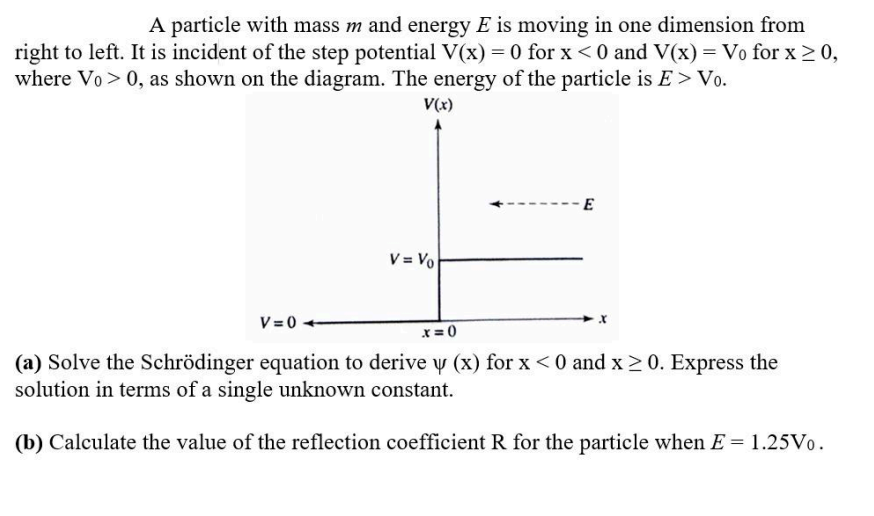 A particle with mass m and energy E is moving in one dimension from
right to left. It is incident of the step potential V(x) = 0 for x < 0 and V(x) = Vo for x > 0,
where Vo > 0, as shown on the diagram. The energy of the particle is £ > Vo.
V(x)
at 3
v=V
v=0 =) x
(a) Solve the Schrodinger equation to derive y (x) for x 0. Express the
solution in terms of a single unknown constant.
(b) Calculate the value of the reflection coefficient R for the particle when E = 1.25Vo.
This is AI generated Response.
Asked by: Rahul
Created at: 2025-09-28 05:33:54
Asked by: Rahul
Created at: 2025-09-28 05:33:54
Final Answer:
Rendered
Raw Text
Did you like this answer?
# Quantum Step Potential Problem
## (a) **Solving the Schrödinger Equation**
### **Potential Profile**
- For \( x < \): \( V(x) = \)
- For \( x \geq \): \( V(x) = V_ \)
- Particle energy: \( E > V_ \)
### **Schrödinger Equation**
\[
-\frac{\hbar^2}{2m} \frac{d^2\psi}{dx^2} + V(x)\psi = E\psi
\]
### **Region I (\(x < \))**
\[
-\frac{\hbar^2}{2m} \frac{d^2\psi}{dx^2} = E\psi
\implies \frac{d^2\psi}{dx^2} + k_1^2 \psi =
\]
where \( k_1 = \frac{\sqrt{2mE}}{\hbar} \).
General solution:
\[
\psi_1(x) = A e^{ik_1 x} + B e^{-ik_1 x}
\]
- \(A\): amplitude of wave traveling to the right (toward the step)
- \(B\): amplitude of reflected wave traveling to the left
### **Region II (\(x \geq \))**
\[
-\frac{\hbar^2}{2m} \frac{d^2\psi}{dx^2} + V_\psi = E\psi
\implies \frac{d^2\psi}{dx^2} + k_2^2 \psi =
\]
where \( k_2 = \frac{\sqrt{2m(E-V_)}}{\hbar} \).
General solution (for particle incident from right):
\[
\psi_2(x) = C e^{-ik_2 x}
\]
Here, we take only the wave traveling to the left (\(e^{-ik_2 x}\)), as the particle is incident from the right and there is no wave coming from \(x = +\infty\).
### **Summary**
Expressing in terms of a single unknown (let's use \(C\)):
- For \(x < \): \(\psi_1(x) = A e^{ik_1 x} + B e^{-ik_1 x}\)
- For \(x \geq \): \(\psi_2(x) = C e^{-ik_2 x}\)
**But since the particle is incident from right, we set \(A = \):**
- For \(x < \): \(\psi_1(x) = B e^{-ik_1 x}\)
- For \(x \geq \): \(\psi_2(x) = C e^{-ik_2 x}\)
Or, if you prefer to use \(C\) as the only unknown:
- For \(x < \): \(\psi_1(x) = r C e^{ik_1 x} + C e^{-ik_1 x}\)
- For \(x \geq \): \(\psi_2(x) = t C e^{-ik_2 x}\)
where \(r\) and \(t\) are reflection and transmission amplitudes.
---
## (b) **Reflection Coefficient for \(E = 1.25V_\)**
### **Boundary Conditions at \(x = \):**
1. \(\psi_1() = \psi_2()\)
2. \(\psi_1'() = \psi_2'()\)
From above:
\[
\psi_1(x) = B e^{-ik_1 x}
\]
\[
\psi_2(x) = C e^{-ik_2 x}
\]
At \(x=\):
\[
B = C
\]
\[
-ik_1 B = -ik_2 C \implies k_1 B = k_2 C
\]
But this leads to \(k_1 = k_2\), which is not generally true unless \(V_ = \). Let's include the general form:
Let the general solution for \(x < \):
\[
\psi_1(x) = A e^{ik_1 x} + B e^{-ik_1 x}
\]
For \(x \geq \):
\[
\psi_2(x) = C e^{-ik_2 x}
\]
The incident wave is from the right (\(e^{-ik_2 x}\)), so in \(x \geq \) we have only the left-moving wave.
Boundary conditions at \(x=\):
1. \(A + B = C\)
2. \(ik_1 A - ik_1 B = -ik_2 C\)
Solving:
\[
\begin{cases}
A + B = C \\
k_1 (A - B) = -k_2 C
\end{cases}
\]
Express \(A\) and \(B\) in terms of \(C\):
From (1): \(A = C - B\)
Plug into (2):
\[
k_1 [(C - B) - B] = -k_2 C \implies k_1 (C - 2B) = -k_2 C
\implies k_1 C - 2k_1 B = -k_2 C
\implies k_1 C + k_2 C = 2k_1 B
\implies B = \frac{(k_1 + k_2)}{2k_1} C
\]
Similarly,
\[
A = C - B = C - \frac{(k_1 + k_2)}{2k_1} C = \frac{(2k_1 - k_1 - k_2)}{2k_1} C = \frac{(k_1 - k_2)}{2k_1} C
\]
### **Reflection Coefficient \(R\):**
\[
R = \left| \frac{A}{B} \right|^2
\]
Plug in values:
\[
\frac{A}{B} = \frac{\frac{k_1 - k_2}{2k_1}}{\frac{k_1 + k_2}{2k_1}} = \frac{k_1 - k_2}{k_1 + k_2}
\]
So:
\[
R = \left| \frac{k_1 - k_2}{k_1 + k_2} \right|^2
\]
Where:
\[
k_1 = \frac{\sqrt{2mE}}{\hbar}
\]
\[
k_2 = \frac{\sqrt{2m(E - V_)}}{\hbar}
\]
For \(E = 1.25 V_\):
\[
k_1 = \frac{\sqrt{2m \cdot 1.25 V_}}{\hbar}
\]
\[
k_2 = \frac{\sqrt{2m (1.25 V_ - V_)}}{\hbar} = \frac{\sqrt{2m \cdot .25 V_}}{\hbar}
\]
So,
\[
R = \left| \frac{\sqrt{1.25} - \sqrt{.25}}{\sqrt{1.25} + \sqrt{.25}} \right|^2
\]
Calculate:
\[
\sqrt{1.25} \approx 1.118, \quad \sqrt{.25} = .5
\]
\[
R = \left| \frac{1.118 - .5}{1.118 + .5} \right|^2 = \left| \frac{.618}{1.618} \right|^2 \approx (.382)^2 \approx .146
\]
---
## **Summary**
**(a) Wavefunctions:**
- \(x < : \psi_1(x) = \frac{k_1 - k_2}{2k_1} C e^{ik_1 x} + \frac{k_1 + k_2}{2k_1} C e^{-ik_1 x}\)
- \(x \geq : \psi_2(x) = C e^{-ik_2 x}\)
**(b) Reflection coefficient for \(E = 1.25V_\):**
\[
R \approx .146
\]
---
**Let me know if you want a more detailed algebraic derivation or further explanation!**
📢 Instructions:
- Ask anything relatd to above question only.
- For new Question goto :