 VIPSolutions
a ms Ste fl fii p The Pranc number s grate then or fl which fs flowing aver fla plate how i the variation of thermel boundary yer wih aspect 1 hydrodymame a i J i hi 4 Le E 3 Data 1s insuffi = i i E D Fi 3 i : pe E ~ 4 A Ha D ji i J : i JRA Bi o HR
Question:
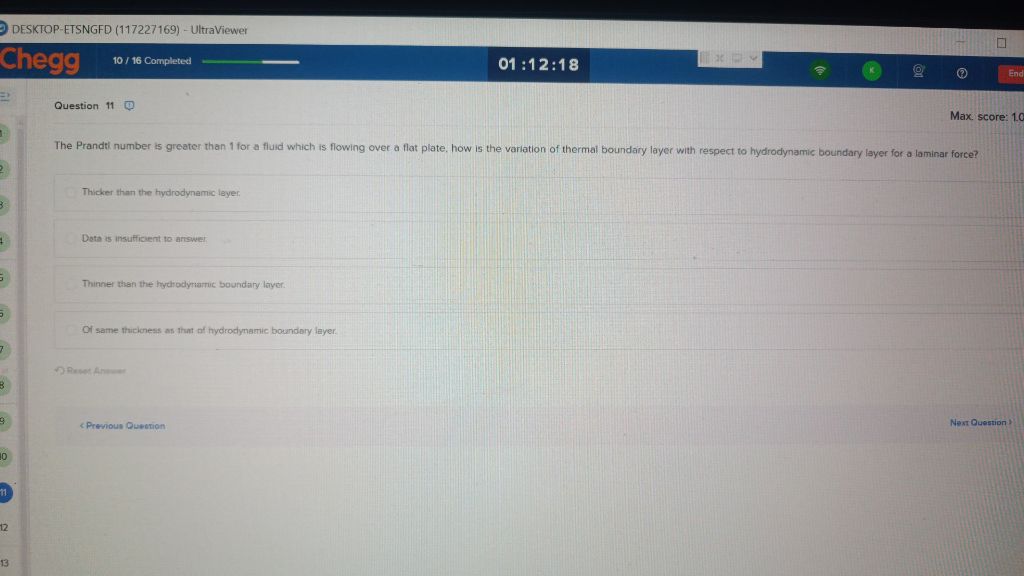 a ms Ste fl
fii
p The Pranc number s grate then or fl which fs flowing aver fla plate how i the variation of thermel boundary yer wih aspect 1 hydrodymame a i
J i hi
4 Le E
3 Data 1s insuffi = i
i E
D Fi
3 i
: pe
E ~
4 A
Ha
D ji i J
: i JRA
Bi
o HR
This is AI generated Response.
Asked by: Veera manikanta
Created at: 2025-08-06 20:27:38
Asked by: Veera manikanta
Created at: 2025-08-06 20:27:38
Final Answer:
Rendered
Raw Text
Did you like this answer?
The question asks:
**"The Prandtl number is greater than 1 for a fluid which is flowing over a flat plate, how is the variation of thermal boundary layer with respect to hydrodynamic boundary layer for a laminar force?"**
Let's break it down:
- **Prandtl number (Pr)** is the ratio of momentum diffusivity (kinematic viscosity) to thermal diffusivity.
\[
Pr = \frac{\nu}{\alpha}
\]
Where:
- \( \nu \) = kinematic viscosity
- \( \alpha \) = thermal diffusivity
- When **Pr > 1**, momentum diffusivity is greater than thermal diffusivity, meaning heat diffuses slower than momentum.
- **Thermal boundary layer**: Region where temperature gradients exist due to heat transfer.
- **Hydrodynamic boundary layer**: Region where velocity gradients exist due to viscous effects.
**For Pr > 1:**
- The thermal boundary layer is **thinner** than the hydrodynamic boundary layer.
### Correct Answer:
**Thinner than the hydrodynamic boundary layer.**
📢 Instructions:
- Ask anything relatd to above question only.
- For new Question goto :