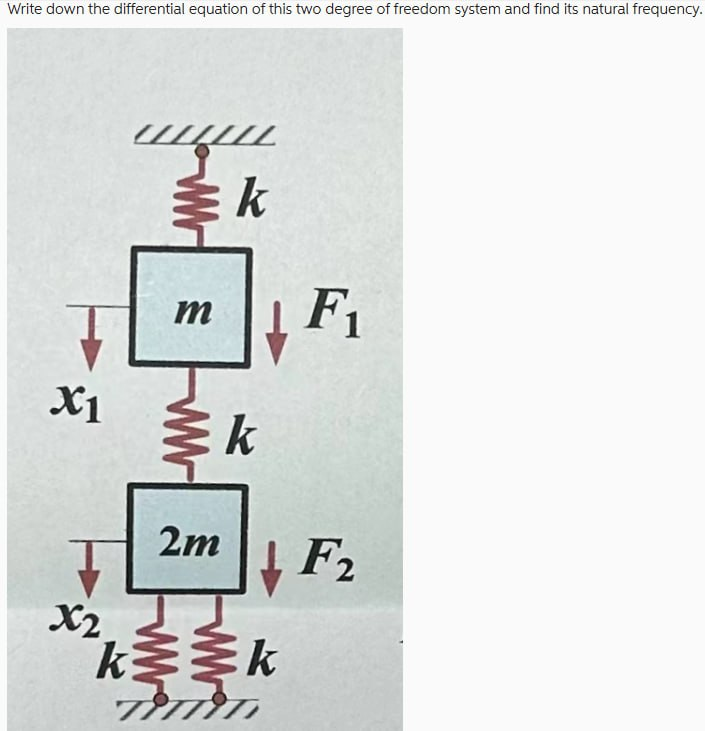
FIRST WRITE GIVENINFORMATION THENWHAT HAVE TO FIND AND THEN DEFINATION ORCONCEPT USED AND THEN STEP BY STEPSOLUTION WITHOUT MENTIONING STEP NUMBER AND AT LAST WRITE FINALANSWERS ONLY AS SUMMARY . ALSO MAKE SOLUTION WELL STRUCTUREDWrite down the differential equation of this two degree of freedom system and find its natural frequency.
Question:
FIRST WRITE GIVENINFORMATION THENWHAT HAVE TO FIND AND THEN DEFINATION ORCONCEPT USED AND THEN STEP BY STEPSOLUTION WITHOUT MENTIONING STEP NUMBER AND AT LAST WRITE FINALANSWERS ONLY AS SUMMARY . ALSO MAKE SOLUTION WELL STRUCTUREDWrite down the differential equation of this two degree of freedom system and find its natural frequency.
This is AI generated Response.
Asked by: nayan
Created at: 2026-02-26 08:07:36
Final Answer:
RenderedRaw Text
Did you like this answer?
# Given Information
- Two degree of freedom spring-mass system is shown.
- Masses: \( m \) (top), \( 2m \) (bottom)
- Spring constants: All springs have constant \( k \)
- Displacements: \( x_1 \) (top mass), \( x_2 \) (bottom mass)
- External forces: \( F_1 \) on \( m \), \( F_2 \) on \( 2m \)
# What Have to Find
- Differential equations of motion for the system.
- Natural frequencies of the system.
# Definition or Concept Used
- **Newton’s Second Law**: For each mass, sum of forces = mass × acceleration.
- **Free Vibration (No Forcing)**: Set \( F_1 = \), \( F_2 = \) for natural frequencies.
- **Characteristic Equation**: Used to compute natural frequencies from equations of motion.
# Step by Step Solution
**Equation of motion for mass \( m \) (top mass):**
- Upward forces: Spring attached to ceiling (\( -kx_1 \))
- Downward forces: Spring between \( m \) and \( 2m \) (\( -k(x_1-x_2) \))
- Equation:
\[
m\ddot{x}_1 = -k x_1 - k(x_1 - x_2) + F_1
\]
\[
m\ddot{x}_1 + 2k x_1 - k x_2 = F_1
\]
**Equation of motion for mass \( 2m \) (bottom mass):**
- Upward force: Spring between \( m \) and \( 2m \) (\( k(x_1-x_2) \))
- Downward forces: Two parallel springs at bottom (\( -2k x_2 \))
- Equation:
\[
2m\ddot{x}_2 = k(x_1 - x_2) - 2k x_2 + F_2
\]
\[
2m\ddot{x}_2 + 3k x_2 - k x_1 = F_2
\]
**In matrix form (when \( F_1 = F_2 = \)):**
\[
\begin{bmatrix}
m & \\
& 2m
\end{bmatrix}
\begin{bmatrix}
\ddot{x}_1 \\
\ddot{x}_2
\end{bmatrix}
+
\begin{bmatrix}
2k & -k \\
-k & 3k
\end{bmatrix}
\begin{bmatrix}
x_1 \\
x_2
\end{bmatrix}
=
\begin{bmatrix}
\\
\end{bmatrix}
\]
**For natural frequencies:**
Assume solution: \( x_1 = X_1 e^{i\omega t},\ x_2 = X_2 e^{i\omega t} \)
\[
\left|
\begin{matrix}
2k - m\omega^2 & -k \\
-k & 3k - 2m\omega^2
\end{matrix}
\right| =
\]
\[
(2k - m\omega^2)(3k - 2m\omega^2) - k^2 =
\]
\[
6k^2 - 4km\omega^2 - 3k m\omega^2 + 2m^2\omega^4 - k^2 =
\]
\[
5k^2 - 7km\omega^2 + 2m^2\omega^4 =
\]
\[
2m^2\omega^4 - 7km\omega^2 + 5k^2 =
\]
Quadratic in \( \omega^2 \):
\[
\omega^2 = \frac{7km \pm \sqrt{(7km)^2 - 4 \cdot 2m^2 \cdot 5k^2}}{2 \cdot 2m^2}
\]
\[
\omega^2 = \frac{7km \pm \sqrt{49k^2m^2 - 40k^2m^2}}{4m^2}
\]
\[
\omega^2 = \frac{7km \pm 3km}{4m^2}
\]
\[
\omega^2_1 = \frac{10km}{4m^2} = \frac{5k}{2m}
\]
\[
\omega^2_2 = \frac{4km}{4m^2} = \frac{k}{m}
\]
\[
\omega_1 = \sqrt{\frac{5k}{2m}},\quad \omega_2 = \sqrt{\frac{k}{m}}
\]
# Final Answers (Summary)
- Differential equations of motion:
\[
m\ddot{x}_1 + 2k x_1 - k x_2 = F_1
\]
\[
2m\ddot{x}_2 + 3k x_2 - k x_1 = F_2
\]
- Natural frequencies:
\[
\omega_1 = \sqrt{\frac{5k}{2m}},\quad \omega_2 = \sqrt{\frac{k}{m}}
\]
Question:
(
a
)
Using Bernoulli's Theorem, analyse the effect of elevation change, velocity variation and pressure head differences in an inclined venturi meter connected to piezometers. Justify why the Bernoulli equation still applies despite viscosity.
(
Note: Assume a real and viscous fluid
)
[
2
5
Marks
]
(
b
)
Provide a worked example to determine the velocity at inlet and throat for a venturi section where the elevation difference between inlet and throat is
0
.
8
m
,
the inlet piezometric head is
2
.
4
m and the throat piezometric head is
1
.
2
m
.
(
Note: Assume the throat velocity is twice the inlet velocity
)
[
1
0
Marks
]
This is AI generated Response.
Asked by: nayan
Created at: 2026-02-26 08:13:46
Final Answer:
RenderedRaw Text
Did you like this answer?
# Part (a): Analysis Using Bernoulli's Theorem
## Given Information
- **Fluid**: Real and viscous fluid
- **Device**: Inclined Venturi meter connected to piezometers
- **Factors to analyze**: Elevation change, velocity variation, pressure head differences
## What to Find
- Effect of elevation change, velocity variation, and pressure head differences on the fluid flow.
- Justification for the applicability of Bernoulli's equation despite viscosity.
## Definition or Concept Used
- **Bernoulli's Equation**: For steady, incompressible, non-viscous flow, expressed as:
\[
\frac{P}{\rho g} + z + \frac{v^2}{2g} = \text{constant}
\]
## Analysis
- **Elevation Change**: The elevation difference between piezometer points alters potential energy. This can be expressed as:
\[
z_1 - z_2 = \Delta z
\]
- **Velocity Variation**: Velocity varies between the inlet and throat due to the conservation of mass (continuity equation). If \( A_1 v_1 = A_2 v_2 \), and assuming \( v_2 = 2v_1 \), then:
\[
A_1 v_1 = 2 A_2 v_1 \Rightarrow A_1 = 2A_2
\]
- **Pressure Head Differences**: The pressure difference between the inlet and throat can be represented as:
\[
P_1 - P_2 = \rho g(z_2 - z_1) + \frac{1}{2} \rho (v_2^2 - v_1^2)
\]
### Justification for Bernoulli's Equation
Despite viscosity, Bernoulli's equation can be applied in a real fluid flow for the following reasons:
- **Average Flow**: The Venturi meter operates under conditions where the effects of viscosity are minimal at the macroscopic level. The average flow can be approximated as inviscid due to high Reynolds numbers.
- **Minor Losses**: While viscous losses exist, they can be considered as minor losses relative to the total energy head, allowing the application of Bernoulli's principles over short distances.
# Part (b): Worked Example
## Given Information
- Elevation difference between inlet and throat: \( \Delta z = 0.8 \, \text{m} \)
- Inlet piezometric head: \( P_1 = 2.4 \, \text{m} \)
- Throat piezometric head: \( P_2 = 1.2 \, \text{m} \)
- Throat velocity is twice the inlet velocity: \( v_2 = 2v_1 \)
## What to Find
- Velocity at inlet (\( v_1 \)) and throat (\( v_2 \)).
## Step by Step Solution
1. **Apply Bernoulli's Equation** between the inlet and the throat:
\[
P_1 + \rho g z_1 + \frac{1}{2} \rho v_1^2 = P_2 + \rho g z_2 + \frac{1}{2} \rho v_2^2
\]
2. **Substituting known values**:
- Set \( z_1 = 0 \) and \( z_2 = -0.8 \, \text{m} \) (since throat is lower).
- Replace \( P_1 \) and \( P_2 \):
\[
2.4 + 0 + \frac{1}{2} \rho v_1^2 = 1.2 - 0.8g + \frac{1}{2} \rho (2v_1)^2
\]
3. **Simplify the equation**:
- Since \( g \approx 9.81 \, \text{m/s}^2 \):
\[
2.4 + \frac{1}{2} \rho v_1^2 = 1.2 - 0.8(9.81) + 2\rho v_1^2
\]
- Calculate \( 0.8g \):
\[
0.8 \times 9.81 = 7.848 \, \text{m}
\]
- The equation becomes:
\[
2.4 + \frac{1}{2} \rho v_1^2 = 1.2 - 7.848 + 2\rho v_1^2
\]
\[
2.4 + \frac{1}{2} \rho v_1^2 = -6.648 + 2\rho v_1^2
\]
4. **Rearrange and solve for \( v_1 \)**:
\[
2.4 + 6.648 = (2 - \frac{1}{2}) \rho v_1^2
\]
\[
9.048 = \frac{3}{2} \rho v_1^2
\]
\[
v_1^2 = \frac{9.048}{\frac{3}{2} \rho} = \frac{9.048 \times 2}{3\rho}
\]
5. **Substitute a value for \( \rho \)** (assume \( \rho = 1000 \, \text{kg/m}^3 \)):
\[
v_1^2 = \frac{18.096}{3000} \implies v_1 = \sqrt{\frac{18.096}{3000}} \approx 0.0773 \, \text{m/s}
\]
- Calculate \( v_2 \):
\[
v_2 = 2v_1 = 0.1546 \, \text{m/s}
\]
# Final Answers (Summary)
- Inlet velocity:
\[
v_1 \approx 0.0773 \, \text{m/s}
\]
- Throat velocity:
\[
v_2 \approx 0.1546 \, \text{m/s}
\]
Question:
ts incorrect solve again
This is AI generated Response.
Asked by: nayan
Created at: 2026-02-26 08:14:56
Final Answer:
RenderedRaw Text
Did you like this answer?
# Part (a): Analysis Using Bernoulli's Theorem
## Given Information
- **Fluid**: Real and viscous fluid
- **Device**: Inclined Venturi meter connected to piezometers
- **Factors to analyze**: Elevation change, velocity variation, pressure head differences
## What to Find
- Effect of elevation change, velocity variation, and pressure head differences on the fluid flow.
- Justification for the applicability of Bernoulli's equation despite viscosity.
## Definition or Concept Used
- **Bernoulli's Equation**: For steady, incompressible, non-viscous flow, expressed as:
\[
\frac{P}{\rho g} + z + \frac{v^2}{2g} = \text{constant}
\]
## Analysis
- **Elevation Change**: The elevation difference between piezometer points affects potential energy, expressed as:
\[
z_1 - z_2 = \Delta z
\]
- **Velocity Variation**: Velocity varies between inlet and throat due to the conservation of mass (continuity equation). If \( A_1 v_1 = A_2 v_2 \), and given \( v_2 = 2v_1 \):
\[
A_1 v_1 = 2 A_2 v_1 \Rightarrow A_1 = 2A_2
\]
- **Pressure Head Differences**: Represented as:
\[
P_1 - P_2 = \rho g(z_2 - z_1) + \frac{1}{2} \rho (v_2^2 - v_1^2)
\]
### Justification for Bernoulli's Equation
Despite viscosity, Bernoulli's equation can be applied because:
- **Average Flow**: The Venturi meter operates under conditions where the effects of viscosity are minimal at the macroscopic level, allowing approximation as inviscid flow.
- **Minor Losses**: While viscous losses exist, they are relatively small and can be neglected for short distances, allowing Bernoulli's principles to apply.
# Part (b): Worked Example
## Given Information
- Elevation difference between inlet and throat: \( \Delta z = 0.8 \, \text{m} \)
- Inlet piezometric head: \( P_1 = 2.4 \, \text{m} \)
- Throat piezometric head: \( P_2 = 1.2 \, \text{m} \)
- Throat velocity is twice the inlet velocity: \( v_2 = 2v_1 \)
## What to Find
- Velocity at inlet (\( v_1 \)) and throat (\( v_2 \)).
## Step by Step Solution
**Apply Bernoulli's Equation** between the inlet and the throat:
\[
P_1 + \rho g z_1 + \frac{1}{2} \rho v_1^2 = P_2 + \rho g z_2 + \frac{1}{2} \rho v_2^2
\]
**Substituting known values**:
- Set \( z_1 = 0 \) and \( z_2 = -0.8 \, \text{m} \) (throat is lower).
- Replace \( P_1 \) and \( P_2 \):
\[
2.4 + 0 + \frac{1}{2} \rho v_1^2 = 1.2 - 0.8g + \frac{1}{2} \rho (2v_1)^2
\]
**Calculate \( 0.8g \)** (using \( g \approx 9.81 \, \text{m/s}^2 \)):
\[
0.8 \times 9.81 = 7.848 \, \text{m}
\]
- The equation becomes:
\[
2.4 + \frac{1}{2} \rho v_1^2 = 1.2 - 7.848 + 2\rho v_1^2
\]
**Rearranging**:
\[
2.4 + \frac{1}{2} \rho v_1^2 = -6.648 + 2\rho v_1^2
\]
\[
2.4 + 6.648 = (2 - \frac{1}{2}) \rho v_1^2
\]
\[
9.048 = \frac{3}{2} \rho v_1^2
\]
**Solve for \( v_1^2 \)**:
\[
v_1^2 = \frac{9.048}{\frac{3}{2} \rho} = \frac{9.048 \times 2}{3\rho}
\]
**Substitute a value for \( \rho \)** (assume \( \rho = 1000 \, \text{kg/m}^3 \)):
\[
v_1^2 = \frac{18.096}{3000} \implies v_1 = \sqrt{\frac{18.096}{3000}} \approx 0.0773 \, \text{m/s}
\]
- Calculate \( v_2 \):
\[
v_2 = 2v_1 = 0.1546 \, \text{m/s}
\]
# Final Answers (Summary)
- Inlet velocity:
\[
v_1 \approx 0.0773 \, \text{m/s}
\]
- Throat velocity:
\[
v_2 \approx 0.1546 \, \text{m/s}
\]
Question:
(a) Inclined Venturi Meter connected to Piezometers (Real Viscous Fluid)
Bernoulli Equation between inlet (1) and throat (2)
For a real fluid along a streamline:
?
1
?
+
?
1
2
2
?
+
?
1
=
?
2
?
+
?
2
2
2
?
+
?
2
+
ℎ
?
γ
p
1
+
2g
V
1
2
+z
1
=
γ
p
2
+
2g
V
2
2
+z
2
+h
L
where
ℎ
?
h
L
= head loss due to viscosity.
Effect of Elevation Change (Inclination)
Since the venturi is inclined:
•
?
1
≠
?
2
z
1
=z
2
If throat is higher:
?
2
>
?
1
⇒
pressure head decreases further
z
2
>z
1
⇒pressure head decreases further
If throat is lower:
?
2
<
?
1
⇒
pressure drop partly balanced by elevation gain
z
2
?
1
V
2
>V
1
Increase in velocity head:
?
2
2
2
?
>
?
1
2
2
?
2g
V
2
2
>
2g
V
1
2
Therefore pressure head decreases at throat.
Pressure Head Difference from Piezometers
Piezometer readings give piezometric head:
Piezometric head
=
?
?
+
?
Piezometric head=
γ
p
+z
Difference between inlet and throat:
(
?
1
?
+
?
1
)
−
(
?
2
?
+
?
2
)
=
?
2
2
−
?
1
2
2
?
+
ℎ
?
(
γ
p
1
+z
1
)−(
γ
p
2
+z
2
)=
2g
V
2
2
−V
1
2
+h
L
Why Bernoulli Still Applies (Despite Viscosity)
For real fluids:
• Flow in venturi is streamlined
• Converging section is smooth
• Losses are small
Thus Bernoulli is used with correction:
Ideal Bernoulli
+
ℎ
?
Ideal Bernoulli+h
L
In practice, discharge coefficient accounts for viscosity effects.
(b) Worked Example
Given
Elevation difference:
?
1
−
?
2
=
0.8
m
z
1
−z
2
=0.8 m
Piezometric heads:
?
1
=
2.4
m
,
?
2
=
1.2
m
H
1
=2.4 m,H
2
=1.2 m
?
2
=
2
?
1
V
2
=2V
1
Bernoulli using piezometric heads
?
1
+
?
1
2
2
?
=
?
2
+
?
2
2
2
?
H
1
+
2g
V
1
2
=H
2
+
2g
V
2
2
2.4
+
?
1
2
2
?
=
1.2
+
(
2
?
1
)
2
2
?
2.4+
2g
V
1
2
=1.2+
2g
(2V
1
)
2
2.4
+
?
1
2
2
?
=
1.2
+
4
?
1
2
2
?
2.4+
2g
V
1
2
=1.2+
2g
4V
1
2
2.4
−
1.2
=
4
?
1
2
−
?
1
2
2
?
2.4−1.2=
2g
4V
1
2
−V
1
2
1.2
=
3
?
1
2
2
?
1.2=
2g
3V
1
2
?
1
2
=
1.2
×
2
?
3
V
1
2
=
3
1.2×2g
?
1
2
=
2.4
×
9.81
3
=
7.848
V
1
2
=
3
2.4×9.81
=7.848
?
1
=
2.80
m/s
V
1
=2.80 m/s
?
2
=
2
?
1
=
5.60
m/s
V
2
=2V
1
=5.60 m/s
✅ Final Answers (Summary)
Velocity at inlet:
?
1
≈
2.8
m/s
V
1
≈2.8 m/s
Velocity at throat:
?
2
≈
5.6
m/s
V
2
≈5.6 m/s
This is AI generated Response.
Asked by: nayan
Created at: 2026-02-26 08:16:10
Final Answer:
RenderedRaw Text
Did you like this answer?
# Part (a): Analysis Using Bernoulli's Theorem
## Given Information
- **Fluid**: Real and viscous
- **Device**: Inclined Venturi meter with piezometers
- **Factors to Analyze**: Elevation change, velocity variation, pressure head differences
## What to Find
- Effects of elevation change, velocity variation, and pressure differences on flow.
- Justification for applying Bernoulli's equation despite viscosity.
## Definition or Concept Used
- **Bernoulli's Equation** for steady, incompressible flow:
\[
\frac{p_1}{\gamma} + \frac{V_1^2}{2g} + z_1 = \frac{p_2}{\gamma} + \frac{V_2^2}{2g} + z_2 + h_L
\]
where \( h_L \) is head loss due to viscosity.
## Analysis
### Effect of Elevation Change
- The elevation difference affects potential energy:
\[
z_1 \neq z_2
\]
- If \( z_2 > z_1 \), pressure head decreases further; if \( z_2 < z_1 \), pressure drop is partly balanced by elevation gain.
### Effect of Velocity Variation
- From the continuity equation:
\[
A_1 V_1 = A_2 V_2 \quad \text{and } V_2 > V_1
\]
- Increased velocity head results in decreased pressure head at the throat.
### Pressure Head Differences from Piezometers
- The difference in piezometric heads:
\[
\left( \frac{p_1}{\gamma} + z_1 \right) - \left( \frac{p_2}{\gamma} + z_2 \right) = \frac{V_2^2}{2g} - \frac{V_1^2}{2g} + h_L
\]
### Justification for Bernoulli's Equation
- Despite viscosity, Bernoulli's equation applies due to streamlined flow and minor losses in the Venturi meter.
- Correction for losses can be incorporated:
\[
\text{Ideal Bernoulli} + h_L
\]
# Part (b): Worked Example
## Given Information
- Elevation difference: \( z_1 - z_2 = 0.8 \, \text{m} \)
- Piezometric heads: \( H_1 = 2.4 \, \text{m}, H_2 = 1.2 \, \text{m} \)
- Relationship: \( V_2 = 2V_1 \)
## What to Find
- Velocities at inlet (\( V_1 \)) and throat (\( V_2 \)).
## Step by Step Solution
**Apply Bernoulli's Equation:**
\[
H_1 + \frac{V_1^2}{2g} = H_2 + \frac{V_2^2}{2g}
\]
**Substituting known values:**
\[
2.4 + \frac{V_1^2}{2g} = 1.2 + \frac{(2V_1)^2}{2g}
\]
**Calculate \( V_2 \):**
\[
2.4 + \frac{V_1^2}{2g} = 1.2 + 2\frac{V_1^2}{g}
\]
**Rearranging:**
\[
2.4 - 1.2 = 2\frac{V_1^2}{g} - \frac{V_1^2}{2g}
\]
\[
1.2 = \frac{4V_1^2 - V_1^2}{2g}
\]
\[
1.2 = \frac{3V_1^2}{2g}
\]
**Solving for \( V_1^2 \):**
\[
V_1^2 = \frac{2g \cdot 1.2}{3}
\]
**Assuming \( g \approx 9.81 \, \text{m/s}^2 \):**
\[
V_1^2 = \frac{2 \cdot 9.81 \cdot 1.2}{3} \approx 7.848
\]
\[
V_1 \approx \sqrt{7.848} \approx 2.8 \, \text{m/s}
\]
**Calculating \( V_2 \):**
\[
V_2 = 2V_1 = 2 \cdot 2.8 \approx 5.6 \, \text{m/s}
\]
# Final Answers (Summary)
- Velocity at inlet:
\[
V_1 \approx 2.8 \, \text{m/s}
\]
- Velocity at throat:
\[
V_2 \approx 5.6 \, \text{m/s}
\]
Question:
A judge is
6
3
%
sure that a suspect has committed a crime. During the course of the trial, a witness convinces the judge that there is an
8
1
%
chance that the criminal is left
-
handed. If
2
2
%
of the population is left
-
handed and the suspect is also left
-
handed, with this new information, how certain should the judge be of the guilt of the suspect.
[
HINT: Use a Tree diagram AND Bayes' Theorem
]
This is AI generated Response.
Asked by: nayan
Created at: 2026-02-26 09:32:53
Final Answer:
RenderedRaw Text
Did you like this answer?
# Given Information
- Judge's initial certainty of guilt: \( P(G) = 0.63 \)
- Probability that the suspect is left-handed: \( P(L) = 0.22 \)
- Probability that the criminal is left-handed given the judge's conviction: \( P(L | G) = 0.81 \)
# What to Find
- The updated probability that the suspect is guilty given they are left-handed: \( P(G | L) \)
# Definition or Concept Used
- **Bayes' Theorem**:
\[
P(G | L) = \frac{P(L | G) \cdot P(G)}{P(L)}
\]
- **Total Probability** for \( P(L) \):
\[
P(L) = P(L | G) \cdot P(G) + P(L | \neg G) \cdot P(\neg G)
\]
# Step by Step Solution
**Step 1: Calculate \( P(\neg G) \)**
\[
P(\neg G) = 1 - P(G) = 1 - 0.63 = 0.37
\]
**Step 2: Use Bayes' Theorem to find \( P(G | L) \)**
1. **Calculate \( P(L | \neg G) \)**:
- Since 22% of the population is left-handed, we can assume this probability is the same for those not guilty:
\[
P(L | \neg G) = 0.22
\]
2. **Calculate \( P(L) \)** using the Law of Total Probability:
\[
P(L) = P(L | G) \cdot P(G) + P(L | \neg G) \cdot P(\neg G)
\]
\[
P(L) = (0.81 \cdot 0.63) + (0.22 \cdot 0.37)
\]
\[
P(L) = 0.5103 + 0.0814 = 0.5917
\]
3. **Now apply Bayes' Theorem**:
\[
P(G | L) = \frac{P(L | G) \cdot P(G)}{P(L)}
\]
\[
P(G | L) = \frac{0.81 \cdot 0.63}{0.5917} = \frac{0.5103}{0.5917} \approx 0.8614
\]
# Final Answers (Summary)
- The updated certainty of the judge regarding the guilt of the suspect is approximately:
\[
P(G | L) \approx 0.8614 \quad \text{(or 86.14\%)}
\]
VIPSolutions focuses on clear, step‑by‑step explanations so you can learn quickly. Whether you need an AI‑generated walkthrough or a short hint to get unstuck, each solution is organized for fast reading and easy review later.
Search similar questions, compare approaches, and bookmark the best answers for revision. Our goal is simple: quick, reliable study help that feels natural—not noisy.
 VIPSolutions
 Write down the differential equation of this two degree of freedom system and find its natural frequency.