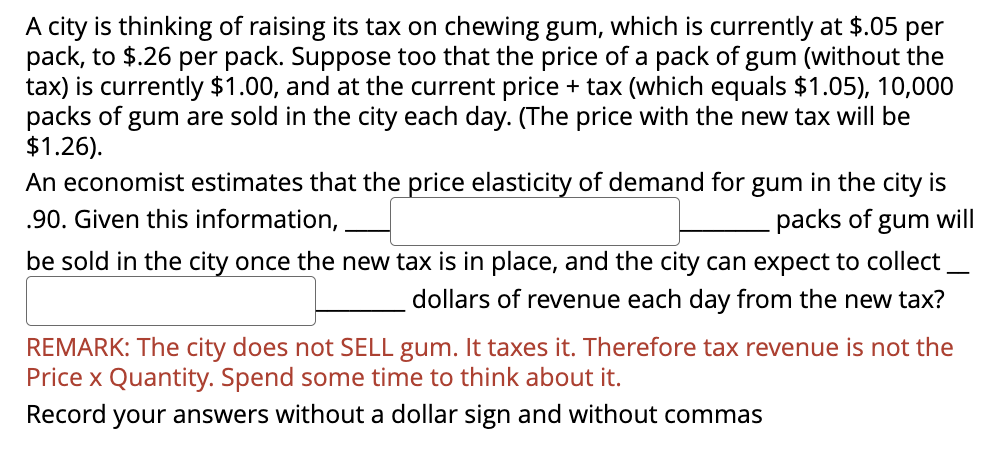
A city is thinking of raising its tax on chewing gum, which is currently at $.05 per
pack, to $.26 per pack. Suppose too that the price of a pack of gum (without the
tax) is currently $1.00, and at the current price + tax (which equals $1.05), 10,000
packs of gum are sold in the city each day. (The price with the new tax will be
$1.26).
An economist estimates that the price elasticity of demand for gum in the city is
.90. Given this information, — packs of gum will
be sold in the city once the new tax is in place, and the city can expect to collect _
| dollars of revenue each day from the new tax?
REMARK: The city does not SELL gum. It taxes it. Therefore tax revenue is not the
Price x Quantity. Spend some time to think about it.
Record your answers without a dollar sign and without commas
Question:
A city is thinking of raising its tax on chewing gum, which is currently at $.05 per
pack, to $.26 per pack. Suppose too that the price of a pack of gum (without the
tax) is currently $1.00, and at the current price + tax (which equals $1.05), 10,000
packs of gum are sold in the city each day. (The price with the new tax will be
$1.26).
An economist estimates that the price elasticity of demand for gum in the city is
.90. Given this information, — packs of gum will
be sold in the city once the new tax is in place, and the city can expect to collect _
| dollars of revenue each day from the new tax?
REMARK: The city does not SELL gum. It taxes it. Therefore tax revenue is not the
Price x Quantity. Spend some time to think about it.
Record your answers without a dollar sign and without commas
This is AI generated Response.
Asked by: Veera manikanta
Created at: 2025-07-31 08:08:18
Final Answer:
RenderedRaw Text
Did you like this answer?
Let's break down the problem step by step:
### 1. **Price and Quantity Change**
- **Current price + tax:** \$1.05 (includes \$0.05 tax)
- **Quantity sold:** 10,000 packs/day
- **New price + tax:** \$1.26 (includes \$0.26 tax)
### 2. **Elasticity Formula**
Price elasticity of demand (\(E\)) is:
\[
E = \frac{\%\ \text{change in quantity}}{\%\ \text{change in price}}
\]
Given \(E = -0.90\) (negative because demand curve slopes down).
### 3. **Calculate % Change in Price**
\[
\%\ \text{change in price} = \frac{1.26 - 1.05}{1.05} = \frac{0.21}{1.05} = 0.2 = 20\%
\]
### 4. **Calculate % Change in Quantity**
\[
\%\ \text{change in quantity} = E \times \%\ \text{change in price}
\]
\[
\%\ \text{change in quantity} = -0.90 \times 0.20 = -0.18 = -18\%
\]
### 5. **Calculate New Quantity Sold**
\[
\text{New quantity} = 10,000 \times (1 - 0.18) = 10,000 \times 0.82 = 8,200
\]
### 6. **Calculate New Tax Revenue**
- Tax per pack = \$0.26
- Packs sold per day ≈ 8,200
\[
\text{Tax revenue} = 0.26 \times 8,200 = 2,132
\]
### **Final Answers**
- **Packs sold:** **8,200**
- **Tax revenue:** **2,132**
---
**Filled Blanks:**
> 8,200 packs of gum will be sold in the city once the new tax is in place, and the city can expect to collect 2,132 dollars of revenue each day from the new tax.
VIPSolutions focuses on clear, step‑by‑step explanations so you can learn quickly. Whether you need an AI‑generated walkthrough or a short hint to get unstuck, each solution is organized for fast reading and easy review later.
Search similar questions, compare approaches, and bookmark the best answers for revision. Our goal is simple: quick, reliable study help that feels natural—not noisy.
 VIPSolutions
 A city is thinking of raising its tax on chewing gum, which is currently at $.05 per
pack, to $.26 per pack. Suppose too that the price of a pack of gum (without the
tax) is currently $1.00, and at the current price + tax (which equals $1.05), 10,000
packs of gum are sold in the city each day. (The price with the new tax will be
$1.26).
An economist estimates that the price elasticity of demand for gum in the city is
.90. Given this information, — packs of gum will
be sold in the city once the new tax is in place, and the city can expect to collect _
| dollars of revenue each day from the new tax?
REMARK: The city does not SELL gum. It taxes it. Therefore tax revenue is not the
Price x Quantity. Spend some time to think about it.
Record your answers without a dollar sign and without commas