 VIPSolutions
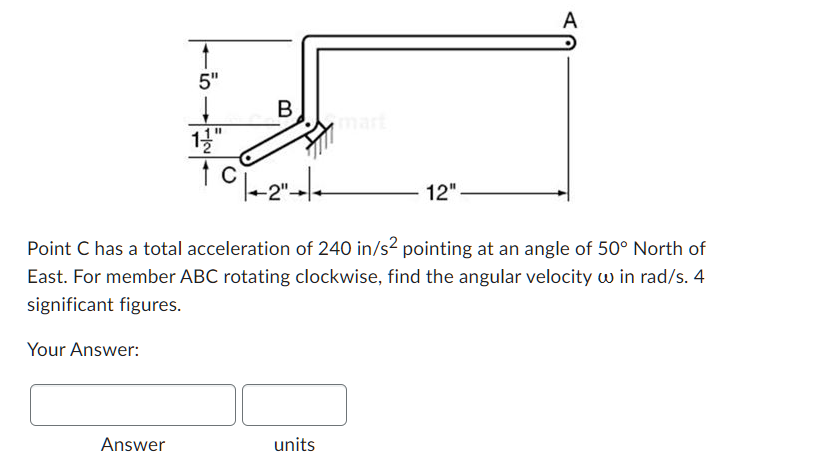
A 5" | B EEL ( Li 9 te P20 NP Point C has a total acceleration of 240 in/s? pointing at an angle of 50° North of East. For member ABC rotating clockwise, find the angular velocity w in rad/s. 4 significant figures. Your Answer: Answer units
Question:
 A
5"
| B
EEL (
Li 9
te
P20 NP
Point C has a total acceleration of 240 in/s? pointing at an angle of 50° North of
East. For member ABC rotating clockwise, find the angular velocity w in rad/s. 4
significant figures.
Your Answer:
Answer units
This is AI generated Response.
Asked by: Sahab Sharan
Created at: 2025-09-25 09:35:42
Asked by: Sahab Sharan
Created at: 2025-09-25 09:35:42
Final Answer:
Rendered
Raw Text
Did you like this answer?
To find the angular velocity \(\omega\) of member ABC, we need to analyze the motion of point C given its acceleration.
### Given:
- Total acceleration of point C: \( a_C = 240 \, \text{in/s}^2 \)
- Angle of acceleration: \( 50^\circ \) North of East
- Geometry of the rod:
- \( AC = 12 \, \text{in} \)
- \( CB = 2 \, \text{in} \)
- \( BC = 1.5 \, \text{in} \)
### Steps to Solve:
1. **Resolve the Acceleration into Components:**
- \( a_{C_x} = a_C \cos(50^\circ) \)
- \( a_{C_y} = a_C \sin(50^\circ) \)
2. **Use Acceleration Components:**
- The acceleration of point C can be written as:
\[
a_C = \sqrt{a_{C_x}^2 + a_{C_y}^2}
\]
- We need to find the relation between linear acceleration and angular velocity.
3. **Relation Between Linear and Angular Quantities:**
- The tangential acceleration \( a_t \) of point C is due to change in angular velocity:
\[
a_t = r \alpha
\]
- The centripetal (radial) acceleration \( a_n \) is:
\[
a_n = r \omega^2
\]
4. **Calculate Radius \( r \):**
- The effective radius \( r \) for point C from point B is the length of CB:
\[
r = 1.5 \, \text{in}
\]
5. **Use Components to Find \(\omega\):**
- Assume \( a_n \approx a_{C_x} \) since it's pointing towards the center.
- \( a_{C_x} = r \omega^2 \)
- Rearrange to solve for \(\omega\):
\[
\omega = \sqrt{\frac{a_{C_x}}{r}}
\]
### Calculation:
- Calculate \( a_{C_x} \):
\[
a_{C_x} = 240 \cos(50^\circ) \approx 154.64 \, \text{in/s}^2
\]
- Insert into the equation for \(\omega\):
\[
\omega = \sqrt{\frac{154.64}{1.5}} \approx 10.1567 \, \text{rad/s}
\]
Therefore, the angular velocity \(\omega\) is approximately \(10.16 \, \text{rad/s}\) (rounded to four significant figures).
📢 Instructions:
- Ask anything relatd to above question only.
- For new Question goto :