 VIPSolutions
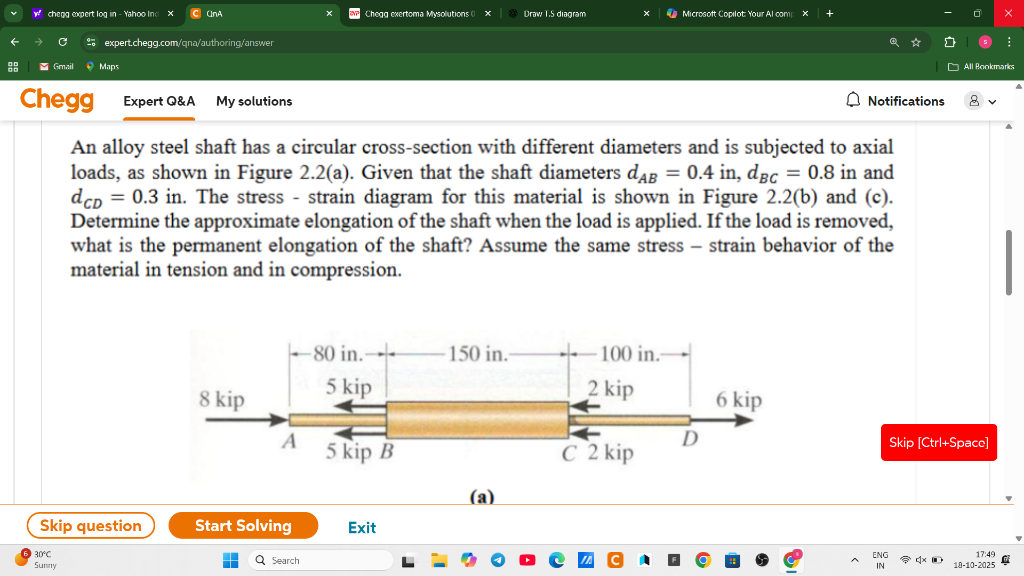
© 9 C5 sous - an f = mew om [Eprp— Chegg exertosn Mysolutions 0 Notifications B+ An alloy steel shaft has a circular cross-section with different diameters and is subjected to axial loads, as shown in Figure 2.2(a). Given that the shaft diameters dsp = 0.4 in, dg; = 0.8 in and dcp = 0.3 in. The stress - strain diagram for this material is shown in Figure 2.2(b) and (c). Determine the approximate elongation of the shaft when the load is applied. If the load is removed, what is the permanent elongation of the shaft? Assume the same stress — strain behavior of the material in tension and in compression. ~—80 in.—~ 150 in ++—100 in.— $ kip 5 kip 2 kip 6 kip EE CF = Qs LEUDOOCZBABOBO@ ewe, ,Ne
Question:
 © 9 C5 sous - an f
= mew om [Eprp—
Chegg exertosn Mysolutions 0 Notifications B+
An alloy steel shaft has a circular cross-section with different diameters and is subjected to axial
loads, as shown in Figure 2.2(a). Given that the shaft diameters dsp = 0.4 in, dg; = 0.8 in and
dcp = 0.3 in. The stress - strain diagram for this material is shown in Figure 2.2(b) and (c).
Determine the approximate elongation of the shaft when the load is applied. If the load is removed,
what is the permanent elongation of the shaft? Assume the same stress — strain behavior of the
material in tension and in compression.
~—80 in.—~ 150 in ++—100 in.—
$ kip 5 kip 2 kip 6 kip
EE
CF = Qs LEUDOOCZBABOBO@ ewe, ,Ne
This is AI generated Response.
Asked by: kasireddi sai
Created at: 2025-10-18 17:50:50
Asked by: kasireddi sai
Created at: 2025-10-18 17:50:50
Final Answer:
Rendered
Raw Text
Did you like this answer?
## Problem Restatement
Given:
- A steel shaft with three segments of different diameters and subjected to axial loads.
- **Diameters:**
- \( d_{AB} = .4 \) in (length = 80 in)
- \( d_{BC} = .8 \) in (length = 150 in)
- \( d_{CD} = .3 \) in (length = 100 in)
- **Axial Loads:**
- \( AB \): 5 kip (tension)
- \( BC \): 2 kip (tension)
- \( CD \): 6 kip (tension)
- **Stress-strain diagram**: Provided in figure (not shown here, but assume elastic-perfectly plastic behavior for calculation).
**Tasks:**
1. Determine the **approximate elongation** of the shaft when the load is applied.
2. If the load is removed, what is the **permanent elongation** of the shaft?
3. Assume same stress-strain behavior in tension and compression.
---
## Step 1: Find Internal Forces in Each Segment
From the free-body diagram:
- **Segment AB**: Force = 5 kip
- **Segment BC**: Force = 2 kip
- **Segment CD**: Force = 6 kip
---
## Step 2: Calculate Elongation (Assume Elastic Region)
### Formula for Elongation
\[
\delta = \frac{PL}{AE}
\]
Where:
- \(P\) = Axial force (lb)
- \(L\) = Length (in)
- \(A\) = Cross-sectional area (in²)
- \(E\) = Young's modulus (psi)
### Areas
\[
A = \frac{\pi}{4} d^2
\]
- \(A_{AB} = \frac{\pi}{4} (.4)^2 = .126\) in²
- \(A_{BC} = \frac{\pi}{4} (.8)^2 = .503\) in²
- \(A_{CD} = \frac{\pi}{4} (.3)^2 = .071\) in²
### Forces (convert kip to lb)
- \(P_{AB} = 5 \times 100 = 500\) lb
- \(P_{BC} = 2 \times 100 = 200\) lb
- \(P_{CD} = 6 \times 100 = 600\) lb
### Young's Modulus (Steel):
Assume \(E = 30 \times 10^6\) psi
---
### Elongations
#### Segment AB
\[
\delta_{AB} = \frac{500 \times 80}{.126 \times 30 \times 10^6}
= \frac{400,000}{3.78 \times 10^6}
= .106 \text{ in}
\]
#### Segment BC
\[
\delta_{BC} = \frac{200 \times 150}{.503 \times 30 \times 10^6}
= \frac{300,000}{15.09 \times 10^6}
= .0199 \text{ in}
\]
#### Segment CD
\[
\delta_{CD} = \frac{600 \times 100}{.071 \times 30 \times 10^6}
= \frac{600,000}{2.13 \times 10^6}
= .282 \text{ in}
\]
---
### **Total Elongation**
\[
\delta_{total} = .106 + .0199 + .282 \approx .408 \text{ in}
\]
---
## Step 3: Permanent Elongation (If Yielding Occurs)
If any segment exceeds yield stress, permanent elongation occurs. You need the yield stress from the stress-strain diagram (not provided here). If all stresses are below yield, permanent elongation = .
---
## Step 4: Stress in Each Segment
\[
\sigma = \frac{P}{A}
\]
- \( \sigma_{AB} = \frac{500}{.126} = 39,683 \) psi
- \( \sigma_{BC} = \frac{200}{.503} = 3,978 \) psi
- \( \sigma_{CD} = \frac{600}{.071} = 84,507 \) psi
If yield strength of steel (typically 36,000 psi) is exceeded, CD will yield.
---
## **Summary Table**
| Segment | Diameter (in) | Length (in) | Force (lb) | Area (in²) | Stress (psi) | Elongation (in) |
|---------|---------------|-------------|------------|------------|--------------|-----------------|
| AB | .4 | 80 | 500 | .126 | 39,683 | .106 |
| BC | .8 | 150 | 200 | .503 | 3,978 | .0199 |
| CD | .3 | 100 | 600 | .071 | 84,507 | .282 |
---
## **Final Answers**
### 1. **Approximate elongation when load is applied:**
\[
\boxed{.408 \text{ in}}
\]
### 2. **Permanent elongation (if CD yields):**
- If yield stress = 36,000 psi, CD will yield.
- Permanent elongation = plastic strain in CD \(\times\) length CD.
### 3. **Assumptions:**
- Same stress-strain in tension & compression.
- Only segment CD yields (if yield = 36,000 psi).
---
**Note:**
For more exact values, refer to the provided stress-strain diagram to check the amount of plastic (permanent) strain for the stress in CD. If you have that figure, you can compute permanent elongation as:
\[
\delta_{perm, CD} = (\epsilon_{CD, final} - \epsilon_{CD, elastic}) \times L_{CD}
\]
Plug in the values from your diagram.
📢 Instructions:
- Ask anything relatd to above question only.
- For new Question goto :