 VIPSolutions
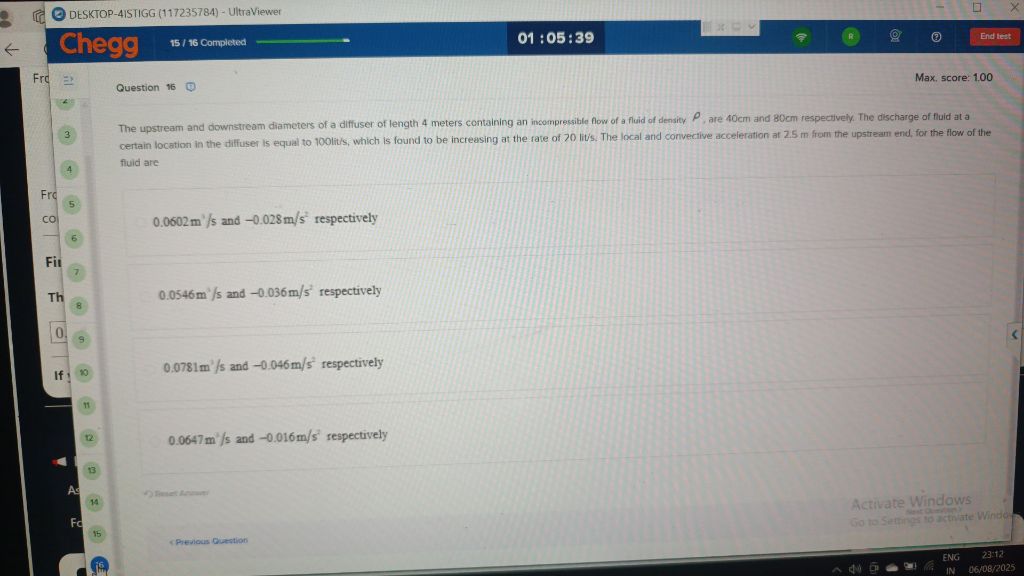
8 @ © oiscroPasTIGo (11723578 Utnaview = LB < Jp— - 01:05:39 * [2 FE owen Max scort00 fe | The ups: 4 meters containing an incomprsibe Ped 40cm respecively. The discharge of fuid ata = © Sees . found tbe Incas at he ate of 20 10s. oto st 25m hom ie spss enm enc oe Row ELI 4 Fre B 5 0602m' fs and —0.028m/s respectivel, H& Fit > TH 46m fs and 0.036m/s’ respective] 0 (UES 4 ‘I "ee 7810's and 0 046s’ respective © 0.0647m’fs 208 ~0016m/s’ sespectvel 1 ® is ® ate Windows 8 Hac ® roses £
Question:
 8 @ © oiscroPasTIGo (11723578 Utnaview = LB
< Jp— - 01:05:39 * [2
FE owen Max scort00
fe
| The ups: 4 meters containing an incomprsibe Ped 40cm respecively. The discharge of fuid ata =
© Sees . found tbe Incas at he ate of 20 10s. oto st 25m hom ie spss enm enc oe Row ELI
4
Fre
B
5 0602m' fs and —0.028m/s respectivel,
H&
Fit >
TH 46m fs and 0.036m/s’ respective]
0
(UES
4 ‘I
"ee 7810's and 0 046s’ respective
© 0.0647m’fs 208 ~0016m/s’ sespectvel 1
® is
® ate Windows 8
Hac
® roses £
This is AI generated Response.
Asked by: Veera manikanta
Created at: 2025-08-06 23:13:36
Asked by: Veera manikanta
Created at: 2025-08-06 23:13:36
Final Answer:
Rendered
Raw Text
Did you like this answer?
Let's break down the question and analyze the given options:
### Given Data:
- **Length of diffuser, L = 4 m**
- **Upstream diameter, D₁ = 40 cm = 0.4 m**
- **Downstream diameter, D₂ = 80 cm = 0.8 m**
- **Discharge at a certain location, Q = 100 L/s = 0.1 m³/s**
- **Discharge rate of increase, dQ/dt = 20 L/s = 0.02 m³/s²**
- **Location from upstream, x = 2.5 m**
### To Find:
- **Local acceleration**
- **Convective acceleration** at 2.5 m from the upstream end.
---
### Step 1: **Calculate Area at x = 2.5 m**
The diameter at 2.5 m can be found by linear interpolation:
\[
\text{Diameter at } x = D_1 + \frac{(D_2 - D_1)}{L} \cdot x
\]
\[
D(x) = 0.4 + \frac{0.8 - 0.4}{4} \times 2.5 = 0.4 + 0.25 = 0.65 \text{ m}
\]
\[
A(x) = \frac{\pi}{4} \times (0.65)^2 = 0.3318 \text{ m}^2
\]
---
### Step 2: **Velocity at x = 2.5 m**
\[
V(x) = \frac{Q}{A(x)} = \frac{0.1}{0.3318} = 0.301 \text{ m/s}
\]
---
### Step 3: **Local Acceleration**
\[
a_\text{local} = \frac{1}{A(x)} \frac{dQ}{dt}
\]
\[
a_\text{local} = \frac{1}{0.3318} \times 0.02 = 0.0602 \text{ m/s}^2
\]
---
### Step 4: **Convective Acceleration**
Convective acceleration, \( a_c = V \frac{dV}{dx} \)
First, express \( V(x) = \frac{Q}{A(x)} \). Since Q is changing with time, for convective acceleration, we only consider the spatial derivative (Q is instantaneously constant).
\[
A(x) = \frac{\pi}{4}[D_1 + \frac{(D_2 - D_1)}{L}x]^2
\]
Let \( D(x) = D_1 + \frac{(D_2 - D_1)}{L}x \)
\[
A(x) = \frac{\pi}{4} D(x)^2
\]
\[
V(x) = \frac{Q}{A(x)} = \frac{4Q}{\pi D(x)^2}
\]
Now,
\[
\frac{dV}{dx} = \frac{d}{dx} \left( \frac{4Q}{\pi D(x)^2} \right) = -\frac{8Q}{\pi D(x)^3} \frac{dD(x)}{dx}
\]
But
\[
\frac{dD(x)}{dx} = \frac{D_2 - D_1}{L} = \frac{0.8 - 0.4}{4} = 0.1
\]
So,
\[
\frac{dV}{dx} = -\frac{8Q}{\pi [0.65]^3} \cdot 0.1
\]
\[
[0.65]^3 = 0.274625
\]
\[
\frac{dV}{dx} = -\frac{8 \times 0.1}{\pi \times 0.274625} \cdot 0.1
\]
\[
= -\frac{0.8}{0.8626} \cdot 0.1
\]
\[
= -0.9276 \cdot 0.1 = -0.09276
\]
So,
\[
a_c = V(x) \cdot \frac{dV}{dx} = 0.301 \times (-0.09276) = -0.0279 \text{ m/s}^2
\]
---
### Step 5: **Match with Options**
- **Option 1:** 0.0602 m/s² and -0.028 m/s² respectively
This matches very closely with our calculations.
---
## **Final Answer:**
**0.0602 m/s² and -0.028 m/s² respectively**
**So, the correct option is the first one.**
📢 Instructions:
- Ask anything relatd to above question only.
- For new Question goto :