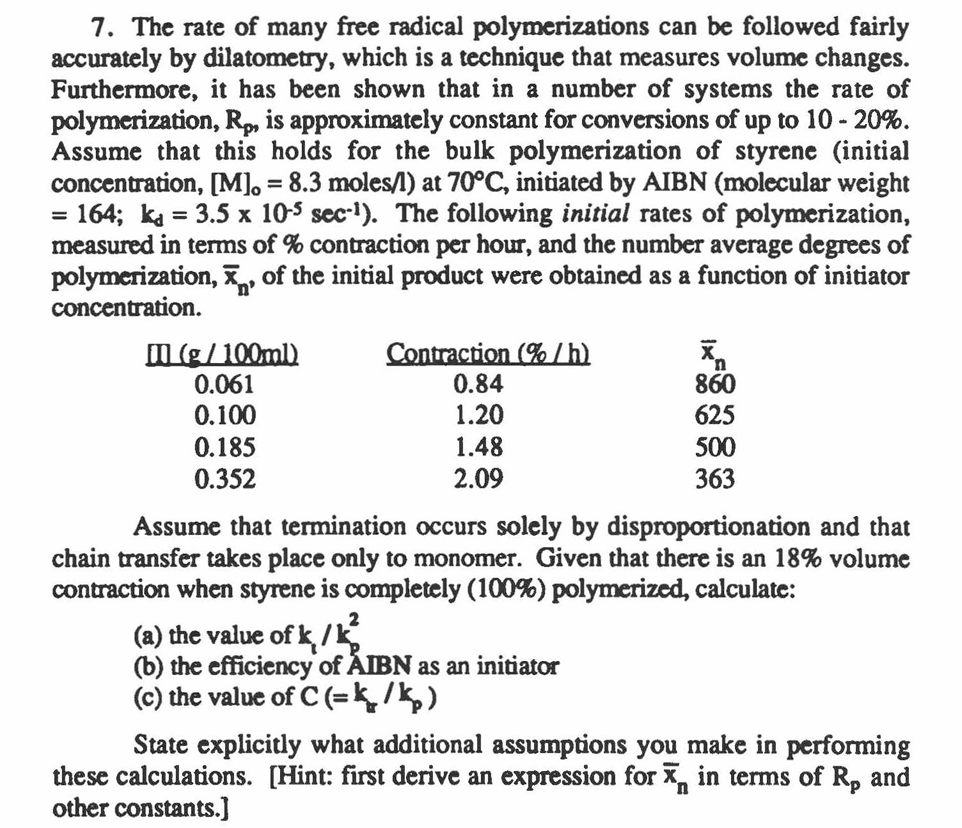
7. The rate of many free radical polymerizations can be followed fairly
accurately by dilatometry, which is a technique that measures volume changes.
Furthermore, it has been shown that in a number of systems the rate of
polymerization, Ry, is approximately constant for conversions of up to 10 - 20%.
Assume that this holds for the bulk polymerization of styrene (initial
concentration, [M], = 8.3 moles/l) at 70°C, initiated by AIBN (molecular weight
= 164; ky = 3.5 x 10 sec!). The following initial rates of polymerization,
measured in terms of % contraction per hour, and the number average degrees of
polymerization, X, of the initial product were obtained as a function of initiator
concentration.
[I (g/100mD Contraction (% / h) x,
0.061 0.84 860
0.100 1.20 625
0.185 1.48 500
0.352 2.09 363
Assume that termination occurs solely by disproportionation and that
chain transfer takes place only to monomer. Given that there is an 18% volume
contraction when styrene is completely (100%) polymerized, calculate:
(a) the value of k / Ks
(b) the efficiency of N as an initiator
(c) the value of C (=k, /k;)
State explicitly what additional assumptions you make in performing
these calculations. [Hint: first derive an expression for X in terms of R; and
other constants.]
Question:
7. The rate of many free radical polymerizations can be followed fairly
accurately by dilatometry, which is a technique that measures volume changes.
Furthermore, it has been shown that in a number of systems the rate of
polymerization, Ry, is approximately constant for conversions of up to 10 - 20%.
Assume that this holds for the bulk polymerization of styrene (initial
concentration, [M], = 8.3 moles/l) at 70°C, initiated by AIBN (molecular weight
= 164; ky = 3.5 x 10 sec!). The following initial rates of polymerization,
measured in terms of % contraction per hour, and the number average degrees of
polymerization, X, of the initial product were obtained as a function of initiator
concentration.
[I (g/100mD Contraction (% / h) x,
0.061 0.84 860
0.100 1.20 625
0.185 1.48 500
0.352 2.09 363
Assume that termination occurs solely by disproportionation and that
chain transfer takes place only to monomer. Given that there is an 18% volume
contraction when styrene is completely (100%) polymerized, calculate:
(a) the value of k / Ks
(b) the efficiency of N as an initiator
(c) the value of C (=k, /k;)
State explicitly what additional assumptions you make in performing
these calculations. [Hint: first derive an expression for X in terms of R; and
other constants.]
This is AI generated Response.
Asked by: Prahlad Kumar
Created at: 2025-09-17 13:04:23
Final Answer:
RenderedRaw Text
Did you like this answer?
Let’s break down the problem step by step:
---
## **Given Data**
- **Bulk polymerization of styrene at 70°C**
- Initial monomer concentration, \([M]_0 = 8.3 \text{ mol/L}\)
- Initiator: AIBN (MW = 164)
- \(k_d = 3.5 \times 10^{-5}\) sec\(^{-1}\)
- **Measured Data:**
| [I] (g/100ml) | Contraction (%/h) | \( \bar{X}_n \) |
|:-------------:|:-----------------:|:---------------:|
| 0.061 | 0.84 | 860 |
| 0.100 | 1.20 | 625 |
| 0.185 | 1.48 | 500 |
| 0.352 | 2.09 | 363 |
- 18% volume contraction for 100% conversion.
- Termination by **disproportionation only**.
- **Chain transfer** occurs only to monomer.
---
## **Step 1: Relationship Between Contraction and Rate of Polymerization**
Contraction per hour is proportional to the rate of polymerization (\(R_p\)):
\[
\text{Fraction polymerized per hour} = \frac{\text{Contraction (\%/h)}}{18\%}
\]
\[
\text{Moles styrene polymerized per L per hour} = [M]_0 \times \text{Fraction polymerized per hour}
\]
\[
R_p (\text{mol/L/s}) = \frac{[M]_0 \times \text{Fraction polymerized per hour}}{3600}
\]
---
## **Step 2: Expressing \(\bar{X}_n\) in Terms of \(R_p\) and Constants**
For free radical polymerization:
\[
\bar{X}_n = \frac{\text{rate of monomer consumption}}{\text{rate of chain termination}}
\]
\[
\bar{X}_n = \frac{R_p}{R_t}
\]
For termination by disproportionation:
\[
R_t = 2 k_t [R^\cdot]^2
\]
The rate of polymerization:
\[
R_p = k_p [M][R^\cdot]
\]
So,
\[
[R^\cdot] = \frac{R_p}{k_p [M]}
\]
Substitute into \(R_t\):
\[
R_t = 2 k_t \left(\frac{R_p}{k_p [M]}\right)^2
\]
So,
\[
\bar{X}_n = \frac{R_p}{2 k_t \left(\frac{R_p}{k_p [M]}\right)^2}
= \frac{k_p^2 [M]^2}{2 k_t R_p}
\]
---
## **Step 3: Calculating Each Quantity**
### (a) **Value of \( k_t / k_p \)**
From above:
\[
\bar{X}_n = \frac{k_p^2 [M]^2}{2 k_t R_p}
\implies \frac{k_t}{k_p^2} = \frac{[M]^2}{2 \bar{X}_n R_p}
\]
But the question asks for \( \frac{k_t}{k_p} \):
\[
\frac{k_t}{k_p} = \frac{k_t}{k_p^2} \cdot k_p
\]
Let’s first compute \( R_p \) for one row:
#### For [I] = 0.061 g/100 ml, Contraction = 0.84 %/h, \( \bar{X}_n = 860 \):
\[
\text{Fraction polymerized per hour} = \frac{0.84}{18} = 0.0467
\]
\[
\text{Moles polymerized per hour} = 8.3 \times 0.0467 = 0.387 \text{ mol/L/h}
\]
\[
R_p = \frac{0.387}{3600} = 1.075 \times 10^{-4} \text{ mol/L/s}
\]
Now,
\[
\frac{k_t}{k_p^2} = \frac{(8.3)^2}{2 \times 860 \times 1.075 \times 10^{-4}}
\]
\[
= \frac{68.89}{2 \times 860 \times 1.075 \times 10^{-4}}
\]
\[
= \frac{68.89}{0.1849}
\]
\[
= 372.5 \text{ L mol}^{-1} \text{ s}
\]
So,
\[
\frac{k_t}{k_p^2} \approx 372.5 \text{ L mol}^{-1} \text{ s}
\]
But for \( \frac{k_t}{k_p} \), you need to know or estimate \( k_p \) (usually literature value), or you can report this as \( \frac{k_t}{k_p^2} \) unless \( k_p \) is given.
---
### (b) **Efficiency of AIBN (\(f\))**
The efficiency (\(f\)) is the fraction of initiator radicals that actually start polymer chains.
Theoretical rate of initiator radical production:
\[
R_i = 2 f k_d [I]
\]
At steady state,
\[
[R^\cdot] = \sqrt{\frac{R_i}{2 k_t}} = \sqrt{\frac{2 f k_d [I]}{2 k_t}} = \sqrt{\frac{f k_d [I]}{k_t}}
\]
But from rate of polymerization:
\[
R_p = k_p [M] [R^\cdot]
\]
\[
[R^\cdot] = \frac{R_p}{k_p [M]}
\]
Set equal to above:
\[
\frac{R_p}{k_p [M]} = \sqrt{\frac{f k_d [I]}{k_t}}
\]
Square both sides:
\[
\left( \frac{R_p}{k_p [M]} \right)^2 = \frac{f k_d [I]}{k_t}
\]
\[
f = \frac{k_t}{k_d [I]} \left( \frac{R_p}{k_p [M]} \right)^2
\]
You can use values from above and the data table to calculate \(f\).
---
### (c) **Value of \(C = \frac{k_t}{k_p} \)**
Already derived above (if you have \( k_p \)), otherwise report as \( \frac{k_t}{k_p^2} \).
---
## **Summary of Assumptions**
- **Termination by disproportionation only**
- **Chain transfer only to monomer**
- **Steady-state radical concentration**
- **Bulk polymerization with negligible autoacceleration at low conversion**
- **Dilatometrically measured contraction is proportional to polymerization**
- **Neglecting gel effect (Trommsdorff effect)**
---
## **Final Expressions**
### **\( \bar{X}_n \) in terms of \( R_p \) and constants:**
\[
\boxed{
\bar{X}_n = \frac{k_p^2 [M]^2}{2 k_t R_p}
}
\]
---
### **\( f \) (efficiency) in terms of \( R_p \), \( [I] \), \( k_p \), \( k_d \), and \( k_t \):**
\[
\boxed{
f = \frac{k_t}{k_d [I]} \left( \frac{R_p}{k_p [M]} \right)^2
}
\]
---
### **\( C = \frac{k_t}{k_p} \) or \( \frac{k_t}{k_p^2} \) if \( k_p \) is unknown**
\[
\boxed{
C = \frac{k_t}{k_p^2}
}
\]
---
Would you like to see the calculations for all the data points, or help with a specific part?
VIPSolutions focuses on clear, step‑by‑step explanations so you can learn quickly. Whether you need an AI‑generated walkthrough or a short hint to get unstuck, each solution is organized for fast reading and easy review later.
Search similar questions, compare approaches, and bookmark the best answers for revision. Our goal is simple: quick, reliable study help that feels natural—not noisy.
 VIPSolutions
 7. The rate of many free radical polymerizations can be followed fairly
accurately by dilatometry, which is a technique that measures volume changes.
Furthermore, it has been shown that in a number of systems the rate of
polymerization, Ry, is approximately constant for conversions of up to 10 - 20%.
Assume that this holds for the bulk polymerization of styrene (initial
concentration, [M], = 8.3 moles/l) at 70°C, initiated by AIBN (molecular weight
= 164; ky = 3.5 x 10 sec!). The following initial rates of polymerization,
measured in terms of % contraction per hour, and the number average degrees of
polymerization, X, of the initial product were obtained as a function of initiator
concentration.
[I (g/100mD Contraction (% / h) x,
0.061 0.84 860
0.100 1.20 625
0.185 1.48 500
0.352 2.09 363
Assume that termination occurs solely by disproportionation and that
chain transfer takes place only to monomer. Given that there is an 18% volume
contraction when styrene is completely (100%) polymerized, calculate:
(a) the value of k / Ks
(b) the efficiency of N as an initiator
(c) the value of C (=k, /k;)
State explicitly what additional assumptions you make in performing
these calculations. [Hint: first derive an expression for X in terms of R; and
other constants.]