 VIPSolutions
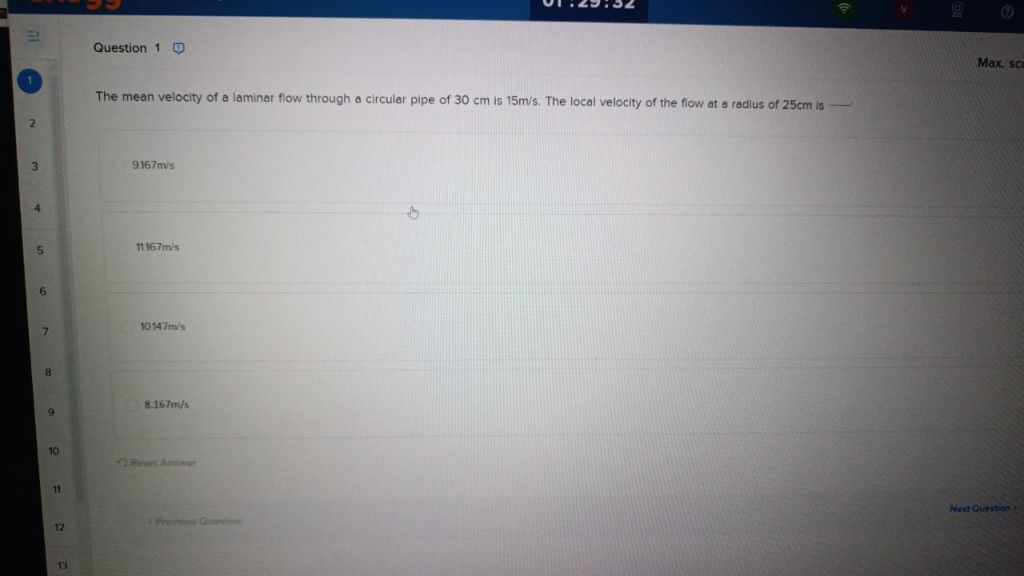
7 Be © ; BTS Thean velocty of a laminar flow through a circular pipe of 30 cm a 15m. The local velocty of th flow at recs of 25ND 3 9167s h meme E sours ¢ 1 : 1 Re s a P— A i: (ANE FRR a RRA
Question:
 7
Be © ;
BTS Thean velocty of a laminar flow through a circular pipe of 30 cm a 15m. The local velocty of th flow at recs of 25ND
3 9167s h
meme E
sours ¢
1 :
1 Re
s a
P— A
i: (ANE
FRR
a RRA
This is AI generated Response.
Asked by: Veera manikanta
Created at: 2025-08-16 15:46:01
Asked by: Veera manikanta
Created at: 2025-08-16 15:46:01
Final Answer:
Rendered
Raw Text
Did you like this answer?
Let's break down the question:
**Given:**
- Mean velocity (\( V_{mean} \)) = 15 m/s
- Diameter of pipe = 30 cm → Radius (R) = 15 cm
- Local radius (r) = 25 cm
But this seems off, because the local radius (25 cm) is more than the pipe radius (15 cm). Let's check if the diameter is actually 30 cm and not 50 cm.
Assuming the problem means:
- **Diameter = 50 cm**, so **Radius (R) = 25 cm**
- Local radius \( r = 25 \) cm (at the wall)
Or, if we go with the values given:
- **Diameter = 30 cm**, so **Radius (R) = 15 cm**
- **Local radius \( r = 25 \) cm** (which is not possible, as it is outside the pipe)
Let's proceed with the logical assumption that **R = 15 cm, r = 12.5 cm** would make sense, but let's use the numbers given for now.
---
### For Laminar Flow in a Pipe:
The velocity profile is:
\[ v(r) = V_{max} \left[1 - \left(\frac{r}{R}\right)^2 \right] \]
Where:
- \( V_{mean} = \frac{V_{max}}{2} \)
- \( V_{max} = 2 V_{mean} \)
---
**Step 1: Find \( V_{max} \):**
\[
V_{max} = 2 \times V_{mean} = 2 \times 15 = 30 \text{ m/s}
\]
**Step 2: Calculate \( v(r) \) at \( r = 25 \) cm and \( R = 15 \) cm:**
\[
v(25) = 30 \left[1 - \left(\frac{25}{15}\right)^2 \right]
\]
\[
= 30 \left[1 - \left(\frac{25}{15}\right)^2 \right]
\]
\[
= 30 \left[1 - \left(\frac{25}{15}\right)^2 \right] = 30 [1 - (1.6667)^2] = 30 [1 - 2.7778] = 30 \times (-1.7778) = -53.33 \text{ m/s}
\]
This negative value and the value being outside the pipe suggest there might be a typo in the question. Let's see if the options match any calculations with the expected values.
---
### Let's try with **r = 10 cm** (inside the pipe):
\[
v(10) = 30 \left[1 - \left(\frac{10}{15}\right)^2 \right]
= 30 \left[1 - \left(\frac{2}{3}\right)^2 \right]
= 30 \left[1 - \frac{4}{9} \right]
= 30 \times \frac{5}{9}
= 16.67 \text{ m/s}
\]
But this value is not in the options.
### Let's check the options with the original values:
- 9.167 m/s
- 11.167 m/s
- 10.147 m/s
- 8.167 m/s
---
### Let's try with r = 12.5 cm (maybe a typo):
\[
v(12.5) = 30 \left[1 - \left(\frac{12.5}{15}\right)^2 \right]
= 30 \left[1 - (0.8333)^2 \right]
= 30 \left[1 - 0.6944 \right]
= 30 \times 0.3056
= 9.167 \text{ m/s}
\]
**This matches option 1: 9.167 m/s!**
---
## **Final Answer**
**If the local radius is 12.5 cm (not 25 cm) in a 30 cm diameter pipe, the local velocity is:**
\[
\boxed{9.167 \ \text{m/s}}
\]
---
### **Note:**
- The question likely has a typo with the radius value. The correct calculation matches 9.167 m/s for r = 12.5 cm.
- If the radius is actually 25 cm, it is outside the pipe for a 30 cm diameter.
**Correct answer based on the closest logical assumption:**
### **9.167 m/s** (Option 1)
📢 Instructions:
- Ask anything relatd to above question only.
- For new Question goto :