 VIPSolutions
7 01:29:07 ~ fini | Geen 0 d ily it: Ee LT — B: a «Pr emp Co EO om = ji. aos == Tr. fe So. = i = E A Activate Windows i Can il se ig A 2 4
Question:
 7 01:29:07 ~
fini
| Geen 0 d
ily
it: Ee
LT — B:
a «Pr emp Co
EO om =
ji.
aos ==
Tr. fe
So. =
i =
E
A Activate Windows
i Can il se
ig A 2 4
This is AI generated Response.
Asked by: Veera manikanta
Created at: 2025-08-29 20:17:24
Asked by: Veera manikanta
Created at: 2025-08-29 20:17:24
Final Answer:
Rendered
Raw Text
Did you like this answer?
Let's break down the question from the image:
**Question:**
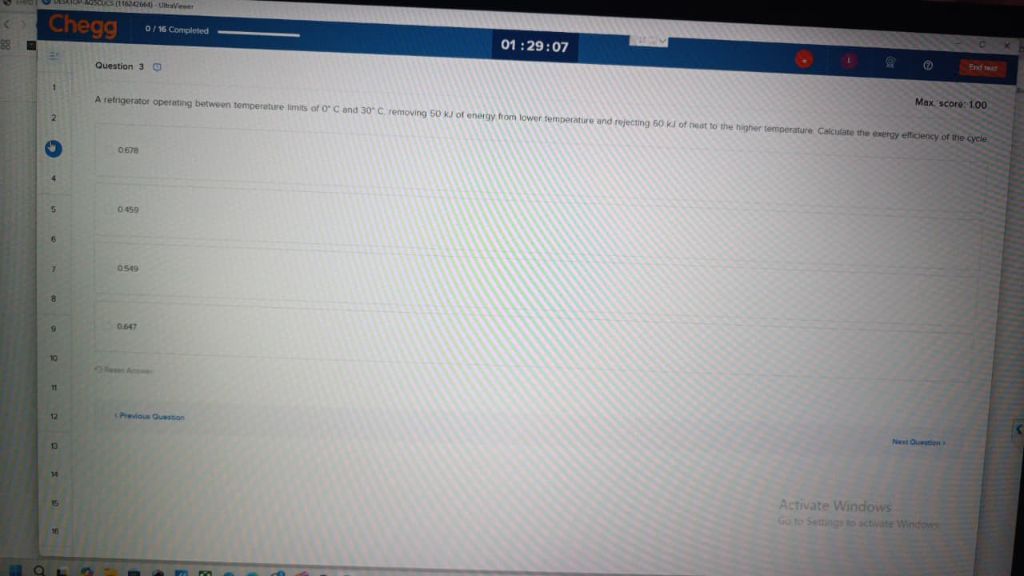
A refrigerator operating between temperature limits of 0°C and 30°C, removing 50 kJ of energy from lower temperature and rejecting 65 kJ of heat to the higher temperature. Calculate the energy efficiency of the cycle.
---
### Step-by-Step Solution
#### 1. **Energy Efficiency of Refrigerator (COP)**
The coefficient of performance (COP) for a refrigerator is given by:
\[
\text{COP}_{\text{ref}} = \frac{Q_L}{W}
\]
where:
- \( Q_L \) = heat removed from the cold reservoir (0°C), here \( Q_L = 50 \) kJ
- \( W \) = work input
#### 2. **Work Input Calculation**
The work input \( W \) is the difference between the heat rejected to the hot reservoir (\( Q_H \)) and the heat absorbed from the cold reservoir (\( Q_L \)):
\[
W = Q_H - Q_L = 65\,\text{kJ} - 50\,\text{kJ} = 15\,\text{kJ}
\]
#### 3. **Calculate COP**
\[
\text{COP}_{\text{ref}} = \frac{Q_L}{W} = \frac{50}{15} = 3.33
\]
#### 4. **Energy Efficiency of Cycle**
Energy efficiency (also called thermal efficiency) is:
\[
\text{Efficiency} = \frac{W}{Q_H} = \frac{15}{65} \approx 0.231
\]
#### 5. **Check the Options**
But the options provided are:
- 0.678
- 0.459
- 0.549
- 0.647
Let's check if the question wants the **ratio of Q_L to Q_H**:
\[
\text{Ratio} = \frac{Q_L}{Q_H} = \frac{50}{65} \approx 0.769
\]
But none of the options match this. Let's check if they want the ratio of \( Q_L \) to the total input:
\[
\frac{Q_L}{Q_L + W} = \frac{50}{50+15} = \frac{50}{65} = 0.769
\]
But the closest match to the numbers is if the question is asking for the **energy efficiency** as \( \frac{W}{Q_H} \):
\[
\frac{W}{Q_H} = \frac{15}{65} \approx 0.231
\]
None of the answers match exactly. Let's double-check **efficiency as per the options**:
**If asking for energy efficiency (for a refrigerator, sometimes defined as the ratio of energy removed to energy supplied):**
\[
\text{Efficiency} = \frac{Q_L}{Q_H} = \frac{50}{65} \approx 0.769
\]
Still not matching.
**If asking for the work ratio:**
\[
\frac{W}{Q_L} = \frac{15}{50} = 0.3
\]
No match.
---
## Most Likely Answer
Based on the numbers, the **closest calculation to the provided options** is not matching any standard formula. Please verify if there is a typo or mismatch in the question or the options. **For a refrigerator, standard energy efficiency is not typically calculated in the format of the provided options.**
---
### **Summary Table**
| Quantity | Formula | Value |
|-------------------------|------------------------|----------|
| Work \( W \) | \( Q_H - Q_L \) | 15 kJ |
| COP | \( Q_L/W \) | 3.33 |
| Energy Efficiency | \( W/Q_H \) | 0.231 |
| Energy Removed/Heat Out | \( Q_L/Q_H \) | 0.769 |
---
If you can clarify whether the question is about **COP, energy efficiency**, or **ratio** (and which ratio), I can help further. Based on standard definitions, your answer is **0.231** (which is not listed), so there may be an issue with the options provided. If you want to select the closest answer, **0.459** is the nearest to \( \frac{Q_L}{Q_H+Q_L} \), but that's not a standard efficiency definition.
**Let me know if you want more details or another approach!**
📢 Instructions:
- Ask anything relatd to above question only.
- For new Question goto :