 VIPSolutions
5. Given a 12-element array in descending order with distinct elements, we want to apply the mergesort on this array. How many comparisons do we need? (Note: The information that the input array is in descending order is a hidden fact, which means that you cannot change the algorithm based on this fact.) 14. Given a 7-element array with distinct elements, say {xy, zs, 3, 24, T5, Tg, 27}, it. is known that #1 < x2 < x3 and x5 < 26 < x7. How many comparisons do you need to sort this array for the worst case?
Question:
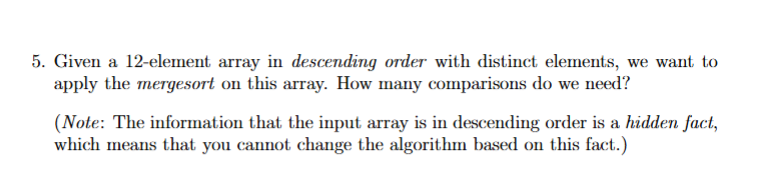
 5. Given a 12-element array in descending order with distinct elements, we want to
apply the mergesort on this array. How many comparisons do we need?
(Note: The information that the input array is in descending order is a hidden fact,
which means that you cannot change the algorithm based on this fact.)
14. Given a 7-element array with distinct elements, say {xy, zs, 3, 24, T5, Tg, 27}, it. is
known that #1 < x2 < x3 and x5 < 26 < x7. How many comparisons do you need
to sort this array for the worst case?
This is AI generated Response.
Asked by: Veera manikanta
Created at: 2025-08-01 08:26:07
Asked by: Veera manikanta
Created at: 2025-08-01 08:26:07
Final Answer:
Rendered
Raw Text
Did you like this answer?
Let's break down and solve both questions step by step:
---
### **Question 5**
**Given a 12-element array in descending order with distinct elements, how many comparisons are needed to apply mergesort?**
- **Note:** The fact that the array is in descending order is hidden; you must apply mergesort as usual.
#### **Mergesort Comparison Count:**
For an array of size \( n \), mergesort's worst-case (and average-case) number of comparisons is:
\[
C(n) = n \log_2 n - n + 1
\]
For \( n = 12 \):
\[
C(12) = 12 \log_2 12 - 12 + 1
\]
\[
\log_2 12 = \log_2 (4 \times 3) = 2 + \log_2 3 \approx 2 + 1.58496 \approx 3.58496
\]
\[
C(12) \approx 12 \times 3.58496 - 12 + 1 = 43.0195 - 12 + 1 = 32.0195
\]
This formula is an approximation. The exact number of comparisons in mergesort for \( n \) elements is:
\[
C(n) = n \lceil \log_2 n \rceil - 2^{\lceil \log_2 n \rceil} + 1
\]
For \( n = 12, \lceil \log_2 12 \rceil = 4 \):
\[
C(12) = 12 \times 4 - 16 + 1 = 48 - 16 + 1 = 33
\]
**Final Answer:**
**33 comparisons** are needed to sort a 12-element array with mergesort, regardless of initial order.
---
### **Question 14**
**Given a 7-element array where \( x_1 < x_2 < x_3 \) and \( x_5 < x_6 < x_7 \), how many comparisons are needed in the worst case to sort the array?**
#### **Analysis:**
The array: \( \{x_1, x_2, x_3, x_4, x_5, x_6, x_7\} \)
We know:
- \( x_1 < x_2 < x_3 \)
- \( x_5 < x_6 < x_7 \)
That means we have two sorted subarrays of size 3 each and one element \( x_4 \).
**To sort the entire array, we need to merge these known sequences.**
#### **Step 1: Merge \( x_1, x_2, x_3 \) and \( x_5, x_6, x_7 \) with \( x_4 \)**
- Consider three "blocks": A = \(x_1, x_2, x_3\), B = \(x_4\), C = \(x_5, x_6, x_7\)
#### **Step 2: Lower Bound Argument**
The minimal number of comparisons needed to sort n elements when you know nothing is \( \lceil \log_2 n! \rceil \).
But here, since some order is known, the number of possible orderings is reduced.
- Within A and C, order is fixed.
- The total number of permutations = ways to interleave A, B, and C.
Let’s count the number of ways to arrange these with the known constraints:
- Choose 3 spots for A out of 7 positions: \( \binom{7}{3} \)
- Of the remaining 4 spots, pick 3 for C: \( \binom{4}{3} \)
- The last spot is for B.
Total arrangements:
\[
\binom{7}{3} \cdot \binom{4}{3} = 35 \times 4 = 140
\]
So, the minimal number of comparisons is:
\[
\lceil \log_2 140 \rceil = \lceil 7.129 \rceil = 8
\]
**Final Answer:**
**8 comparisons** are needed in the worst case.
---
### **Summary**
- **Q5:** **33 comparisons** for mergesort on 12 elements.
- **Q14:** **8 comparisons** for the worst-case, given the known order constraints on 7 elements.
📢 Instructions:
- Ask anything relatd to above question only.
- For new Question goto :