 VIPSolutions
» 5 a Gomes F. Se § w 2 E 1.59 Write the vectors A, i E > and C in Cartesian coordi {¢ i) 4 nates : 1.60 Calculate the length es and direction of the vecta Lo A, B,and ( 5! 1.61 Add the three vectors A Pai | B, and C graphical 7 1.62 Determine the diffe ence vector E=1 A graph cally Addit | the three vectors A ol 1.63 Add the 0 pl 21 2° 2d C using the OFF : be, wat? ector D gH < a Save Share —
Question:
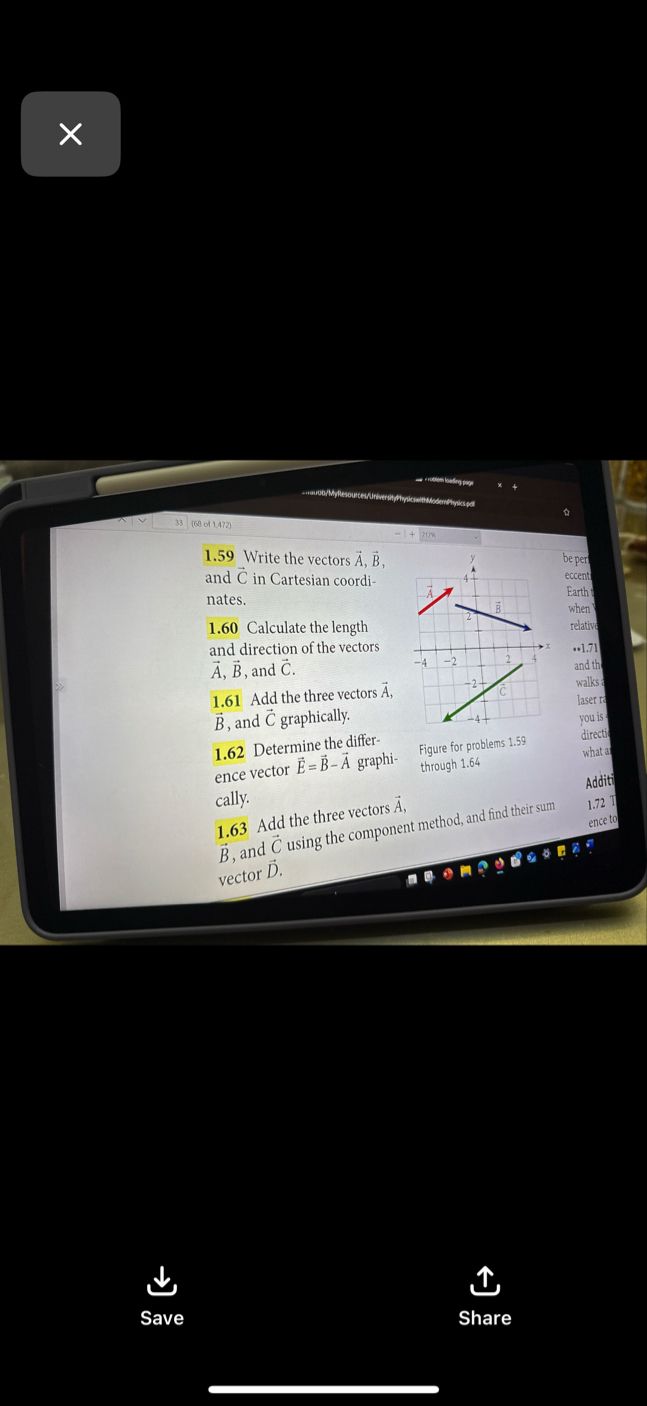 » 5 a Gomes F.
Se §
w 2 E
1.59 Write the vectors A, i E >
and C in Cartesian coordi {¢ i) 4
nates :
1.60 Calculate the length es
and direction of the vecta Lo
A, B,and ( 5!
1.61 Add the three vectors A Pai
| B, and C graphical 7
1.62 Determine the diffe
ence vector E=1 A graph
cally Addit
| the three vectors A ol
1.63 Add the 0 pl 21
2° 2d C using the OFF :
be, wat?
ector D gH
< a
Save Share
—
This is AI generated Response.
Asked by: Sahab Sharan
Created at: 2025-09-17 19:46:32
Asked by: Sahab Sharan
Created at: 2025-09-17 19:46:32
Final Answer:
Rendered
Raw Text
Did you like this answer?
Let's analyze and solve the **first problem (1.59)** step by step using the image you provided.
## Step 1: **Write the vectors \(\vec{A}\), \(\vec{B}\), and \(\vec{C}\) in Cartesian coordinates**
Let's the vectors from the graph in the image:
- The **red vector \(\vec{A}\)** starts at the origin (0,0) and ends at (-2, 2).
- The **blue vector \(\vec{B}\)** starts at the origin (0,0) and ends at (3, 1).
- The **green vector \(\vec{C}\)** starts at the origin (0,0) and ends at (2, -3).
### **Cartesian Coordinates**
- \(\vec{A} = \langle -2, 2 \rangle\)
- \(\vec{B} = \langle 3, 1 \rangle\)
- \(\vec{C} = \langle 2, -3 \rangle\)
---
## Step 2: **Calculate the length and direction of the vectors \(\vec{A}\), \(\vec{B}\), and \(\vec{C}\) (for 1.60)**
Let's use the formula for the magnitude:
\[
|\vec{V}| = \sqrt{V_x^2 + V_y^2}
\]
### **Magnitude**
- \(|\vec{A}| = \sqrt{(-2)^2 + (2)^2} = \sqrt{4 + 4} = \sqrt{8} = 2\sqrt{2}\)
- \(|\vec{B}| = \sqrt{(3)^2 + (1)^2} = \sqrt{9 + 1} = \sqrt{10}\)
- \(|\vec{C}| = \sqrt{(2)^2 + (-3)^2} = \sqrt{4 + 9} = \sqrt{13}\)
### **Direction (angle \(\theta\) from the x-axis, counterclockwise)**
\[
\theta = \tan^{-1}\left(\frac{V_y}{V_x}\right)
\]
- \(\theta_A = \tan^{-1}\left(\frac{2}{-2}\right) = \tan^{-1}(-1) = 135^\circ\) (since it's in the second quadrant)
- \(\theta_B = \tan^{-1}\left(\frac{1}{3}\right) \approx 18.4^\circ\)
- \(\theta_C = \tan^{-1}\left(\frac{-3}{2}\right) \approx -56.3^\circ\) (or 303.7° if you prefer a positive angle)
---
## **Summary Table**
| Vector | Cartesian Form | Magnitude | Direction (from x-axis) |
|--------|----------------------|-----------------|------------------------|
| \(\vec{A}\) | \(\langle -2, 2 \rangle\) | \(2\sqrt{2}\) | \(135^\circ\) |
| \(\vec{B}\) | \(\langle 3, 1 \rangle\) | \(\sqrt{10}\) | \(18.4^\circ\) |
| \(\vec{C}\) | \(\langle 2, -3 \rangle\) | \(\sqrt{13}\) | \(-56.3^\circ\) |
---
Let me know if you want to proceed with the next steps (1.61, 1.62, and 1.63)!
📢 Instructions:
- Ask anything relatd to above question only.
- For new Question goto :