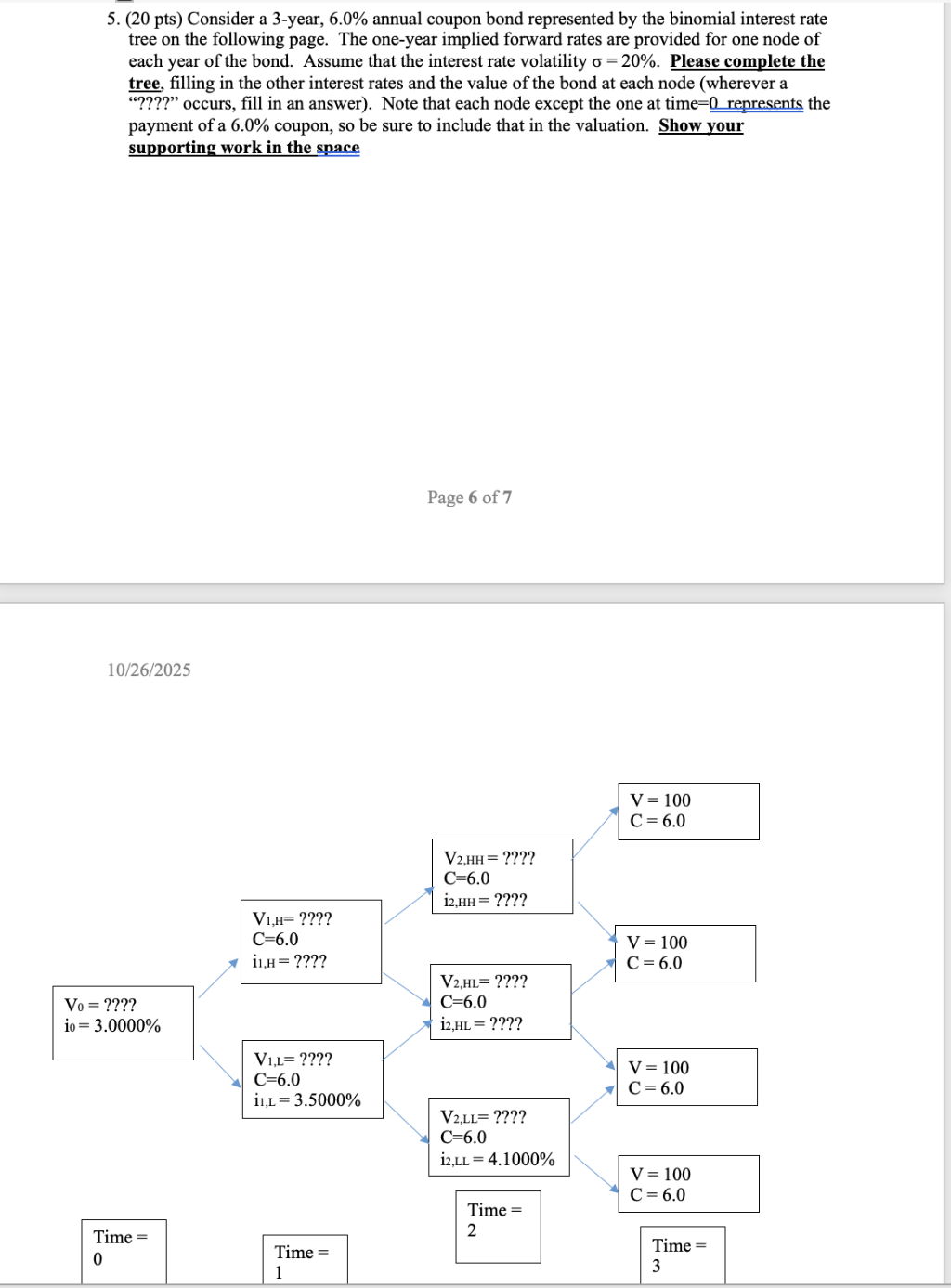
5. (20 pts) Consider a 3-year, 6.0% annual coupon bond represented by the binomial interest rate
tree on the following page. The one-year implied forward rates are provided for one node of
each year of the bond. Assume that the interest rate volatility c =20%. Please complete the
tree, filling in the other interest rates and the value of the bond at each node (wherever a
“2277” occurs, fill in an answer). Note that each node except the one at time=(_represents the
payment of a 6.0% coupon, so be sure to include that in the valuation. Show your
supporting work in the space
Page 6 of 7
10/26/2025
V=100
/ C=6.0
Var |
C=6.0
A ioam=2222
Vis 2722 AN
C=6.0 V=100
| u=1777? 7 C=6.0
/ | Vam=1277? pd
Vo=2722 . 4 C=6.0
i0=3.0000% A i2pL= 277? N
S| vie=2222 . “v=100
4 c=80 4 C=60
i1L=3.5000% / .
S| Vau= 7? /
4 C=6.0
i2LL=4.1000% |
~_| V=100
N C=6.0
Time =
me = 2
Time = Timo= Time =
0 1 3
Question:
5. (20 pts) Consider a 3-year, 6.0% annual coupon bond represented by the binomial interest rate
tree on the following page. The one-year implied forward rates are provided for one node of
each year of the bond. Assume that the interest rate volatility c =20%. Please complete the
tree, filling in the other interest rates and the value of the bond at each node (wherever a
“2277” occurs, fill in an answer). Note that each node except the one at time=(_represents the
payment of a 6.0% coupon, so be sure to include that in the valuation. Show your
supporting work in the space
Page 6 of 7
10/26/2025
V=100
/ C=6.0
Var |
C=6.0
A ioam=2222
Vis 2722 AN
C=6.0 V=100
| u=1777? 7 C=6.0
/ | Vam=1277? pd
Vo=2722 . 4 C=6.0
i0=3.0000% A i2pL= 277? N
S| vie=2222 . “v=100
4 c=80 4 C=60
i1L=3.5000% / .
S| Vau= 7? /
4 C=6.0
i2LL=4.1000% |
~_| V=100
N C=6.0
Time =
me = 2
Time = Timo= Time =
0 1 3
This is AI generated Response.
Asked by: REDDY BHARGAVA SURYA TEJA
Created at: 2025-11-13 21:59:04
Final Answer:
RenderedRaw Text
Did you like this answer?
Let's break down the problem and fill out the tree step by step.
---
## **Given Information**
- **3-year annual coupon bond**
- **Coupon rate:** 6.% (so annual coupon = \$6.00)
- **Face value:** \$100
- **Initial one-year forward rate \(i_{}\):** 3.00%
-One-year forward rate at (1, L):** \(i_{1, L} = 3.50\%\)
- **One-year forward rate at (2, LL):** \(i_{2, LL} = 4.10\%\)
- **Volatility (\(\sigma\)) = 20% (.20)**
- **Tree is binomial.**
---
## **Step 1: Fill in Missing Interest Rates**
### **Year 1**
- **At node H (up move):**
- Use the formula for binomial tree forward rates:
\[
i_{1,H} = i_ \cdot e^{\sigma}
\]
\[
i_{1,L} = i_ \cdot e^{-\sigma}
\]
Plug in values:
\[
i_{1,H} = 3.00\% \cdot e^{.2} \approx 3.00\% \cdot 1.2214 \approx 3.6642\%
\]
\[
i_{1,L} = 3.00\% \cdot e^{-.2} \approx 3.00\% \cdot .8187 \approx 2.4561\%
\]
But the tree says \(i_{1,L} = 3.50\%\), so let's use the provided value for L and keep the calculated value for H.
---
### **Year 2**
- **At node (2, HH):**
\[
i_{2,HH} = i_{1,H} \cdot e^{\sigma}
\]
\[
i_{2,HL} = i_{1,H} \cdot e^{-\sigma}
\]
\[
i_{2,LL} = 4.10\% \text{ (given)}
\]
First, calculate \(i_{1,H}\) as above: \(3.6642\%\).
- **Calculate:**
\[
i_{2,HH} = 3.6642\% \cdot e^{.2} \approx 3.6642\% \cdot 1.2214 \approx 4.478\%
\]
\[
i_{2,HL} = 3.6642\% \cdot e^{-.2} \approx 3.6642\% \cdot .8187 \approx 3.002\%
\]
- **At node (2, LL):** Given as \(4.10\%\).
---
## **Step 2: Bond Valuation at Each Node**
At maturity (Time 3), the value is always the face value plus last coupon:
\[
V = 100 + 6 = 106
\]
### **Time 2**
- At each node, the value is:
\[
V_2 = \frac{V_{3,up} + V_{3,down}}{2} \cdot \frac{1}{1+i_2} + 6
\]
But since the tree is recombining, at each node at time 2 there is only one possible next value.
At each node:
\[
V_2 = \frac{106}{1+i_2}
\]
- \(V_{2,HH} = \frac{106}{1+.04478} = \frac{106}{1.04478} \approx 101.48\)
- \(V_{2,HL} = \frac{106}{1+.03002} = \frac{106}{1.03002} \approx 102.91\)
- \(V_{2,LL} = \frac{106}{1+.041} = \frac{106}{1.041} \approx 101.92\)
---
### **Time 1**
- At each node:
\[
V_1 = \frac{V_{2,up} + V_{2,down}}{2} \cdot \frac{1}{1 + i_1} + 6
\]
#### **Node H:**
\[
V_{1,H} = \frac{101.48 + 102.91}{2} \cdot \frac{1}{1+.036642} + 6
\]
\[
= \frac{204.39}{2} \cdot \frac{1}{1.036642} + 6
\]
\[
= 102.195 \cdot .9646 + 6 \approx 98.55 + 6 = 104.55
\]
#### **Node L:**
\[
V_{1,L} = \frac{102.91 + 101.92}{2} \cdot \frac{1}{1+.035} + 6
\]
\[
= 102.415 \cdot \frac{1}{1.035} + 6 = 102.415 \cdot .9662 + 6 \approx 98.93 + 6 = 104.93
\]
---
### **Time **
\[
V_ = \frac{V_{1,H} + V_{1,L}}{2} \cdot \frac{1}{1+i_}
\]
\[
= \frac{104.55 + 104.93}{2} \cdot \frac{1}{1.03}
\]
\[
= 104.74 \cdot .9709 = 101.67
\]
---
## **Step 3: Fill in the Tree**
### **Interest Rates:**
- \(i_ = 3.00\%\)
- \(i_{1,H} \approx 3.66\%\)
- \(i_{1,L} = 3.50\%\) (given, use this for the tree)
- \(i_{2,HH} \approx 4.48\%\)
- \(i_{2,HL} \approx 3.00\%\)
- \(i_{2,LL} = 4.10\%\) (given)
### **Bond Values:**
- \(V_ \approx 101.67\)
- \(V_{1,H} \approx 104.55\)
- \(V_{1,L} \approx 104.93\)
- \(V_{2,HH} \approx 101.48\)
- \(V_{2,HL} \approx 102.91\)
- \(V_{2,LL} \approx 101.92\)
- \(V_3 = 106\) at each terminal node
---
## **Final Tree (Filled):**
```plaintext
V = 101.67
i = 3.000%
|
---------------------
| |
V1,H = 104.55 V1,L = 104.93
i1,H = 3.66% i1,L = 3.50%
| |
----------- -----------
| | | |
V2,HH=101.48 V2,HL=102.91 V2,LL=101.92
i2,HH=4.48% i2,HL=3.00% i2,LL=4.10%
| | |
V=106 V=106 V=106
```
---
### **Summary Table**
| Node | Rate (%) | Value |
|--------|----------|---------|
| | 3.00 | 101.67 |
| 1H | 3.66 | 104.55 |
| 1L | 3.50 | 104.93 |
| 2HH | 4.48 | 101.48 |
| 2HL | 3.00 | 102.91 |
| 2LL | 4.10 | 101.92 |
| 3 | - | 106.00 |
---
### **Supporting Work**
All calculations shown above. If you need to show detailed work for each node, you can use the formulas above and plug in the numbers step by step.
---
**If you need the tree in a more compact graphical form or with equations for each node, just let me know!**
VIPSolutions focuses on clear, step‑by‑step explanations so you can learn quickly. Whether you need an AI‑generated walkthrough or a short hint to get unstuck, each solution is organized for fast reading and easy review later.
Search similar questions, compare approaches, and bookmark the best answers for revision. Our goal is simple: quick, reliable study help that feels natural—not noisy.
 VIPSolutions
 5. (20 pts) Consider a 3-year, 6.0% annual coupon bond represented by the binomial interest rate
tree on the following page. The one-year implied forward rates are provided for one node of
each year of the bond. Assume that the interest rate volatility c =20%. Please complete the
tree, filling in the other interest rates and the value of the bond at each node (wherever a
“2277” occurs, fill in an answer). Note that each node except the one at time=(_represents the
payment of a 6.0% coupon, so be sure to include that in the valuation. Show your
supporting work in the space
Page 6 of 7
10/26/2025
V=100
/ C=6.0
Var |
C=6.0
A ioam=2222
Vis 2722 AN
C=6.0 V=100
| u=1777? 7 C=6.0
/ | Vam=1277? pd
Vo=2722 . 4 C=6.0
i0=3.0000% A i2pL= 277? N
S| vie=2222 . “v=100
4 c=80 4 C=60
i1L=3.5000% / .
S| Vau= 7? /
4 C=6.0
i2LL=4.1000% |
~_| V=100
N C=6.0
Time =
me = 2
Time = Timo= Time =
0 1 3