4. Permanent Deformation
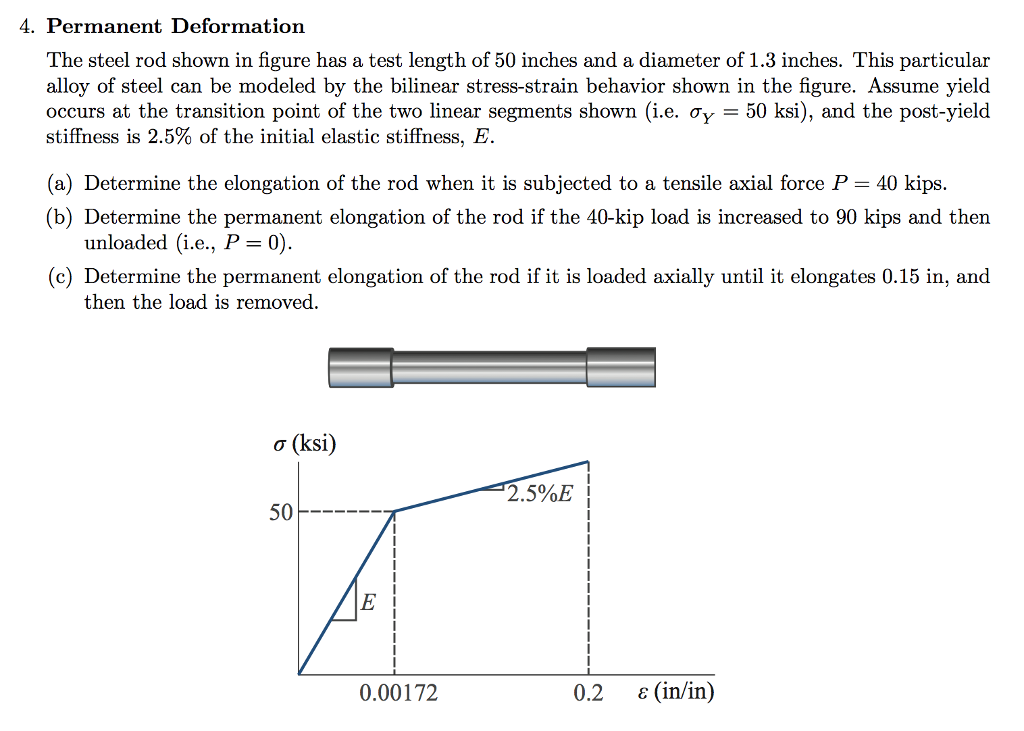
The steel rod shown in figure has a test length of 50 inches and a diameter of 1.3 inches. This particular
alloy of steel can be modeled by the bilinear stress-strain behavior shown in the figure. Assume yield
occurs at the transition point of the two linear segments shown (i.e. oy = 50 ksi), and the post-yield
stiffness is 2.5% of the initial elastic stiffness, E.
(a) Determine the elongation of the rod when it is subjected to a tensile axial force P = 40 kips.
(b) Determine the permanent elongation of the rod if the 40-kip load is increased to 90 kips and then
unloaded (i.e., P = 0).
(c) Determine the permanent elongation of the rod if it is loaded axially until it elongates 0.15 in, and
then the load is removed.
o (ksi)
1
2.5%E |
50 F—————— 1
fi 1
i |
i 1
i 1
i 1
i 1
E | i
i 1
i 1
i 1
i i
0.00172 0.2 &(infin)
Question:
4. Permanent Deformation
The steel rod shown in figure has a test length of 50 inches and a diameter of 1.3 inches. This particular
alloy of steel can be modeled by the bilinear stress-strain behavior shown in the figure. Assume yield
occurs at the transition point of the two linear segments shown (i.e. oy = 50 ksi), and the post-yield
stiffness is 2.5% of the initial elastic stiffness, E.
(a) Determine the elongation of the rod when it is subjected to a tensile axial force P = 40 kips.
(b) Determine the permanent elongation of the rod if the 40-kip load is increased to 90 kips and then
unloaded (i.e., P = 0).
(c) Determine the permanent elongation of the rod if it is loaded axially until it elongates 0.15 in, and
then the load is removed.
o (ksi)
1
2.5%E |
50 F—————— 1
fi 1
i |
i 1
i 1
i 1
i 1
E | i
i 1
i 1
i 1
i i
0.00172 0.2 &(infin)
This is AI generated Response.
Asked by: Md Israrul Haque
Created at: 2025-08-25 04:40:06
Final Answer:
RenderedRaw Text
Did you like this answer?
Let's break down the problem step by step using the given data:
### **Given Data**
- **Length, \( L \)** = 50 in
- **Diameter, \( d \)** = 1.3 in
- **Yield Stress, \( \sigma_Y \)** = 50 ksi
- **Elastic Modulus, \( E \)**
- **Post-yield stiffness** = 2.5% of \( E \)
- **Yield Strain** = \( \epsilon_Y = \frac{\sigma_Y}{E} = 0.00172 \) (from the graph)
- **Cross-sectional Area, \( A \) = \(\frac{\pi d^2}{4}\)**
- **1 kip = 1000 lb**
Let's solve each part:
---
## **(a) Elongation under \( P = 40 \) kips**
Find stress:
\[
\sigma = \frac{P}{A}
\]
\[
A = \frac{\pi}{4} d^2 = \frac{\pi}{4} (1.3)^2 = 1.327 \, \text{in}^2
\]
\[
\sigma = \frac{40,000}{1.327} = 30,146 \, \text{psi} = 30.15 \, \text{ksi}
\]
Since \( 30.15 \) ksi < \( \sigma_Y \), the rod is in the elastic regime.
\[
\epsilon = \frac{\sigma}{E}
\]
From the graph, \( \epsilon_Y = 0.00172 \) at \( \sigma_Y = 50 \) ksi:
\[
E = \frac{50}{0.00172} = 29,070 \, \text{ksi}
\]
\[
\epsilon = \frac{30.15}{29,070} = 0.001037
\]
Elongation:
\[
\delta = \epsilon L = 0.001037 \times 50 = 0.0518 \, \text{in}
\]
---
## **(b) Permanent elongation after loading to 90 kips and unloading**
First, calculate the stress at 90 kips:
\[
\sigma = \frac{90,000}{1.327} = 67,844 \, \text{psi} = 67.84 \, \text{ksi}
\]
This exceeds yield, so the rod deforms plastically.
### **Step 1: Find total strain at 67.84 ksi:**
- The elastic region goes up to \( \sigma_Y = 50 \) ksi, \( \epsilon_Y = 0.00172 \).
- Beyond that, use the post-yield slope (\( E_p = 0.025E \)):
\[
E_p = 0.025 \times 29,070 = 726.75 \, \text{ksi}
\]
\[
\epsilon = \epsilon_Y + \frac{\sigma - \sigma_Y}{E_p}
\]
\[
\epsilon = 0.00172 + \frac{67.84-50}{726.75} = 0.00172 + \frac{17.84}{726.75} = 0.00172 + 0.02455 = 0.02627
\]
Total elongation at max load:
\[
\delta_{total} = \epsilon \times L = 0.02627 \times 50 = 1.314 \, \text{in}
\]
### **Step 2: When unloaded, only elastic strain remains:**
Elastic strain at yield:
\[
\epsilon_{elastic} = \frac{\sigma_{unload}}{E} = \frac{0}{E} = 0
\]
But the *residual* elastic strain will be that corresponding to the yield stress \( \sigma_Y \), because when unloaded, the rod follows the original elastic modulus back down to zero stress, from the maximum strain.
\[
\epsilon_{residual} = \epsilon_{max} - \frac{\sigma_Y}{E}
\]
\[
\epsilon_{plastic} = \epsilon_{max} - \frac{\sigma_Y}{E}
\]
\[
= 0.02627 - 0.00172 = 0.02455
\]
Permanent elongation:
\[
\delta_{perm} = \epsilon_{plastic} \cdot L = 0.02455 \times 50 = 1.227 \, \text{in}
\]
---
## **(c) Permanent elongation after elongating to 0.15 in and unloading**
Maximum total strain:
\[
\delta_{max} = 0.15 \, \text{in}
\]
\[
\epsilon_{max} = \frac{\delta_{max}}{L} = \frac{0.15}{50} = 0.003
\]
This is above yield (\( \epsilon_Y = 0.00172 \)), so it enters the plastic region.
### **Step 1: Find the max stress**
\[
\epsilon_{max} = \epsilon_Y + \frac{\sigma_{max} - \sigma_Y}{E_p}
\]
\[
0.003 = 0.00172 + \frac{\sigma_{max} - 50}{726.75}
\]
\[
0.003 - 0.00172 = \frac{\sigma_{max} - 50}{726.75}
\]
\[
0.00128 \times 726.75 = \sigma_{max} - 50
\]
\[
0.930 = \sigma_{max} - 50
\]
\[
\sigma_{max} = 50.93 \, \text{ksi}
\]
### **Step 2: Permanent strain after unloading**
Unloading follows the original elastic slope \( E \):
\[
\epsilon_{perm} = \epsilon_{max} - \frac{\sigma_{max}}{E}
\]
\[
= 0.003 - \frac{50.93}{29,070} = 0.003 - 0.001752 = 0.00125
\]
Permanent elongation:
\[
\delta_{perm} = \epsilon_{perm} \times L = 0.00125 \times 50 = 0.0625 \, \text{in}
\]
---
## **Summary of Answers**
**(a)** Elongation under 40 kip load:
\[
\boxed{0.0518 \, \text{in}}
\]
**(b)** Permanent elongation after 90 kip load and unload:
\[
\boxed{1.23 \, \text{in}}
\]
**(c)** Permanent elongation after 0.15 in elongation and unload:
\[
\boxed{0.0625 \, \text{in}}
\]
Let me know if you want detailed step-by-step calculations for any part!
VIPSolutions focuses on clear, step‑by‑step explanations so you can learn quickly. Whether you need an AI‑generated walkthrough or a short hint to get unstuck, each solution is organized for fast reading and easy review later.
Search similar questions, compare approaches, and bookmark the best answers for revision. Our goal is simple: quick, reliable study help that feels natural—not noisy.
 VIPSolutions
 4. Permanent Deformation
The steel rod shown in figure has a test length of 50 inches and a diameter of 1.3 inches. This particular
alloy of steel can be modeled by the bilinear stress-strain behavior shown in the figure. Assume yield
occurs at the transition point of the two linear segments shown (i.e. oy = 50 ksi), and the post-yield
stiffness is 2.5% of the initial elastic stiffness, E.
(a) Determine the elongation of the rod when it is subjected to a tensile axial force P = 40 kips.
(b) Determine the permanent elongation of the rod if the 40-kip load is increased to 90 kips and then
unloaded (i.e., P = 0).
(c) Determine the permanent elongation of the rod if it is loaded axially until it elongates 0.15 in, and
then the load is removed.
o (ksi)
1
2.5%E |
50 F—————— 1
fi 1
i |
i 1
i 1
i 1
i 1
E | i
i 1
i 1
i 1
i i
0.00172 0.2 &(infin)