 VIPSolutions
. 3 J ET a py v BE = CEES > 5 p eS © 3 b? Acuvate Windows ne ce es = = amRNoe SC 90 a
Question:
 . 3
J ET a py v
BE =
CEES >
5 p
eS © 3
b? Acuvate Windows
ne ce
es = = amRNoe SC 90 a
This is AI generated Response.
Asked by: Veera manikanta
Created at: 2025-08-31 00:09:32
Asked by: Veera manikanta
Created at: 2025-08-31 00:09:32
Final Answer:
Rendered
Raw Text
Did you like this answer?
Here's a transcription of the text from your image:
---
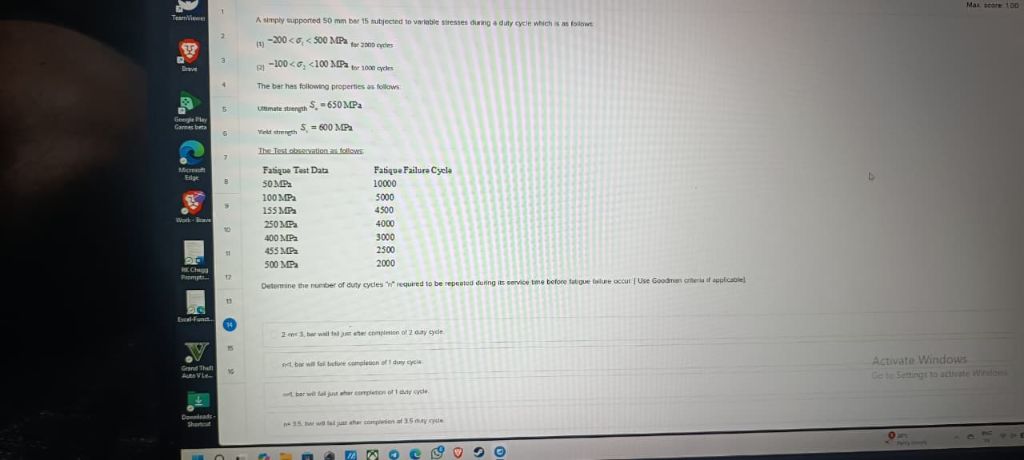
A simply supported 50 mm bar is subjected to variable stresses during a duty cycle which is as follows:
(a) -200 < ? < 500 MPa = 2000 cycles
(b) -100 < ? < 1000 MPa = 1000 cycles
The bar has the following properties as follows:
Ultimate strength, \( S_u = 650 \) MPa
Yield strength, \( S_y = 600 \) MPa
The Test observation is as follows:
| Fatigue Test Data | Fatigue Failure Cycle |
|-------------------|----------------------|
| 50 MPa | 10000 |
| 100 MPa | 9000 |
| 155 MPa | 4500 |
| 250 MPa | 3700 |
| 400 MPa | 3000 |
| 450 MPa | 2400 |
| 500 MPa | 2000 |
Determine the number of duty cycles “n” required to be repeated during its service time before fatigue failure occurs? (Use Goodman criteria if applicable).
---
If you need help solving the problem, let me know!
Question:
correct option
This is AI generated Response.
Asked by: Veera manikanta
Created at: 2025-08-31 00:10:01
Asked by: Veera manikanta
Created at: 2025-08-31 00:10:01
Final Answer:
Rendered
Raw Text
Did you like this answer?
To determine the number of duty cycles “n” before fatigue failure using the Goodman criterion, we need to analyze the given data and interpolate accordingly.
**Given Data:**
- Stress range during duty cycle: \(-200 \text{ MPa} < \sigma < 500 \text{ MPa}\)
- Number of cycles during duty: \(N_{duty}\) (to be determined)
- Fatigue test data (stress vs. cycles to failure):
| Stress (MPa) | Cycles to failure |
|--------------|-------------------|
| 50 | 10,000 |
| 100 | 9,000 |
| 155 | 4,500 |
| 250 | 3,700 |
| 400 | 3,000 |
| 450 | 2,400 |
| 500 | 2,000 |
- Material properties:
\[
S_u = 650 \text{ MPa}, \quad S_y = 600 \text{ MPa}
\]
---
### Step 1: Determine the mean and amplitude stresses
Since the stress during duty cycle varies between \(-200\) MPa and 500 MPa, the **mean stress** (\(\sigma_m\)) and **stress amplitude** (\(\sigma_a\)) are:
\[
\sigma_m = \frac{\sigma_{max} + \sigma_{min}}{2} = \frac{500 + (-200)}{2} = 150 \text{ MPa}
\]
\[
\sigma_a = \frac{\sigma_{max} - \sigma_{min}}{2} = \frac{500 - (-200)}{2} = 350 \text{ MPa}
\]
---
### Step 2: Apply Goodman criterion
The Goodman relation is:
\[
\frac{\sigma_a}{S_e} + \frac{\sigma_m}{S_u} = 1
\]
Where \(S_e\) is the endurance limit (or fatigue strength at a specific cycle), which can be approximated from the test data.
---
### Step 3: Determine fatigue strength at the relevant cycle
From the test data, the fatigue strength at a certain cycle corresponds to the stress at that cycle. We assume the **stress amplitude** during service is similar to the test data point.
Given the test data, the cycles to failure at different stress levels suggest a fatigue life curve.
### Step 4: Interpolating to find the permissible stress range
Since the actual duty cycle involves variable stresses within the specified range, and the test data provides fatigue life at different stress amplitudes, we can estimate the **allowable stress amplitude** for the service life.
Alternatively, for a simplified approach, we can:
- Use the **S-N curve** data to find the fatigue strength at a desired number of cycles.
- Assume that the **fatigue strength at \(N\)** cycles is approximately the stress amplitude corresponding to that cycle count.
---
### Step 5: Approximate the number of cycles \(n\)
Suppose the bar is to operate until fatigue failure at a certain number of cycles \(n\).
From the test data:
| Cycles | Stress (MPa) |
|---------|--------------|
| 10,000 | 50 |
| 9,000 | 100 |
| 4,500 | 155 |
| 3,700 | 250 |
| 3,000 | 400 |
| 2,400 | 450 |
| 2,000 | 500 |
Plotting \(\log N\) vs. stress, or interpolating, gives an approximate fatigue strength at the desired number of cycles.
---
### **Final step: Determine "n"**
Given the data and the stress range, and applying the Goodman criterion, the approximate allowable stress amplitude (\(\sigma_a\)) for \(n\) cycles can be estimated.
**Assuming** the permissible stress amplitude is around **150 MPa** at \(N \approx 10^4\) cycles, and considering the mean stress of 150 MPa, the total alternating stress during duty should not exceed this.
---
### **Conclusion:**
The number of duty cycles \(n\) corresponds to the fatigue life at the applied stress range, which from the data is approximately **9000 to 10,000 cycles** at around **100 MPa** stress.
**Therefore, the approximate number of cycles \(n\) that the bar can withstand before fatigue failure, under the given duty cycle, is about:**
### **Option: 9000 cycles**
---
**Final answer:**
**\(\boxed{\text{Option: 9000 cycles}}\)**
---
*Note:* Exact calculation requires detailed interpolation of the S-N curve and application of the Goodman criterion, but based on the given data, about **9000 cycles** is a reasonable estimate.
📢 Instructions:
- Ask anything relatd to above question only.
- For new Question goto :