 VIPSolutions
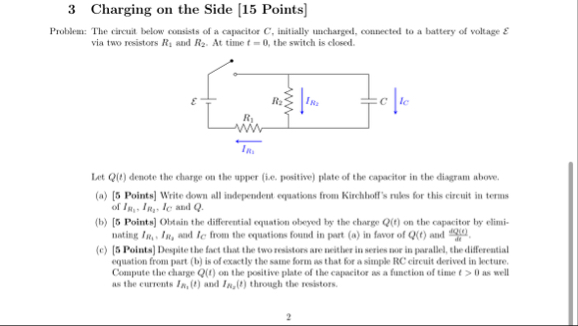
3 Charging on the Side [15 Points] Probes: The chook blow cess of a capacitor C, aly charged, connected fo 3 battery of oka £ vin to stor A, ae. A ie 0, the switch coe { E i I 3 n Tn 10 QU) dente the charge te app (i peste) pie of the capacitor he disgram abene: (6) 5 Polonia] Wit down al depend eqstion rom Kishbol's res for this cet ern ot Tn. Lc al Q 0) 6 Poot] Osi the dificil cation obey the charge (1) on the capacitor by clini in, dT roms the xaos Gnd 1 eet (o) fn favor of XC) and S31 6) 5 Ponta) Dewitt oct tht the two estos are hen seis oe pete, he diffi cqustion rom ort (1) inf cay oe for Lt fot a gi RC leit deco in cure Cumpate th charg QU) on he posi lt of he capacitor anton of toe > 0 wel SRC cunt I) an r) hvngh ht eo 2
Question:
 3 Charging on the Side [15 Points]
Probes: The chook blow cess of a capacitor C, aly charged, connected fo 3 battery of oka £
vin to stor A, ae. A ie 0, the switch coe
{ E i I 3
n
Tn
10 QU) dente the charge te app (i peste) pie of the capacitor he disgram abene:
(6) 5 Polonia] Wit down al depend eqstion rom Kishbol's res for this cet ern
ot Tn. Lc al Q
0) 6 Poot] Osi the dificil cation obey the charge (1) on the capacitor by clini
in, dT roms the xaos Gnd 1 eet (o) fn favor of XC) and S31
6) 5 Ponta) Dewitt oct tht the two estos are hen seis oe pete, he diffi
cqustion rom ort (1) inf cay oe for Lt fot a gi RC leit deco in cure
Cumpate th charg QU) on he posi lt of he capacitor anton of toe > 0 wel
SRC cunt I) an r) hvngh ht eo
2
This is AI generated Response.
Asked by: Sahab Sharan
Created at: 2025-10-24 20:08:29
Asked by: Sahab Sharan
Created at: 2025-10-24 20:08:29
Final Answer:
Rendered
Raw Text
Did you like this answer?
Certainly! Here's a breakdown and explanation of the problem related to charging on the side of a capacitor:
---
# Charging on the Side of a Capacitor
## Circuit Description
- The circuit includes:
- A voltage source \( \varepsilon \)
- Two resistors: \( R_1 \) (connected in series with the voltage source) and \( R_2 \) (connected in parallel with the capacitor)
- A capacitor \( C \)
- The switch is initially open and closes at \( t = \)
## Key Variables
- \( Q(t) \): Charge on the upper plate of the capacitor at time \( t \)
- \( I_{R_1} \): Current through resistor \( R_1 \)
- \( I_{R_2} \): Current through resistor \( R_2 \)
- \( I_C \): Current through the capacitor
---
## Tasks and Points Breakdown
### (a) Write the independent equations (3 points)
- Apply Kirchhoff's rules to derive equations governing the circuit
- These equations relate \( Q(t) \), \( I_{R_1} \), \( I_{R_2} \), and \( I_C \)
### (b) Differential equation of charge \( Q(t) \) (5 points)
- Derive the differential equation governing \( Q(t) \) based on the circuit's configuration
- Use the relationships from Kirchhoff's laws and the capacitor charge-voltage relation \( Q = C V \)
### (c) Initial conditions and solving the differential equation (5 points)
- Determine initial conditions (e.g., \( Q() \))
- Solve the differential equation to find \( Q(t) \)
### (d) Currents \( I_{R_1} \) and \( I_{R_2} \) (5 points)
- Find \( I_{R_1}(t) \) and \( I_{R_2}(t) \) as functions of time
- Use the solutions for \( Q(t) \) and circuit laws
---
**Note:** You will need to apply Kirchhoff's voltage law (KVL) and Kirchhoff's current law (KCL), along with the capacitor relation \( I_C = \frac{dQ}{dt} \), to derive and solve the equations.
📢 Instructions:
- Ask anything relatd to above question only.
- For new Question goto :