VIPSolutions logo ✨ VIPSolutions

2) This problem is comprised of four parts. Figure[d represents a ball of mass m and radius connected to a mass-less rope of length L, which is connected to a vertical pole of height h. The angle between the taut rope and the pole is denoted by (+). The rope is free to spin about the pole and the angle capturing this rotation is denoted by a(-). aln]2 L h|—7 TN A) (m) g _/ Figure .1. A point mass moving on a spinning circle a) Set a reference frame I centered at O that is fixed in space and a reference frame J centered at O that moves with the ball. (You can draw these reference frames on the figure) b) Express in the reference frame J the velocity of the ball with respect to I. ¢) Express in the reference frame J the acceleration of the ball with respect to I. d) Apply Newton's second law to find the equations of motion of the ball. e) Find fy € (0,7/2) and « : [0,00) — R, if any, such that 3(f) remains a constant for all +> 0. that is. 3(1) = Bn. t > 0.

Question:
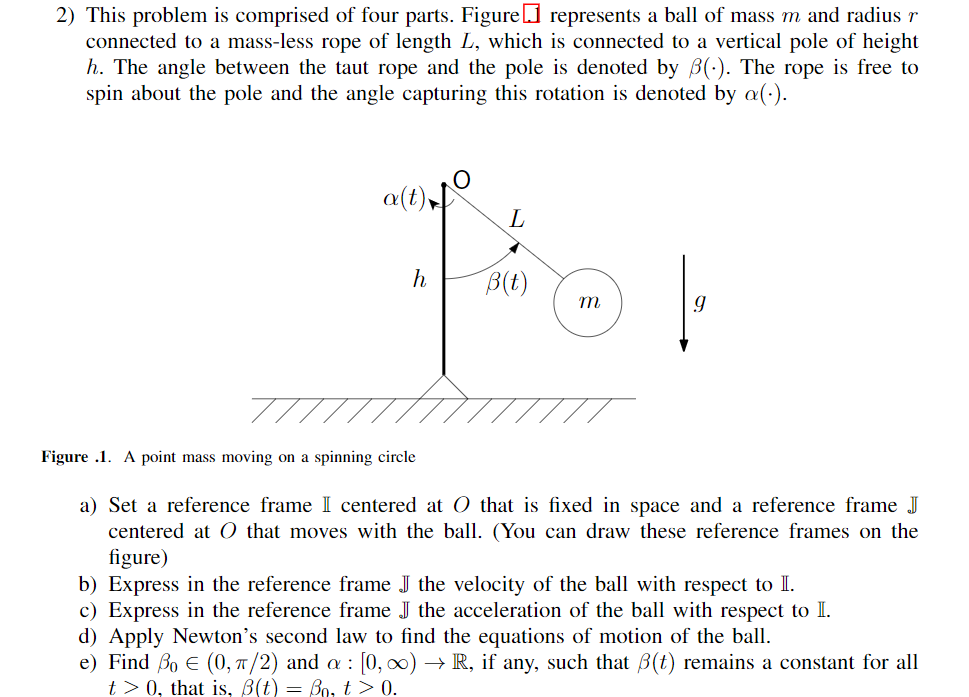
Uploaded Image2) This problem is comprised of four parts. Figure[d represents a ball of mass m and radius connected to a mass-less rope of length L, which is connected to a vertical pole of height h. The angle between the taut rope and the pole is denoted by (+). The rope is free to spin about the pole and the angle capturing this rotation is denoted by a(-). aln]2 L h|—7 TN A) (m) g _/ Figure .1. A point mass moving on a spinning circle a) Set a reference frame I centered at O that is fixed in space and a reference frame J centered at O that moves with the ball. (You can draw these reference frames on the figure) b) Express in the reference frame J the velocity of the ball with respect to I. ¢) Express in the reference frame J the acceleration of the ball with respect to I. d) Apply Newton's second law to find the equations of motion of the ball. e) Find fy € (0,7/2) and « : [0,00) — R, if any, such that 3(f) remains a constant for all +> 0. that is. 3(1) = Bn. t > 0.

This is AI generated Response.
Asked by: Adapaka Jagadeesh
Created at: 2025-07-29 12:06:36

Final Answer:

Rendered Raw Text
Did you like this answer?
Let's break down the problem and address each part step by step. --- ### a) Reference Frames - **Frame ? (Inertial Frame):** Fixed at point O (origin), does not rotate or move. - **Frame ? (Rotating Frame):** Also centered at O, but it rotates with the rope and the ball. Its axes move such that one axis is always along the rope (direction of tension), and the other is perpendicular to it in the plane of motion. You can draw: - ?: \( \hat{x}_I, \hat{y}_I, \hat{z}_I \) (vertical pole is along \( \hat{z}_I \)) - ?: \( \hat{x}_J \) along the rope (from O to m), \( \hat{y}_J \) perpendicular to the rope in the plane, \( \hat{z}_J \) perpendicular to the plane. --- ### b) Velocity of the Ball with respect to ? The position vector of the ball in ? is: \[ \vec{r} = h\hat{z}_I + L\left(\sin\beta(t)\cos\alpha(t)\hat{x}_I + \sin\beta(t)\sin\alpha(t)\hat{y}_I - \cos\beta(t)\hat{z}_I\right) \] Therefore, the velocity is: \[ \vec{v} = \frac{d\vec{r}}{dt} \] Compute derivative: \[ \vec{v} = L \left[ \dot{\beta} \cos\beta \cos\alpha - \sin\beta \sin\alpha\, \dot{\alpha} \right] \hat{x}_I + L \left[ \dot{\beta} \cos\beta \sin\alpha + \sin\beta \cos\alpha\, \dot{\alpha} \right] \hat{y}_I + L \left[ \dot{\beta} \sin\beta \right] \hat{z}_I \] --- ### c) Acceleration of the Ball with respect to ? Take the second time derivative of \(\vec{r}\): \[ \vec{a} = \frac{d^2\vec{r}}{dt^2} \] This will be a lengthy expression, but you can write it as: \[ \vec{a} = \frac{d\vec{v}}{dt} \] Or, if you prefer, you can use the non-inertial (rotating) frame ? and add fictitious forces (centrifugal, Coriolis, etc.) as appropriate. --- ### d) Newton's Second Law (Equations of Motion) Apply \(m\vec{a} = \vec{F}\): - Forces acting: gravity (\(mg\)), tension (\(T\)), and possibly the constraint force from the pole. Write the equations in terms of \(\beta(t)\) and \(\alpha(t)\): - Radial and tangential components along the rope and perpendicular to it. - For a mass on a rope, usually, you get two equations: one for \(\beta(t)\), one for \(\alpha(t)\). --- ### e) Conditions for Constant \(\beta(t) = \beta_0\) Set \(\dot{\beta} = 0\) and \(\ddot{\beta} = 0\) in the equations from (d). - Find what value(s) of \(\alpha(t)\) (i.e., angular velocity) are required so that the ball maintains a constant angle \(\beta_0\). - This is a standard "conical pendulum" condition. \[ mg \sin\beta_0 = m L \sin\beta_0 \, \dot{\alpha}^2 \cos\beta_0 \] \[ g = L \dot{\alpha}^2 \cos\beta_0 \] \[ \dot{\alpha} = \sqrt{\frac{g}{L\cos\beta_0}} \] So for any \(\beta_0 \in (0, \pi/2)\), as long as \(\alpha(t)\) is constant and given by the above, \(\beta(t)\) will remain constant. --- **Summary Table:** | Part | Key Step/Result | |------|------------------| | (a) | Draw ? (fixed) and ? (rotating with rope/ball) at O | | (b) | \(\vec{v}\) in ?: time derivative of position vector | | (c) | \(\vec{a}\) in ?: second derivative of position vector | | (d) | Newton's law: break into radial/tangential components | | (e) | \(\dot{\alpha} = \sqrt{\frac{g}{L\cos\beta_0}}\) for constant \(\beta(t) = \beta_0\) | If you need **worked-out details for any specific part**, let me know!

📢 Instructions:

  • Ask anything relatd to above question only.
  • For new Question goto :

Study Help, Fast Answers

VIPSolutions focuses on clear, step‑by‑step explanations so you can learn quickly. Whether you need an AI‑generated walkthrough or a short hint to get unstuck, each solution is organized for fast reading and easy review later.

Search similar questions, compare approaches, and bookmark the best answers for revision. Our goal is simple: quick, reliable study help that feels natural—not noisy.