 VIPSolutions
2. The temperature in part of the sun’ atmosphere is 5000 XK Find the relative numbers of hydrogen atoms in this region that are in the n = 1, 2, 3, and 4 energy levels. Be sure to take into account the multiplicity of each level.
Question:
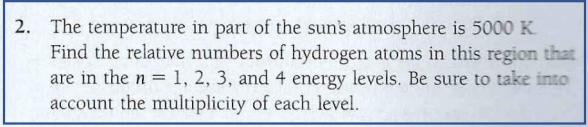 2. The temperature in part of the sun’ atmosphere is 5000 XK
Find the relative numbers of hydrogen atoms in this region that
are in the n = 1, 2, 3, and 4 energy levels. Be sure to take into
account the multiplicity of each level.
This is AI generated Response.
Asked by: Rajveer Prajapat
Created at: 2025-10-11 08:06:34
Asked by: Rajveer Prajapat
Created at: 2025-10-11 08:06:34
Final Answer:
Rendered
Raw Text
Did you like this answer?
## Solution
Given:
- Temperature, \( T = 500 \) K
- Find **relative population** of hydrogen atoms in \( n = 1, 2, 3, 4 \) (energy levels)
- **Multiplicity** must be included.
### 1. **Boltzmann Distribution**
The relative population of atoms in energy level \( i \) is given by:
\[
\frac{N_i}{N_1} = \frac{g_i}{g_1} \exp\left(-\frac{E_i - E_1}{kT}\right)
\]
Where:
- \( N_i \): Number of atoms in level \( i \)
- \( g_i \): Degeneracy (multiplicity) of level \( i \)
- \( E_i \): Energy of level \( i \)
- \( k \): Boltzmann constant (\( 8.617 \times 10^{-5} \) eV/K)
- \( T \): Temperature in Kelvin
---
### 2. **For Hydrogen Atom:**
- **Energy levels:** \( E_n = -13.6\,\text{eV}/n^2 \)
- **Multiplicity:** \( g_n = 2n^2 \) (factor of 2 for spin)
---
#### Calculate \( E_n \):
\[
\begin{align*}
E_1 &= -13.6\, \text{eV} \\
E_2 &= -13.6/4 = -3.4\, \text{eV} \\
E_3 &= -13.6/9 = -1.511\, \text{eV} \\
E_4 &= -13.6/16 = -.85\, \text{eV} \\
\end{align*}
\]
---
#### Calculate \( g_n \):
\[
\begin{align*}
g_1 &= 2 \times 1^2 = 2 \\
g_2 &= 2 \times 2^2 = 8 \\
g_3 &= 2 \times 3^2 = 18 \\
g_4 &= 2 \times 4^2 = 32 \\
\end{align*}
\]
---
#### Calculate \( \Delta E_{n1} = E_n - E_1 \):
\[
\begin{align*}
\Delta E_{21} &= -3.4 - (-13.6) = 10.2\, \text{eV} \\
\Delta E_{31} &= -1.511 - (-13.6) = 12.089\, \text{eV} \\
\Delta E_{41} &= -.85 - (-13.6) = 12.75\, \text{eV} \\
\end{align*}
\]
---
### 3. **Plug into Boltzmann Equation**
Boltzmann constant:
\[
k = 8.617 \times 10^{-5} \ \text{eV/K}
\]
\[
kT = 8.617 \times 10^{-5} \times 500 = .431 \ \text{eV}
\]
Now compute ratios:
\[
\frac{N_n}{N_1} = \frac{g_n}{g_1} \exp\left(-\frac{\Delta E_{n1}}{kT}\right)
\]
---
#### **For \( n=2 \):**
\[
\frac{N_2}{N_1} = \frac{8}{2} \exp\left(-\frac{10.2}{.431}\right) = 4 \times \exp(-23.68)
\]
\[
\exp(-23.68) \approx 5.17 \times 10^{-11}
\]
\[
\frac{N_2}{N_1} \approx 2.07 \times 10^{-10}
\]
---
#### **For \( n=3 \):**
\[
\frac{N_3}{N_1} = \frac{18}{2} \exp\left(-\frac{12.089}{.431}\right) = 9 \times \exp(-28.05)
\]
\[
\exp(-28.05) \approx 6.62 \times 10^{-13}
\]
\[
\frac{N_3}{N_1} \approx 5.96 \times 10^{-12}
\]
---
#### **For \( n=4 \):**
\[
\frac{N_4}{N_1} = \frac{32}{2} \exp\left(-\frac{12.75}{.431}\right) = 16 \times \exp(-29.58)
\]
\[
\exp(-29.58) \approx 1.36 \times 10^{-13}
\]
\[
\frac{N_4}{N_1} \approx 2.18 \times 10^{-12}
\]
---
## **Summary Table**
| Level | \( g_n \) | \( E_n \) (eV) | \( \Delta E_{n1} \) (eV) | \( N_n/N_1 \) |
|-------|--------|----------------|-------------------------|--------------------|
| 1 | 2 | -13.6 | | 1 |
| 2 | 8 | -3.4 | 10.2 | \( 2.07 \times 10^{-10} \) |
| 3 | 18 | -1.511 | 12.089 | \( 5.96 \times 10^{-12} \) |
| 4 | 32 | -.85 | 12.75 | \( 2.18 \times 10^{-12} \) |
---
## **Conclusion**
- **Almost all hydrogen atoms are in the ground state (\( n = 1 \)) at 500 K.**
- **Very few are in \( n=2, 3, \) or \( 4 \).**
Let me know if you want the absolute numbers or further explanation!
📢 Instructions:
- Ask anything relatd to above question only.
- For new Question goto :