 VIPSolutions
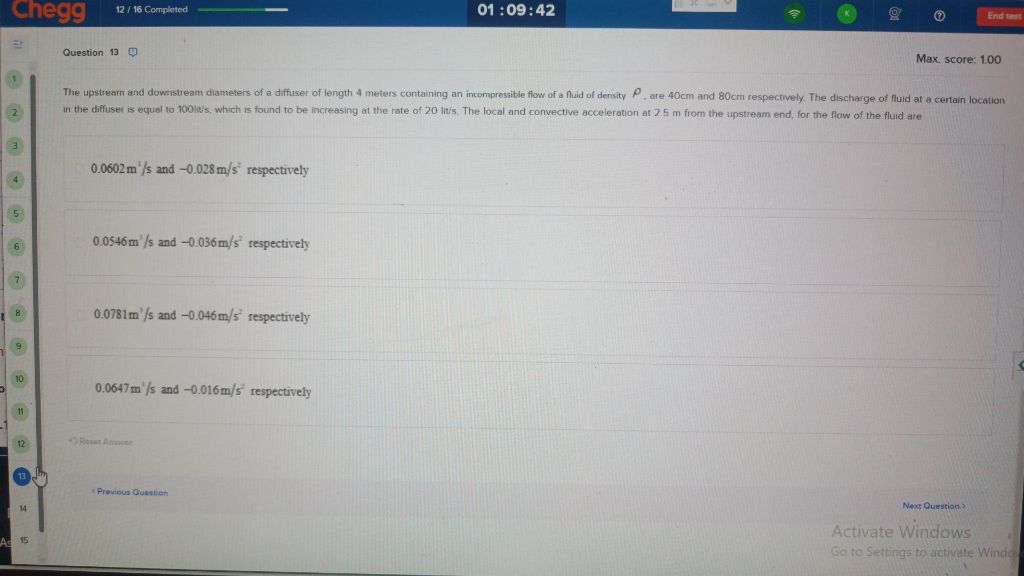
12/16 Completed _— 01:09:42 = “Gwinn © ra ' : The pwe and dowetream diameters of a fuse of length 4 meters contain an ores hid of erty, are 40m and 80cm sespactvely. The clachavge SE RU A UNNI 5 In the diffuser equal fo 100s. which 5 found 1 te of 70 1s. The local and conveciig acceleration at 2.5 m from the upsieam end, for the flow of the lll a 5 0.0602m'/s and ~0.028ms’ respectively | “ | E 2 0.0546m'/s 208 ~0.036m/s’ respective 3 “ 0.0781m'/s 208 —0.046m/s" respectively a Iv 1 » “ 00647m'/s 208 0.016m/5" respective " 2 Frodo Commie BE " g ate Windows ® a 16 activate Wi = ANG
Question:
 12/16 Completed _— 01:09:42 =
“Gwinn © ra
' :
The pwe and dowetream diameters of a fuse of length 4 meters contain an ores hid of erty, are 40m and 80cm sespactvely. The clachavge SE RU A UNNI
5 In the diffuser equal fo 100s. which 5 found 1 te of 70 1s. The local and conveciig acceleration at 2.5 m from the upsieam end, for the flow of the lll a
5
0.0602m'/s and ~0.028ms’ respectively |
“
|
E
2 0.0546m'/s 208 ~0.036m/s’ respective
3
“ 0.0781m'/s 208 —0.046m/s" respectively
a Iv
1
» “
00647m'/s 208 0.016m/5" respective
"
2
Frodo Commie BE
" g
ate Windows
® a 16 activate Wi
= ANG
This is AI generated Response.
Asked by: Veera manikanta
Created at: 2025-08-06 20:30:26
Asked by: Veera manikanta
Created at: 2025-08-06 20:30:26
Final Answer:
Rendered
Raw Text
Did you like this answer?
The question is about a diffuser with upstream and downstream diameters of 40 cm and 80 cm, a length of 4 meters, and involves calculating the local and convective accelerations of an incompressible fluid flow.
### Let's break down the information:
- **Length of diffuser:** 4 m
- **Upstream diameter:** 40 cm = 0.4 m
- **Downstream diameter:** 80 cm = 0.8 m
- **Discharge (Q):** 100 liters/s = 0.1 m³/s
- **Discharge increasing at:** 20 liters/s = 0.02 m³/s²
- **Location for calculation:** 2.5 m from upstream end
### The options are:
1. 0.0602 m/s² and -0.028 m/s² respectively
2. 0.0546 m/s² and -0.036 m/s² respectively
3. 0.0781 m/s² and -0.046 m/s² respectively
4. 0.0647 m/s² and -0.016 m/s² respectively
### **Calculation steps:**
#### 1. **Area at x = 2.5 m from upstream**
The diameter changes linearly from 0.4 m to 0.8 m over 4 m.
Let \( d(x) \) be the diameter at distance \( x \) from upstream:
\[
d(x) = d_1 + \frac{d_2 - d_1}{L} x
\]
Where:
- \( d_1 = 0.4 \) m
- \( d_2 = 0.8 \) m
- \( L = 4 \) m
At \( x = 2.5 \) m:
\[
d(2.5) = 0.4 + \frac{0.8 - 0.4}{4} \times 2.5 = 0.4 + 0.1 \times 2.5 = 0.4 + 0.25 = 0.65 \text{ m}
\]
Area at \( x = 2.5 \):
\[
A = \frac{\pi}{4} d^2 = \frac{\pi}{4} (0.65)^2 \approx 0.332 \text{ m}^2
\]
#### 2. **Velocity at \( x = 2.5 \) m:**
\[
V = \frac{Q}{A} = \frac{0.1}{0.332} \approx 0.301 \text{ m/s}
\]
#### 3. **Local acceleration (\( \frac{\partial V}{\partial t} \)):**
\[
\frac{\partial V}{\partial t} = \frac{1}{A} \frac{dQ}{dt} = \frac{0.02}{0.332} \approx 0.0602 \text{ m/s}^2
\]
#### 4. **Convective acceleration (\( V \frac{dV}{dx} \)):**
First, find \( \frac{dV}{dx} \):
Since \( Q \) and thus \( V \) is a function of \( x \):
\[
V(x) = \frac{Q}{A(x)}
\]
\[
\frac{dV}{dx} = \frac{d}{dx} \left( \frac{Q}{A(x)} \right) = -\frac{Q}{A(x)^2} \frac{dA}{dx}
\]
Area: \( A = \frac{\pi}{4} d^2 \)
\[
\frac{dA}{dx} = \frac{\pi}{2} d \frac{dd}{dx}
\]
\[
\frac{dd}{dx} = \frac{d_2 - d_1}{L} = \frac{0.4}{4} = 0.1
\]
\[
\frac{dA}{dx} = \frac{\pi}{2} \times 0.65 \times 0.1 \approx 0.102 \text{ m}^2/\text{m}
\]
Now,
\[
\frac{dV}{dx} = -\frac{0.1}{(0.332)^2} \times 0.102 \approx -0.0925 \text{ m/s} \cdot \text{m}^{-1}
\]
\[
\text{Convective acceleration} = V \frac{dV}{dx} = 0.301 \times (-0.0925) \approx -0.0278 \text{ m/s}^2
\]
---
### **Final Answers (rounded to match options):**
- **Local acceleration:** \( 0.0602 \) m/s²
- **Convective acceleration:** \( -0.028 \) m/s²
So, the correct answer is:
**0.0602 m/s² and −0.028 m/s² respectively** (first option).
📢 Instructions:
- Ask anything relatd to above question only.
- For new Question goto :