 VIPSolutions
11. Use the singularity functions u(f) and (f), along with appropriate scaling and time shifting, to represent cach of the following signals. When units are not given, let each tic mark represent a unit change of 1. x, (1) a. TN. x3(0) b. SR I x1) c. x4(1) d. - | A— 1
Question:
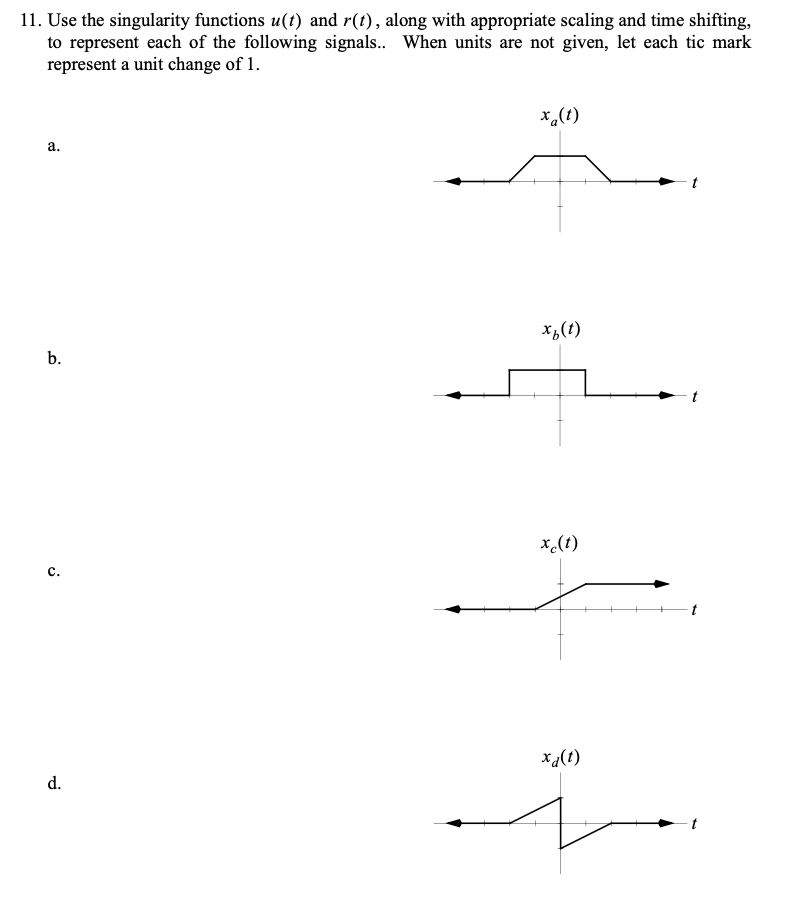 11. Use the singularity functions u(f) and (f), along with appropriate scaling and time shifting,
to represent cach of the following signals. When units are not given, let each tic mark
represent a unit change of 1.
x, (1)
a.
TN.
x3(0)
b.
SR I
x1)
c.
x4(1)
d.
- | A— 1
This is AI generated Response.
Asked by: ABCD
Created at: 2025-09-05 05:30:25
Asked by: ABCD
Created at: 2025-09-05 05:30:25
Final Answer:
Rendered
Raw Text
Did you like this answer?
Let's use the singularity functions \( u(t) \) (unit step) and \( r(t) \) (unit ramp), scaled and shifted as needed.
### a. \( x_a(t) \)
This is a triangular pulse that starts at \( t = -1 \), peaks at \( t = 0 \), and ends at \( t = 1 \).
- From \( t = -1 \) to \( t = 0 \), it ramps up: \( r(t+1) \)
- From \( t = 0 \) to \( t = 1 \), it ramps down: \( -r(t) \)
- After \( t = 1 \), subtract the ramp: \( r(t-1) \)
Combining:
\[
\boxed{x_a(t) = r(t+1) - 2r(t) + r(t-1)}
\]
---
### b. \( x_b(t) \)
This is a rectangular pulse from \( t = -1 \) to \( t = 1 \).
- Turns on at \( t = -1 \): \( u(t+1) \)
- Turns off at \( t = 1 \): \( u(t-1) \)
Combining:
\[
\boxed{x_b(t) = u(t+1) - u(t-1)}
\]
---
### c. \( x_c(t) \)
This is a ramp that starts at \( t = 0 \) and continues indefinitely.
- \( r(t) \) is a ramp starting at \( t = 0 \).
So:
\[
\boxed{x_c(t) = r(t)}
\]
---
### d. \( x_d(t) \)
This is an "inverted V" centered at \( t = 0 \), with slopes 1 to the left and -1 to the right.
- Left of \( t = 0 \), it is \( r(t+1) \).
- Right of \( t = 0 \), it decreases: \( -r(t) \).
Combine:
\[
\boxed{x_d(t) = r(t+1) - 2r(t)}
\]
---
### Summary Table
| Part | Signal Expression |
|------|-------------------|
| a | \( r(t+1) - 2r(t) + r(t-1) \) |
| b | \( u(t+1) - u(t-1) \) |
| c | \( r(t) \) |
| d | \( r(t+1) - 2r(t) \) |
If you need the derivation for any part, feel free to ask!
📢 Instructions:
- Ask anything relatd to above question only.
- For new Question goto :