 VIPSolutions
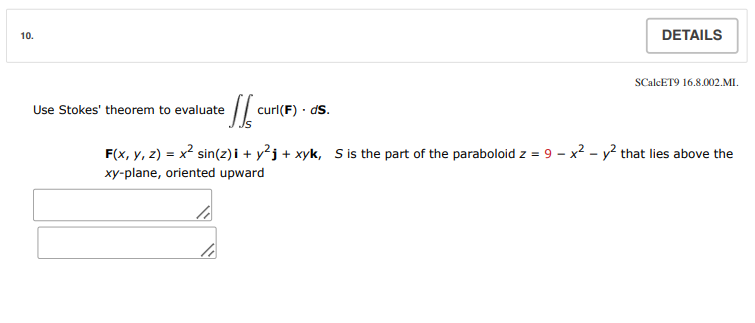
10. DETAILS SCD 680021 Use Stokes’ theorem to evaluate / [ an(F) - as. 5 F(x, y,2) = x2 sin(@) + y§ + xyk, Ss the part of the paraboloid z = 9 - x? - y? that les above the xy-plane, oriented upward / 4
Question:
 10. DETAILS
SCD 680021
Use Stokes’ theorem to evaluate / [ an(F) - as.
5
F(x, y,2) = x2 sin(@) + y§ + xyk, Ss the part of the paraboloid z = 9 - x? - y? that les above the
xy-plane, oriented upward
/
4
This is AI generated Response.
Asked by: pooja gargunde
Created at: 2025-07-22 12:48:55
Asked by: pooja gargunde
Created at: 2025-07-22 12:48:55
Final Answer:
Rendered
Raw Text
Did you like this answer?
Let's solve the problem step-by-step using **Stokes' Theorem**:
### **Step 1: Stokes' Theorem**
Stokes' Theorem states:
\[
\iint_S (\nabla \times \mathbf{F}) \cdot d\mathbf{S} = \oint_C \mathbf{F} \cdot d\mathbf{r}
\]
Where \( C \) is the boundary curve of surface \( S \).
### **Step 2: Identify the Boundary Curve \( C \)**
The surface \( S \) is the part of the paraboloid \( z = 9 - x^2 - y^2 \) above the xy-plane (\(z\geq 0\)). The boundary occurs when \(z = 0\):
\[
0 = 9 - x^2 - y^2 \implies x^2 + y^2 = 9
\]
So, \( C \) is the circle of radius 3 in the \(xy\)-plane.
### **Step 3: Parameterize \( C \)**
Let:
\[
\mathbf{r}(t) = \langle 3\cos t, 3\sin t, 0 \rangle, \quad t \in [0, 2\pi]
\]
### **Step 4: Evaluate \( \mathbf{F} \) on \( C \)**
\[
\mathbf{F}(x, y, z) = x^2 \sin(z)\,\mathbf{i} + y^2\,\mathbf{j} + xy\,\mathbf{k}
\]
On \(C\): \(z = 0\), \(x = 3\cos t\), \(y = 3\sin t\):
- \(x^2 \sin(z) = (3\cos t)^2 \cdot 0 = 0\)
- \(y^2 = (3\sin t)^2 = 9\sin^2 t\)
- \(xy = (3\cos t)(3\sin t) = 9\sin t \cos t\)
So,
\[
\mathbf{F}(\mathbf{r}(t)) = \langle 0, 9\sin^2 t, 9\sin t \cos t \rangle
\]
### **Step 5: Compute \( d\mathbf{r} \)**
\[
d\mathbf{r} = \frac{d\mathbf{r}}{dt} dt = \langle -3\sin t, 3\cos t, 0 \rangle dt
\]
### **Step 6: Calculate the Line Integral**
\[
\mathbf{F} \cdot d\mathbf{r} = \langle 0, 9\sin^2 t, 9\sin t \cos t \rangle \cdot \langle -3\sin t, 3\cos t, 0 \rangle dt
\]
\[
= (0)(-3\sin t) + (9\sin^2 t)(3\cos t) + (9\sin t \cos t)(0)
\]
\[
= 27\sin^2 t \cos t \, dt
\]
### **Step 7: Integrate over \( t \) from 0 to \( 2\pi \)**
\[
\oint_C \mathbf{F} \cdot d\mathbf{r} = \int_0^{2\pi} 27\sin^2 t \cos t \, dt
\]
Let’s use substitution \(u = \sin t\), \(du = \cos t dt\):
When \(t = 0\), \(u = 0\). When \(t = 2\pi\), \(u = 0\).
So,
\[
\int_0^{2\pi} \sin^2 t \cos t dt = \int_0^{0} u^2 du = 0
\]
Thus,
\[
\boxed{0}
\]
---
**Final Answers:**
**First box:** \(\int_0^{2\pi} 27\sin^2 t \cos t \, dt\)
**Second box:** \(0\)
---
If you need the explicit form for the integral or more explanation, let me know!
📢 Instructions:
- Ask anything relatd to above question only.
- For new Question goto :