 VIPSolutions
(1) Use Gauss’s law to find the electric field inside and outside a long nonconducting cylinder of radius R which carries a volume charge density p = As? where A is a constant and s is the radial distance from the cylinder axis. (2) Use the result obtained in problem 1 above to find an expression for the potential outside of the cylinder.
Question:
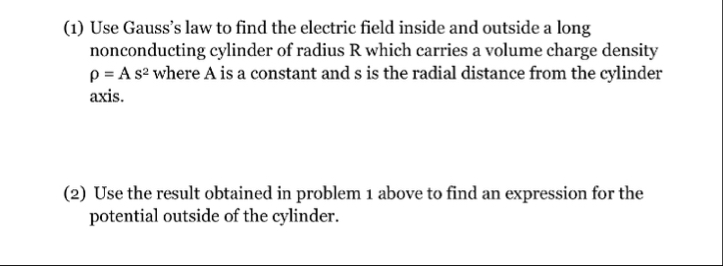 (1) Use Gauss’s law to find the electric field inside and outside a long
nonconducting cylinder of radius R which carries a volume charge density
p = As? where A is a constant and s is the radial distance from the cylinder
axis.
(2) Use the result obtained in problem 1 above to find an expression for the
potential outside of the cylinder.
This is AI generated Response.
Asked by: Rajveer Prajapat
Created at: 2025-09-19 01:47:42
Asked by: Rajveer Prajapat
Created at: 2025-09-19 01:47:42
Final Answer:
Rendered
Raw Text
Did you like this answer?
# Solution
## (1) **Electric Field Inside and Outside the Cylinder Using Gauss's Law**
Given:
- Cylinder radius: \( R \)
- Volume charge density: \( \rho = A s^2 \), where \( s \) is the radial distance from the axis
### **Inside the Cylinder (\( s < R \)):**
**Step 1: Find Enclosed Charge**
Consider a cylindrical Gaussian surface of radius \( s \) and length \( L \):
\[
q_{\text{enc}} = \int \rho \, dV
\]
\[
dV = 2\pi s' L ds'
\]
\[
q_{\text{enc}} = \int_0^s A {s'}^2 (2\pi s' L) ds' = 2\pi A L \int_0^s {s'}^3 ds'
\]
\[
= 2\pi A L \left[ \frac{{s'}^4}{4} \right]_0^s = 2\pi A L \frac{s^4}{4}
\]
**Step 2: Apply Gauss’s Law**
\[
\oint \vec{E} \cdot d\vec{A} = \frac{q_{\text{enc}}}{\epsilon_0}
\]
\[
E(2\pi s L) = \frac{2\pi A L s^4}{4\epsilon_0}
\]
\[
E = \frac{A s^3}{4 \epsilon_0}
\]
**Final Expression (Inside):**
\[
\boxed{E_{\text{in}}(s) = \frac{A s^3}{4 \epsilon_0}, \quad s < R}
\]
---
### **Outside the Cylinder (\( s > R \)):**
**Step 1: Find Total Charge Enclosed by Cylinder**
\[
q_{\text{enc}} = \int_0^R \rho \cdot 2\pi s' L ds' = 2\pi A L \int_0^R {s'}^3 ds' = 2\pi A L \frac{R^4}{4}
\]
\[
= \frac{\pi A L R^4}{2}
\]
**Step 2: Apply Gauss’s Law**
\[
E(2\pi s L) = \frac{q_{\text{enc}}}{\epsilon_0} = \frac{\pi A L R^4}{2\epsilon_0}
\]
\[
E = \frac{A R^4}{4 \epsilon_0 s}
\]
**Final Expression (Outside):**
\[
\boxed{E_{\text{out}}(s) = \frac{A R^4}{4 \epsilon_0 s}, \quad s > R}
\]
---
## (2) **Potential Outside the Cylinder**
The electric potential difference is given by:
\[
V(s) - V(\infty) = -\int_{\infty}^{s} \vec{E} \cdot d\vec{l}
\]
Taking \( V(\infty) = 0 \), and using \( E_{\text{out}}(s) \) from part 1:
\[
V(s) = -\int_{\infty}^{s} \frac{A R^4}{4 \epsilon_0 s'} ds'
\]
\[
= -\frac{A R^4}{4 \epsilon_0} \int_{\infty}^{s} \frac{1}{s'} ds'
\]
\[
= -\frac{A R^4}{4 \epsilon_0} [\ln s']_{\infty}^{s}
\]
\[
= -\frac{A R^4}{4 \epsilon_0} (\ln s - \ln \infty)
\]
Since \( \ln \infty \to \infty \), but we set \( V(\infty) = 0 \), so the potential is:
\[
V(s) = \frac{A R^4}{4 \epsilon_0} \ln \left( \frac{\infty}{s} \right) \to -\frac{A R^4}{4 \epsilon_0} \ln s
\]
**Final Expression:**
\[
\boxed{V(s) = -\frac{A R^4}{4\epsilon_0}\ln(s) + C \qquad (s > R)}
\]
where \( C \) is set by the reference point for the potential (typically \( V(\infty) = 0 \)).
📢 Instructions:
- Ask anything relatd to above question only.
- For new Question goto :