 VIPSolutions
#1 The wheel has a velocity of 2 ft/s up the inclined plane and a clockwise angular velocity of 5 rad/s. Determine the rate of slip at the contact point A (the relative velocity between the point on the wheel and the stationary surface). Sradfs 7s radius =15.inches / Asin 21ts The velocity of the point Aon the wheel Cm w= - would be zero if there was rolling contact. es Aec - There is sliding (not rolling) contact in this rT = problem. Ps G05
Question:
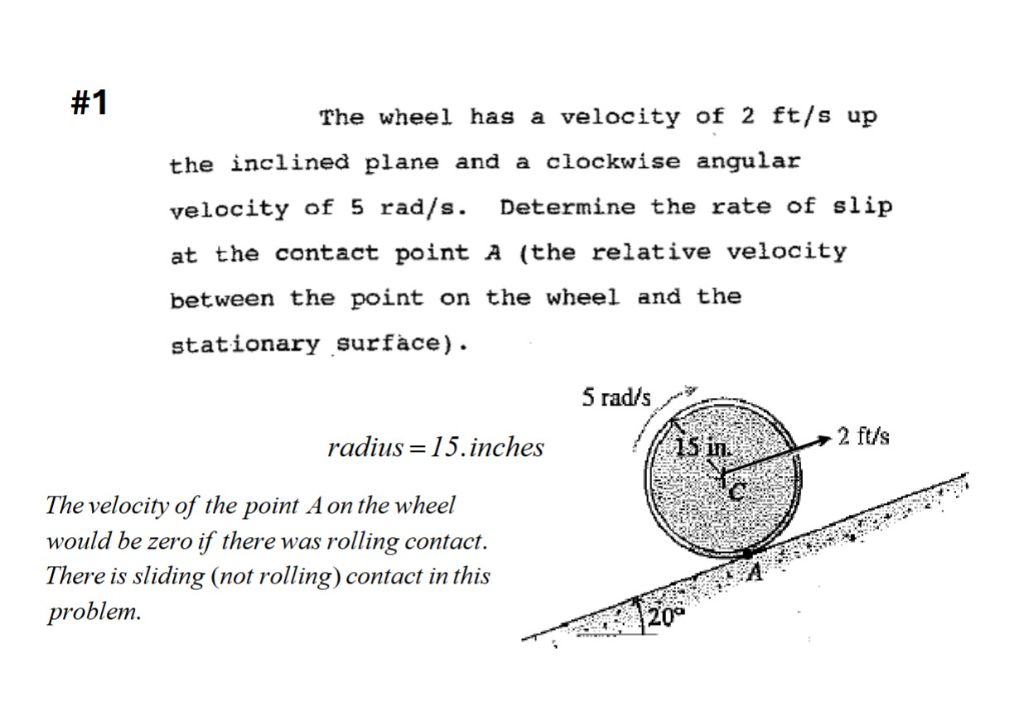 #1 The wheel has a velocity of 2 ft/s up
the inclined plane and a clockwise angular
velocity of 5 rad/s. Determine the rate of slip
at the contact point A (the relative velocity
between the point on the wheel and the
stationary surface).
Sradfs 7s
radius =15.inches / Asin 21ts
The velocity of the point Aon the wheel Cm w= -
would be zero if there was rolling contact. es Aec -
There is sliding (not rolling) contact in this rT =
problem. Ps G05
This is AI generated Response.
Asked by: manish kumar
Created at: 2025-12-03 09:54:46
Asked by: manish kumar
Created at: 2025-12-03 09:54:46
Final Answer:
Rendered
Raw Text
Did you like this answer?
# Solution: Rate of Slip at Point A
Let's break down the problem and solve for the rate of slip at the contact point **A**.
## Given Data
- Linear velocity of the wheel's center (\( v_C \)): **2 ft/s** (up the incline)
- Angular velocity (\( \omega \)): **5 rad/s** (clockwise)
- Radius (\( r \)): **15 in** = **1.25 ft** (since 1 ft = 12 in)
## Step 1: Velocity at Point A
The velocity of point A (the point in contact with the surface) relative to the ground is:
\[
\vec{v}_A = \vec{v}_C + \vec{v}_{A/C}
\]
Where:
- \( \vec{v}_C \) = velocity of the center (2 ft/s, up the incline)
- \( \vec{v}_{A/C} = \omega \times r \) (perpendicular to the radius, due to rotation)
### Direction of Rotational Velocity
- The wheel spins **clockwise**, so at point A (bottom of the wheel), the rotational velocity due to \(\omega\) is **down the incline**.
### Magnitude of Rotational Velocity
\[
v_{A/C} = \omega \times r = 5 \, \text{rad/s} \times 1.25 \, \text{ft} = 6.25 \, \text{ft/s}
\]
- This is **down the incline**.
## Step 2: Combine Velocities
- \( v_C \) is **up the incline** (**positive** direction).
- \( v_{A/C} \) is **down the incline** (**negative** direction).
So,
\[
v_A = v_C - v_{A/C}
\]
\[
v_A = 2 \, \text{ft/s} - 6.25 \, \text{ft/s} = -4.25 \, \text{ft/s}
\]
- **Negative sign** means the velocity at point A is **down the incline** relative to the surface.
## Step 3: Rate of Slip
The **rate of slip** is the **magnitude** of the velocity of point A relative to the surface:
\[
\boxed{4.25 \, \text{ft/s}}
\]
This is the relative velocity between point A on the wheel and the surface (down the incline).
---
### **Summary Table**
| Quantity | Value | Direction |
|---------------|---------------|------------------|
| \(v_C\) | 2 ft/s | Up the incline |
| \(\omega\) | 5 rad/s | Clockwise |
| \(r\) | 1.25 ft | — |
| \(v_{A/C}\) | 6.25 ft/s | Down the incline |
| **Slip Rate** | **4.25 ft/s** | Down the incline |
---
## **Final Answer**
> **The rate of slip at the contact point A is \( \boxed{4.25 \, \text{ft/s}} \) down the incline.**
📢 Instructions:
- Ask anything relatd to above question only.
- For new Question goto :