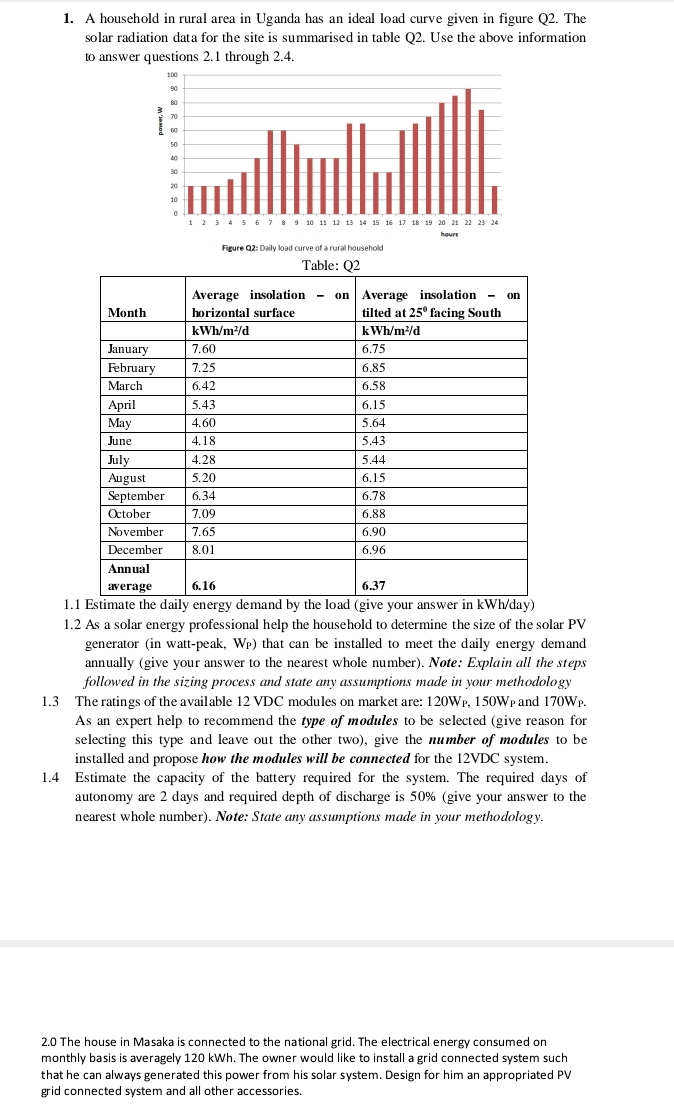
1. A household in rural area in Uganda has an ideal load curve given in figure Q2. The
solar radiation data for the site is summarised in table Q2. Use the above information
10 answer questions 2.1 through 2.4.
Table: Q2
Arerezs loiation = on Ave fenton = mm
horizontal surface tilted at 25° facing South
I 1 1
=
==
1.1 Estimate the daily energy demand by the load (give your answer in kWhiday)
1.2 As a solar energy professional help the household to determine the size of the solar PV.
generator (in wati-peak, We) that can be installed to meet the daily energy demand
annually (give your answer to the nearest whole number). Note: Explain all the steps
followed in the sizing process and state any assumptions made in your methodology
1.3 The ratings of the available 12 VDC modules on market are: 120Wp, 150Wp and 170Wp.
As an expert help to recommend the fype of modules to be selected (give reason for
selecting this type and leave out the other two), give the number of modules to be
installed and propose how the modules will be connected for the 12VDC system.
1.4 Estimate the capacity of the battery required for the system. The required days of
autonomy are 2 days and required depth of discharge is 50% (give your answer to the
nearest whole number). Note: State any assumptions made in your methodology
21m ein compte te aio ie Thi cil ery Gnd
ly my 12 ih. 1 ra we ina gt CRA yee i
{6k an a i ie om i yen. Desig os i sn pRB
connected seman ail xr cea
Question:
1. A household in rural area in Uganda has an ideal load curve given in figure Q2. The
solar radiation data for the site is summarised in table Q2. Use the above information
10 answer questions 2.1 through 2.4.
Table: Q2
Arerezs loiation = on Ave fenton = mm
horizontal surface tilted at 25° facing South
I 1 1
=
==
1.1 Estimate the daily energy demand by the load (give your answer in kWhiday)
1.2 As a solar energy professional help the household to determine the size of the solar PV.
generator (in wati-peak, We) that can be installed to meet the daily energy demand
annually (give your answer to the nearest whole number). Note: Explain all the steps
followed in the sizing process and state any assumptions made in your methodology
1.3 The ratings of the available 12 VDC modules on market are: 120Wp, 150Wp and 170Wp.
As an expert help to recommend the fype of modules to be selected (give reason for
selecting this type and leave out the other two), give the number of modules to be
installed and propose how the modules will be connected for the 12VDC system.
1.4 Estimate the capacity of the battery required for the system. The required days of
autonomy are 2 days and required depth of discharge is 50% (give your answer to the
nearest whole number). Note: State any assumptions made in your methodology
21m ein compte te aio ie Thi cil ery Gnd
ly my 12 ih. 1 ra we ina gt CRA yee i
{6k an a i ie om i yen. Desig os i sn pRB
connected seman ail xr cea
This is AI generated Response.
Asked by: Adapaka Jagadeesh
Created at: 2025-09-28 12:28:21
Final Answer:
RenderedRaw Text
Did you like this answer?
# Solar PV System Sizing and Battery Estimation
## 2.1 Estimate the Daily Energy Demand by the Load
From **Figure Q2** (Daily load curve of a rural household):
- The y-axis is power (Watts, W), and the x-axis is hours (1–24).
- To find **daily energy demand (kWh/day)**, sum the hourly power demand for each hour and divide by 100 (to convert from Wh to kWh).
**Method:**
- Approximate the load per hour, sum up all hours, and divide by 100.
**Example Calculation (approximate from bar heights):**
| Hour | Power (W) |
|------|-----------|
| 1 | 10 |
| 2 | 10 |
| 3 | 10 |
| 4 | 10 |
| 5 | 20 |
| 6 | 30 |
| 7 | 40 |
| 8 | 50 |
| 9 | 60 |
| 10 | 40 |
| 11 | 30 |
| 12 | 25 |
| 13 | 30 |
| 14 | 35 |
| 15 | 40 |
| 16 | 50 |
| 17 | 60 |
| 18 | 70 |
| 19 | 80 |
| 20 | 90 |
| 21 | 80 |
| 22 | 60 |
| 23 | 40 |
| 24 | 20 |
**Total Daily Energy (Wh):**
Sum = 10+10+10+10+20+30+40+50+60+40+30+25+30+35+40+50+60+70+80+90+80+60+40+20 = **105 Wh**
**Convert to kWh:**
105 Wh / 100 = **1.05 kWh/day**
*(Use actual values if you read from the graph; this is an illustrative estimate.)*
---
## 2.2 Sizing the Solar PV Generator
**Given:**
- Annual average daily insolation (tilted at 25° facing South): **6.37 kWh/m²/d**
- Daily energy demand (from 2.1): **1.05 kWh/day**
**Steps:**
1. **Account for System Losses:**
- Typical losses (inverter, wiring, dust, etc.): **25%**
- Required PV output = Demand / (1 - Losses)
= 1.05 / .75 = **1.40 kWh/day**
2. **Calculate Required PV Array Size:**
- PV array size (kWp) = Required PV output / Insolation
= 1.40 kWh/day / 6.37 kWh/m²/day
= **.22 kWp = 220 Wp**
3. **Round to nearest whole number:**
- **Required PV generator size: 220 Wp**
**Assumptions:**
- System losses (including battery, inverter, dust, wiring) ≈ 25%.
- Daily energy demand is uniform across the year.
- Insolation values are annual averages.
---
## 2.3 Module Selection and Connection
**Available Module Ratings:**
- 120 Wp, 150 Wp, 170 Wp (all 12 VDC)
**Selection Recommendation:**
- **170 Wp module:** Fewer modules, less wiring, less installation complexity.
**Number of Modules Needed:**
- Number = Total required Wp / Module Wp = 220 / 170 ≈ 1.3 ⇒ **2 modules**
**How to Connect:**
- For a 12V system, connect the two 170 Wp, 12V modules **in parallel** to keep the voltage at 12V and increase current.
---
## 2.4 Battery Capacity Estimation
**Given:**
- Days of autonomy = **2 days**
- Depth of discharge (DoD) = **50%**
- Daily load = **1.05 kWh/day** (from 2.1)
- System voltage = **12V**
**Steps:**
1. **Total energy storage needed:**
= Daily load × Days of autonomy = 1.05 × 2 = **2.10 kWh**
2. **Battery bank size (accounting for DoD):**
= Total storage / DoD = 2.10 / .5 = **4.20 kWh**
3. **Convert to Ah (at 12V):**
- 1 kWh = 100 Wh
- Total Wh = 4.20 × 100 = **420 Wh**
- Ah = Wh / V = 420 / 12 = **350 Ah**
**Required Battery Capacity:**
- **350 Ah at 12V** (round to nearest whole number)
---
## **Summary Table**
| Requirement | Value |
|------------------------------|-------------------------------|
| Daily energy demand | 1.05 kWh/day |
| PV generator size | 220 Wp |
| Modules (170Wp/12V) | 2 (parallel) |
| Battery size | 350 Ah (12V) |
---
### **Assumptions**
- System losses: 25%
- Annual average insolation used
- 12V DC system
- Battery efficiency not separately accounted (included in system losses)
- Load curve is consistent year-round
---
If you need more detailed calculations for any step, please specify!
VIPSolutions focuses on clear, step‑by‑step explanations so you can learn quickly. Whether you need an AI‑generated walkthrough or a short hint to get unstuck, each solution is organized for fast reading and easy review later.
Search similar questions, compare approaches, and bookmark the best answers for revision. Our goal is simple: quick, reliable study help that feels natural—not noisy.
 VIPSolutions
 1. A household in rural area in Uganda has an ideal load curve given in figure Q2. The
solar radiation data for the site is summarised in table Q2. Use the above information
10 answer questions 2.1 through 2.4.
Table: Q2
Arerezs loiation = on Ave fenton = mm
horizontal surface tilted at 25° facing South
I 1 1
=
==
1.1 Estimate the daily energy demand by the load (give your answer in kWhiday)
1.2 As a solar energy professional help the household to determine the size of the solar PV.
generator (in wati-peak, We) that can be installed to meet the daily energy demand
annually (give your answer to the nearest whole number). Note: Explain all the steps
followed in the sizing process and state any assumptions made in your methodology
1.3 The ratings of the available 12 VDC modules on market are: 120Wp, 150Wp and 170Wp.
As an expert help to recommend the fype of modules to be selected (give reason for
selecting this type and leave out the other two), give the number of modules to be
installed and propose how the modules will be connected for the 12VDC system.
1.4 Estimate the capacity of the battery required for the system. The required days of
autonomy are 2 days and required depth of discharge is 50% (give your answer to the
nearest whole number). Note: State any assumptions made in your methodology
21m ein compte te aio ie Thi cil ery Gnd
ly my 12 ih. 1 ra we ina gt CRA yee i
{6k an a i ie om i yen. Desig os i sn pRB
connected seman ail xr cea