 VIPSolutions
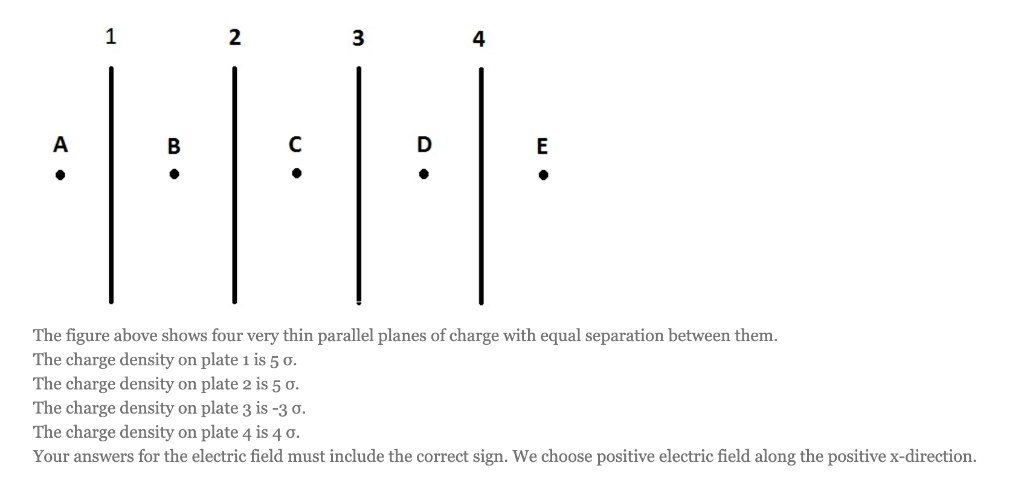
1 2 3 4 A B Cc D E Ll] . . LJ] LJ The figure above shows four very thin parallel planes of charge with equal separation between them. The charge density on plate 1is 5. The charge density on plate 2 is 5 0. ‘The charge density on plate 3is -3 0. ‘The charge density on plate 4is 4 o. Your answers for the electric field must include the correct sign. We choose positive electric field along the positive x-direction.
Question:
 1 2 3 4
A B Cc D E
Ll] . . LJ] LJ
The figure above shows four very thin parallel planes of charge with equal separation between them.
The charge density on plate 1is 5.
The charge density on plate 2 is 5 0.
‘The charge density on plate 3is -3 0.
‘The charge density on plate 4is 4 o.
Your answers for the electric field must include the correct sign. We choose positive electric field along the positive x-direction.
This is AI generated Response.
Asked by: Sahab Sharan
Created at: 2025-09-16 19:38:40
Asked by: Sahab Sharan
Created at: 2025-09-16 19:38:40
Final Answer:
Rendered
Raw Text
Did you like this answer?
Let's analyze the problem step by step.
## **Given Data**
- Four parallel plates with surface charge densities:
- Plate 1: \( \sigma_1 = 5\sigma \)
- Plate 2: \( \sigma_2 = 5\sigma \)
- Plate 3: \( \sigma_3 = -3\sigma \)
- Plate 4: \( \sigma_4 = 4\sigma \)
- Points A, B, C, D, E are located as shown (A left of plate 1, E right of plate 4).
- The electric field is positive in the positive x-direction.
## **Electric Field Due to a Single Infinite Plane**
The electric field due to an infinite plane with charge density \( \sigma \) is:
\[
E = \frac{\sigma}{2\epsilon_0}
\]
- **To the right** of the plane: field points away if \( \sigma > 0 \), toward if \( \sigma < 0 \)
- **To the left** of the plane: field points toward if \( \sigma > 0 \), away if \( \sigma < 0 \)
## **Net Electric Field Calculation**
At each region, sum the contributions of all plates to the **right** of the observation point.
### **Regions:**
- **A:** Left of all plates
- **B:** Between plate 1 and 2
- **C:** Between plate 2 and 3
- **D:** Between plate 3 and 4
- **E:** Right of all plates
Let's calculate the net field at each point:
---
### **A (Left of Plate 1)**
All plates are to the right.
- For each plate, field at A points to the **left** for \( \sigma > 0 \), to the **right** for \( \sigma < 0 \).
- Field at A (due to all plates):
\[
E_A = -\frac{1}{2\epsilon_0}(\sigma_1 + \sigma_2 + \sigma_3 + \sigma_4)
\]
\[
= -\frac{1}{2\epsilon_0} (5\sigma + 5\sigma - 3\sigma + 4\sigma) = -\frac{1}{2\epsilon_0}(11\sigma)
\]
---
### **B (Between Plate 1 and 2)**
Plates 2, 3, 4 are to the right; Plate 1 is to the left.
- Field at B:
- Plate 1: right of point, so field is \( +\frac{\sigma_1}{2\epsilon_0} \)
- Plates 2, 3, 4: to the right of point, so field is \( -\frac{\sigma}{2\epsilon_0} \)
\[
E_B = +\frac{1}{2\epsilon_0}\sigma_1 - \frac{1}{2\epsilon_0}(\sigma_2 + \sigma_3 + \sigma_4)
\]
\[
= \frac{1}{2\epsilon_0}\left[5\sigma - (5\sigma - 3\sigma + 4\sigma)\right]
\]
\[
= \frac{1}{2\epsilon_0}(5\sigma - 6\sigma) = -\frac{1}{2\epsilon_0}\sigma
\]
---
### **C (Between Plate 2 and 3)**
Plates 3, 4 are to the right; Plates 1, 2 to the left.
- Field at C:
\[
E_C = +\frac{1}{2\epsilon_0}(\sigma_1 + \sigma_2) - \frac{1}{2\epsilon_0}(\sigma_3 + \sigma_4)
\]
\[
= \frac{1}{2\epsilon_0}[(5\sigma + 5\sigma) - (-3\sigma + 4\sigma)]
\]
\[
= \frac{1}{2\epsilon_0}(10\sigma - 1\sigma)
\]
\[
= \frac{1}{2\epsilon_0}(9\sigma)
\]
---
### **D (Between Plate 3 and 4)**
Plate 4 is to the right; Plates 1, 2, 3 to the left.
- Field at D:
\[
E_D = +\frac{1}{2\epsilon_0}(\sigma_1 + \sigma_2 + \sigma_3) - \frac{1}{2\epsilon_0}\sigma_4
\]
\[
= \frac{1}{2\epsilon_0}[(5\sigma + 5\sigma - 3\sigma) - 4\sigma]
\]
\[
= \frac{1}{2\epsilon_0}(7\sigma - 4\sigma) = \frac{1}{2\epsilon_0}(3\sigma)
\]
---
### **E (Right of Plate 4)**
All plates are to the left.
- Field at E:
\[
E_E = +\frac{1}{2\epsilon_0}(\sigma_1 + \sigma_2 + \sigma_3 + \sigma_4)
\]
\[
= \frac{1}{2\epsilon_0}(11\sigma)
\]
---
## **Summary Table**
| Point | Electric Field \( E \) |
|-------|------------------------|
| A | \( -\frac{11\sigma}{2\epsilon_0} \) |
| B | \( -\frac{\sigma}{2\epsilon_0} \) |
| C | \( \frac{9\sigma}{2\epsilon_0} \) |
| D | \( \frac{3\sigma}{2\epsilon_0} \) |
| E | \( \frac{11\sigma}{2\epsilon_0} \) |
- Negative sign: field points in the negative x-direction.
- Positive sign: field points in the positive x-direction.
---
## **Final Answers**
- **A:** \( E = -\frac{11\sigma}{2\epsilon_0} \)
- **B:** \( E = -\frac{\sigma}{2\epsilon_0} \)
- **C:** \( E = \frac{9\sigma}{2\epsilon_0} \)
- **D:** \( E = \frac{3\sigma}{2\epsilon_0} \)
- **E:** \( E = \frac{11\sigma}{2\epsilon_0} \)
📢 Instructions:
- Ask anything relatd to above question only.
- For new Question goto :