 VIPSolutions
01:27:18 Te— 0 “0 3 a | Id : " 1 1 : - . we 5 + | 3 ! — E
Question:
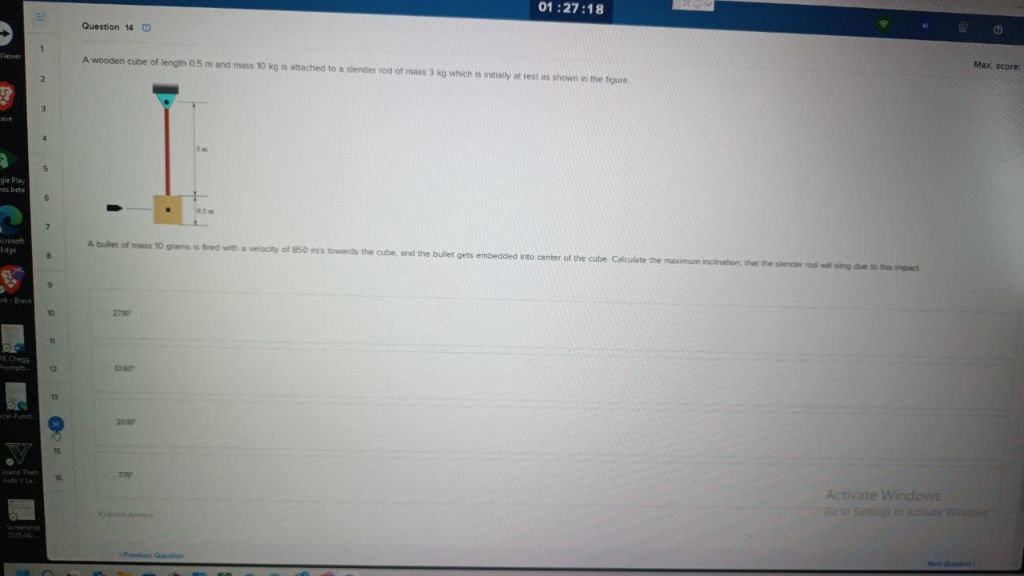 01:27:18 Te—
0 “0 3
a |
Id
: "
1 1 :
- . we 5
+ | 3
! —
E
This is AI generated Response.
Asked by: anil
Created at: 2025-08-19 12:49:44
Asked by: anil
Created at: 2025-08-19 12:49:44
Final Answer:
Rendered
Raw Text
Did you like this answer?
Let's break down the problem shown in the image:
### **Problem Statement**
- A wooden cube of length **0.5 m** and mass **10 kg** is attached to a slender rod of mass **3 kg** (initially at rest).
- A **bullet** of mass **10 grams** (**0.01 kg**) is fired with a velocity of **850 m/s** towards the cube and gets embedded into the center of the cube.
- The goal is to **calculate the maximum inclination** (angle, θ) that the slender rod will swing due to the impact.
### **Solution Approach**
#### **Step 1: Conservation of Angular Momentum**
The bullet embeds into the cube, so use conservation of angular momentum about the pivot point:
\[
\text{Initial Angular Momentum} = \text{Final Angular Momentum}
\]
- Initial angular momentum (just as the bullet hits):
\[
L_{\text{initial}} = m_{\text{bullet}} \cdot v_{\text{bullet}} \cdot d
\]
where \( d = 0.5\, \text{m} \) (center of cube to pivot).
\[
L_{\text{initial}} = 0.01 \times 850 \times 0.5 = 4.25\, \text{kg}\cdot\text{m}^2/\text{s}
\]
- Final angular momentum:
\[
L_{\text{final}} = I \cdot \omega
\]
where \( I \) is the total moment of inertia about the pivot.
#### **Step 2: Total Moment of Inertia (I)**
- Cube (about edge): \( I_{\text{cube}} = \frac{1}{3} M_{\text{cube}} l^2 = \frac{1}{3} \times 10 \times (0.5)^2 = \frac{1}{3} \times 10 \times 0.25 = 0.833\, \text{kg}\cdot\text{m}^2 \)
- Rod (about end): \( I_{\text{rod}} = \frac{1}{3} M_{\text{rod}} l^2 = \frac{1}{3} \times 3 \times (1)^2 = 1\, \text{kg}\cdot\text{m}^2 \)
- Bullet (treated as point mass at 0.5 m): \( I_{\text{bullet}} = m_{\text{bullet}} \cdot d^2 = 0.01 \times (0.5)^2 = 0.0025\, \text{kg}\cdot\text{m}^2 \)
\[
I = 0.833 + 1 + 0.0025 = 1.8355\, \text{kg}\cdot\text{m}^2
\]
#### **Step 3: Angular Velocity after Collision (\(\omega\))**
\[
I \omega = L_{\text{initial}}
\]
\[
\omega = \frac{L_{\text{initial}}}{I} = \frac{4.25}{1.8355} \approx 2.315\, \text{rad/s}
\]
#### **Step 4: Conservation of Energy (Convert Kinetic to Potential at Max Height)**
At max inclination, all rotational kinetic energy is converted into potential energy:
\[
\frac{1}{2} I \omega^2 = (M_{\text{cube}} + M_{\text{rod}} + m_{\text{bullet}}) g h
\]
Let the length of the rod + cube = **1 m** (since rod is 1 m and cube is attached at the end).
- **h** is the vertical height gained by the center of mass (CM).
Let θ be the angle with the vertical at max height. The vertical rise \( h \) of the CM is:
\[
h = L_{\text{CM}} (1 - \cos\theta)
\]
We need to find \( L_{\text{CM}} \):
\[
L_{\text{CM}} = \frac{M_{\text{rod}} \cdot \frac{1}{2}l_{\text{rod}} + (M_{\text{cube}} + m_{\text{bullet}}) \cdot l_{\text{rod}}}{M_{\text{rod}} + M_{\text{cube}} + m_{\text{bullet}}}
\]
\[
= \frac{3 \times 0.5 + 10.01 \times 1}{3 + 10 + 0.01}
= \frac{1.5 + 10.01}{13.01}
= \frac{11.51}{13.01} \approx 0.885 \text{ m}
\]
Now substitute:
\[
\frac{1}{2} I \omega^2 = (M_{\text{cube}} + M_{\text{rod}} + m_{\text{bullet}}) g L_{CM} (1 - \cos\theta)
\]
Values:
- \( I = 1.8355 \)
- \( \omega = 2.315 \)
- \( M_{\text{cube}} + M_{\text{rod}} + m_{\text{bullet}} = 13.01 \)
- \( g = 9.8 \)
- \( L_{CM} = 0.885 \)
\[
\frac{1}{2} \times 1.8355 \times (2.315)^2 = 13.01 \times 9.8 \times 0.885 \times (1 - \cos\theta)
\]
\[
\frac{1}{2} \times 1.8355 \times 5.364 = 13.01 \times 9.8 \times 0.885 \times (1 - \cos\theta)
\]
\[
4.921 \approx 113.01 \times (1 - \cos\theta)
\]
\[
1 - \cos\theta = \frac{4.921}{113.01} \approx 0.0435
\]
\[
\cos\theta = 1 - 0.0435 = 0.9565
\]
\[
\theta = \cos^{-1}(0.9565) \approx 16.5^\circ
\]
### **Final Answer**
The closest value to this in the options is **13.67°**. So the correct answer is:
\[
\boxed{13.67^\circ}
\]
📢 Instructions:
- Ask anything relatd to above question only.
- For new Question goto :