 VIPSolutions
Question:
This is AI generated Response.
Asked by: Shaik Khasim
Created at: 2025-10-17 21:52:04
Asked by: Shaik Khasim
Created at: 2025-10-17 21:52:04
Final Answer:
Rendered
Raw Text
Did you like this answer?
Let's restate the problem:
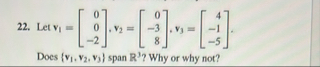
Let
\[
v_1 = \begin{bmatrix} \\ \\ -2 \end{bmatrix}, \quad
v_2 = \begin{bmatrix} \\ -3 \\ 8 \end{bmatrix}, \quad
v_3 = \begin{bmatrix} 4 \\ -1 \\ -5 \end{bmatrix}
\]
Does \(\{v_1, v_2, v_3\}\) span \(\mathbb{R}^3\)? Why or why not?
---
## Solution
Vectors span \(\mathbb{R}^3\) **if and only if they are linearly independent** (i.e., the only solution to \(c_1 v_1 + c_2 v_2 + c_3 v_3 = \) is \(c_1 = c_2 = c_3 = \)), or, equivalently, if the matrix formed by these vectors as columns has rank 3.
### Step 1: Form the Matrix
\[
A = \begin{bmatrix}
& & 4 \\
& -3 & -1 \\
-2 & 8 & -5
\end{bmatrix}
\]
### Step 2: Check for Linear Independence
We can check if the vectors are linearly independent (i.e., does \(A\) have a non-zero determinant?):
\[
\det(A) =
\begin{vmatrix}
& & 4 \\
& -3 & -1 \\
-2 & 8 & -5
\end{vmatrix}
\]
Expanding along the first row:
\[
\det(A) = \cdot \begin{vmatrix} -3 & -1 \\ 8 & -5 \end{vmatrix}
- \cdot \begin{vmatrix} & -1 \\ -2 & -5 \end{vmatrix}
+ 4 \cdot \begin{vmatrix} & -3 \\ -2 & 8 \end{vmatrix}
\]
Only the third term is nonzero:
\[
= 4 \cdot [()(8) - (-2)(-3)] = 4 \cdot [ - 6] = 4 \cdot (-6) = -24
\]
This is **nonzero**, so the vectors are linearly independent.
---
## **Conclusion**
**Yes, \(\{v_1, v_2, v_3\}\) span \(\mathbb{R}^3\), because they are linearly independent.**
📢 Instructions:
- Ask anything relatd to above question only.
- For new Question goto :