 VIPSolutions
Question:
This is AI generated Response.
Asked by: Veera manikanta
Created at: 2025-09-01 17:54:13
Asked by: Veera manikanta
Created at: 2025-09-01 17:54:13
Final Answer:
Rendered
Raw Text
Did you like this answer?
Let's break down the problem:
**Given:**
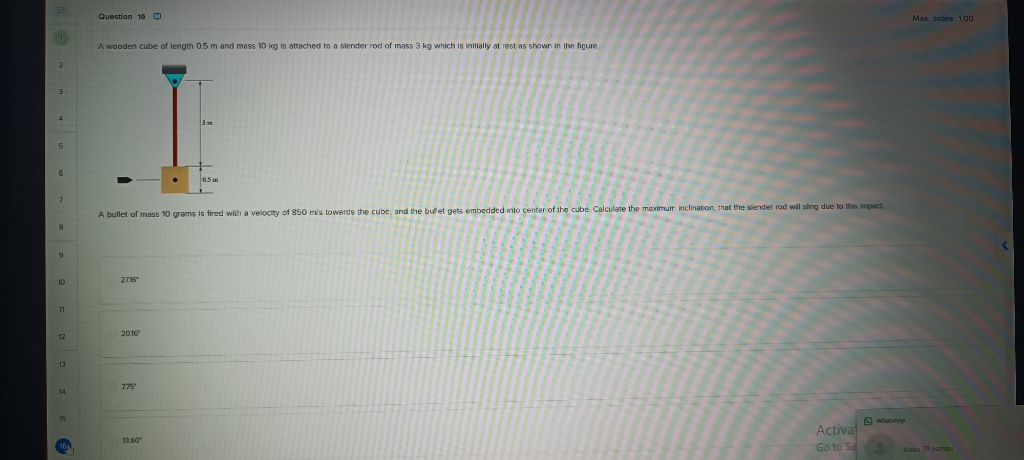
- Wooden cube: Length = 0.5 m, Mass = 10 kg
- Slender rod: Mass = 3 kg, initially at rest as shown in the figure
- Bullet: Mass = 10 grams = 0.01 kg, Velocity = 850 m/s, fired towards the center of the cube and gets embedded
**Asked:**
Calculate the **maximum inclination** (angle) that the slender rod will swing due to this impact.
---
### Step 1: **Conservation of Angular Momentum**
Since the bullet gets embedded, it's a perfectly inelastic collision.
**Total Angular Momentum before impact:**
The system is initially at rest, except the bullet.
The bullet hits the center of the cube, which is at one end of the rod, a distance of \( L = 0.5 \) m from the axis of rotation.
Angular momentum of the bullet about the axis:
\[
L_{\text{bullet}} = m_{\text{bullet}} \cdot v_{\text{bullet}} \cdot r
\]
Where:
- \( m_{\text{bullet}} = 0.01 \) kg
- \( v_{\text{bullet}} = 850 \) m/s
- \( r = 0.5 \) m
\[
L_{\text{bullet}} = 0.01 \times 850 \times 0.5 = 4.25 \, \text{kg} \cdot \text{m}^2/\text{s}
\]
---
### Step 2: **Moment of Inertia**
After the collision, the bullet is embedded in the cube. The moment of inertia about the axis for the whole system (rod + cube + bullet):
- **Rod (pivoted at one end, length \( L \)):**
\[
I_{\text{rod}} = \frac{1}{3} M_{\text{rod}} L^2 = \frac{1}{3} \times 3 \times (0.5)^2 = \frac{1}{3} \times 3 \times 0.25 = 0.25 \, \text{kg} \cdot \text{m}^2
\]
- **Cube (as a point mass at end):**
\[
I_{\text{cube}} = M_{\text{cube}} L^2 = 10 \times (0.5)^2 = 2.5 \, \text{kg} \cdot \text{m}^2
\]
- **Bullet (as a point mass at end):**
\[
I_{\text{bullet}} = 0.01 \times (0.5)^2 = 0.0025 \, \text{kg} \cdot \text{m}^2
\]
Total moment of inertia:
\[
I_{\text{total}} = 0.25 + 2.5 + 0.0025 = 2.7525 \, \text{kg} \cdot \text{m}^2
\]
---
### Step 3: **Angular Velocity after Collision**
By conservation of angular momentum:
\[
L_{\text{initial}} = I_{\text{total}} \omega
\]
\[
4.25 = 2.7525 \omega
\]
\[
\omega = \frac{4.25}{2.7525} \approx 1.544 \, \text{rad/s}
\]
---
### Step 4: **Maximum Inclination (Energy Conservation)**
After the collision, the system swings up. At its maximum inclination, all kinetic energy is converted to potential energy.
- **Initial rotational kinetic energy:**
\[
KE = \frac{1}{2} I_{\text{total}} \omega^2 = \frac{1}{2} \times 2.7525 \times (1.544)^2 \approx 3.284 \, \text{J}
\]
- **Potential energy at maximum height:** (let θ be the maximum angle with the vertical)
The center of mass rises. For a rod of length \( L \) and mass \( M \) pivoted at one end, the change in height for a swing to angle θ is \( h = \text{distance from pivot to COM} \times (1 - \cos\theta) \).
For rod: COM at \( L/2 \) from pivot
For cube and bullet: at \( L \) from pivot
Total change in potential energy:
\[
\Delta PE = M_{\text{rod}} g \frac{L}{2} (1 - \cos\theta) + (M_{\text{cube}} + M_{\text{bullet}}) g L (1 - \cos\theta)
\]
Substitute values:
- \( M_{\text{rod}} = 3 \) kg
- \( M_{\text{cube}} = 10 \) kg
- \( M_{\text{bullet}} = 0.01 \) kg
- \( g = 9.8 \) m/s²
- \( L = 0.5 \) m
\[
\Delta PE = 3 \times 9.8 \times 0.25 (1 - \cos\theta) + 10.01 \times 9.8 \times 0.5 (1 - \cos\theta)
\]
\[
= 7.35 (1 - \cos\theta) + 49.549 (1 - \cos\theta)
\]
\[
= 56.899 (1 - \cos\theta)
\]
Set \( KE = \Delta PE \):
\[
3.284 = 56.899 (1 - \cos\theta)
\]
\[
1 - \cos\theta = \frac{3.284}{56.899} \approx 0.0577
\]
\[
\cos\theta = 1 - 0.0577 = 0.9423
\]
\[
\theta = \cos^{-1}(0.9423) \approx 20^\circ
\]
---
### Step 5: **Match with Options**
The closest option to \( 20^\circ \) is **20.16°**.
---
## **Final Answer:**
**20.16°** is the correct answer.
Let me know if you need the solution in a more detailed or step-by-step format!
📢 Instructions:
- Ask anything relatd to above question only.
- For new Question goto :