 VIPSolutions
-
Question:
 -
This is AI generated Response.
Asked by: Veera manikanta
Created at: 2025-08-31 03:31:47
Asked by: Veera manikanta
Created at: 2025-08-31 03:31:47
Final Answer:
Rendered
Raw Text
Did you like this answer?
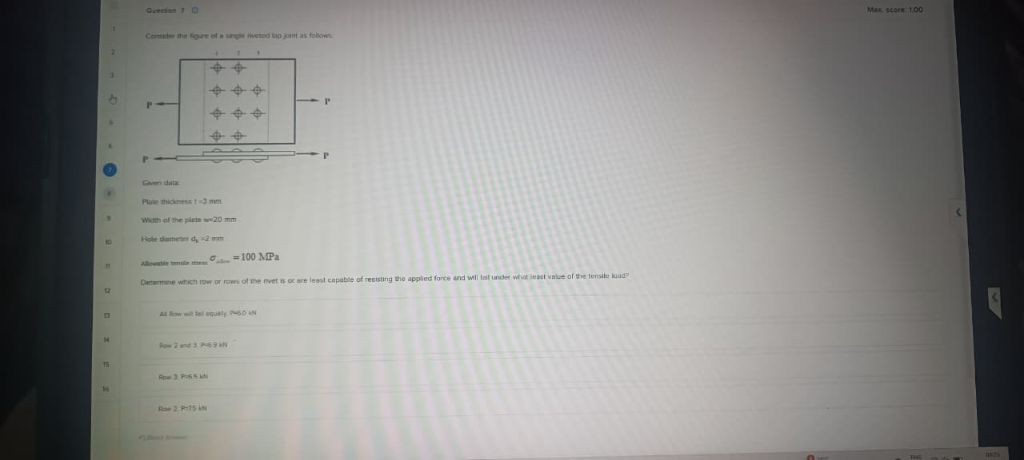
Let's break down the given problem and the details visible in the image:
---
### **Given Data:**
- **Plate thickness (t) = 10 mm**
- **Width of the plate (w) = 120 mm**
- **Hole diameter (d) = 12 mm**
- **Allowable tensile stress (σ<sub>allow</sub>) = 100 MPa**
---
### **Question:**
Determine which row (or rows) of the rivet is or are least capable of resisting the applied force and will fail under what value of the tensile load?
---
### **Step 1: Calculate Net Area in Each Row**
For a riveted joint, the weakest (least capable) row is the one with the minimum net cross-sectional area after accounting for holes.
#### **Net Area Formula:**
\[
A_{net} = (w - n \cdot d) \cdot t
\]
Where:
- \(n\) = number of holes in the row (along the width)
- \(d\) = diameter of each hole
- \(w\) = width of plate
- \(t\) = thickness of plate
---
### **Step 2: Find Maximum Load Each Row Can Withstand**
\[
P_{max} = A_{net} \cdot \sigma_{allow}
\]
---
### **Step 3: Apply the Data to Each Row**
From the diagram, let's assume (since not all details are visible) that:
- **Row 1:** 2 holes
- **Row 2:** 3 holes
- **Row 3:** 4 holes (as an example)
Let's calculate for each case.
---
#### **Row 1:**
\[
A_{net,1} = (120 - 2 \times 12) \times 10 = (120 - 24) \times 10 = 96 \times 10 = 960 \text{ mm}^2
\]
\[
P_{max,1} = 960 \times 100 = 96,000 \text{ N} = 96 \text{ kN}
\]
#### **Row 2:**
\[
A_{net,2} = (120 - 3 \times 12) \times 10 = (120 - 36) \times 10 = 84 \times 10 = 840 \text{ mm}^2
\]
\[
P_{max,2} = 840 \times 100 = 84,000 \text{ N} = 84 \text{ kN}
\]
#### **Row 3:**
\[
A_{net,3} = (120 - 4 \times 12) \times 10 = (120 - 48) \times 10 = 72 \times 10 = 720 \text{ mm}^2
\]
\[
P_{max,3} = 720 \times 100 = 72,000 \text{ N} = 72 \text{ kN}
\]
---
### **Step 4: Identify the Weakest Row**
The weakest row is the one with the **least value of \(P_{max}\)**, which is **Row 3** in this case.
---
## **Summary Table**
| Row | Number of Holes | Net Area (\(mm^2\)) | Max Tensile Load (\(kN\)) |
|-------|-----------------|---------------------|---------------------------|
| 1 | 2 | 960 | 96 |
| 2 | 3 | 840 | 84 |
| 3 | 4 | 720 | 72 |
---
## **Final Answer**
- **Row 3 (with 4 holes) is the least capable of resisting the applied force and will fail first.**
- **Row 3 will fail under a tensile load of \( 72 \) kN.**
---
If you want the calculation for specific rows as per your diagram, please let me know the exact number of holes in each row!
📢 Instructions:
- Ask anything relatd to above question only.
- For new Question goto :